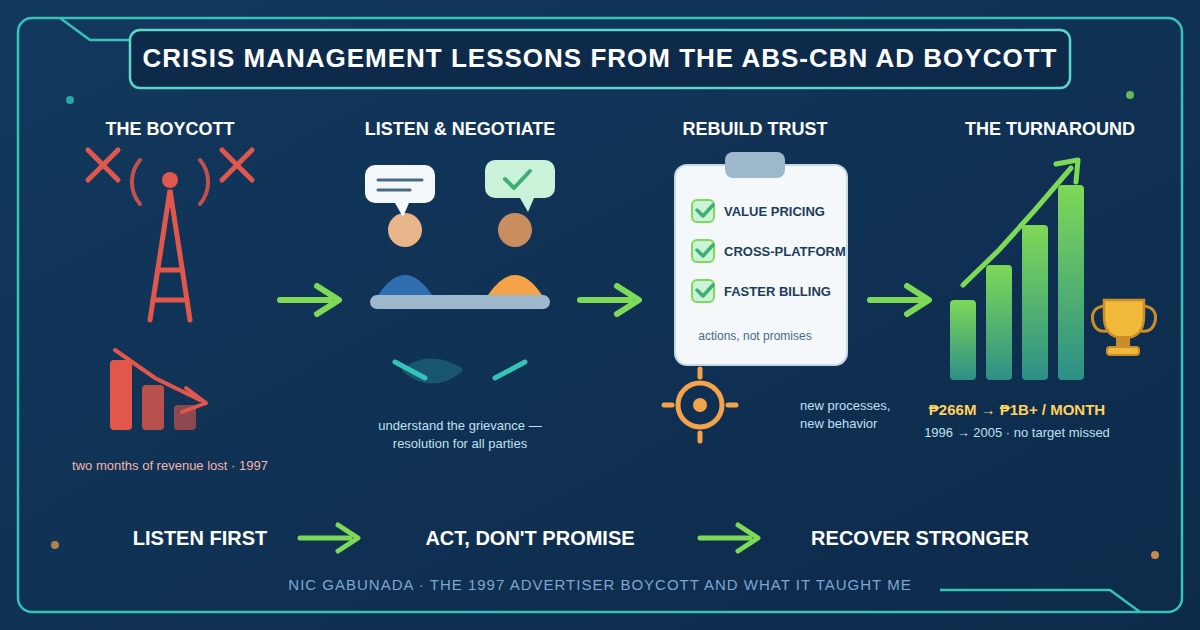
Infographic of the ABS-CBN ad boycott crisis: listening, rebuilding trust, and a revenue turnaround from ₱266M to ₱1B a month

Crisis Management Lessons From the ABS-CBN Advertiser Boycott

Key Takeaways: I was appointed Head of Sales and Marketing at ABS-CBN in February 1997–straight into an advertiser and ad agency boycott Lesson 1: understand what the aggrieved side actually needs before you defend or counter Lesson 2: trust is rebuilt through behavior, not statements — make moves that speak for themselves Lesson 3: a team that’s behind needs a clear goal, not a pep talk — we set the target and hoit it The turnaround grew into quadrupled revenues: from P266M to over P1B per month, without missing a target   February 1997. I had just been appointed Head of Sales and Marketing at ABS-CBN. It was a role I didn’t ask for, by the way. Freddie Garcia called me into his office and

read more   →
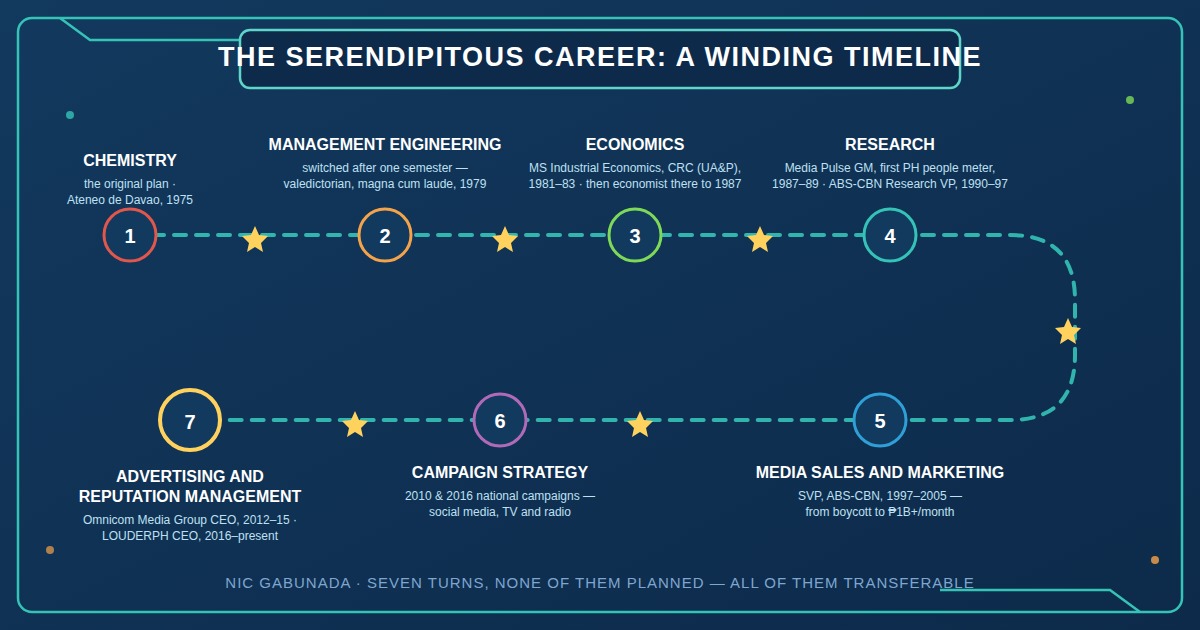
Winding timeline of Nic Gabunada's seven career stages from chemistry to advertising and reputation management

The Serendipitous Career: Why a Non-Linear Career Path Wins

Key Takeways: I enrolled in BS Chemistry; two professors talked me into Management Engineering — the first serendipitous turn of many From activist detention in Davao to economics at CRC to Media Pulse to ABS-CBN: none of it was planned When Freddie Garcia handed me Sales and Marketing with no sales background, mentorship made ‘yes’ posible Non-linear career are failure of planning — they’re evidence of adaptability The market rewards specialists, but it deeply needs sympathizers who transfer knowledge across fields   I wanted to be a chemist. That’s the truth. When I enrolled at Ateneo de Davao University, I signed up for BS Chemistry. I had a plan. I had a direction. And then the plan changed — the first turn in what became

read more   →
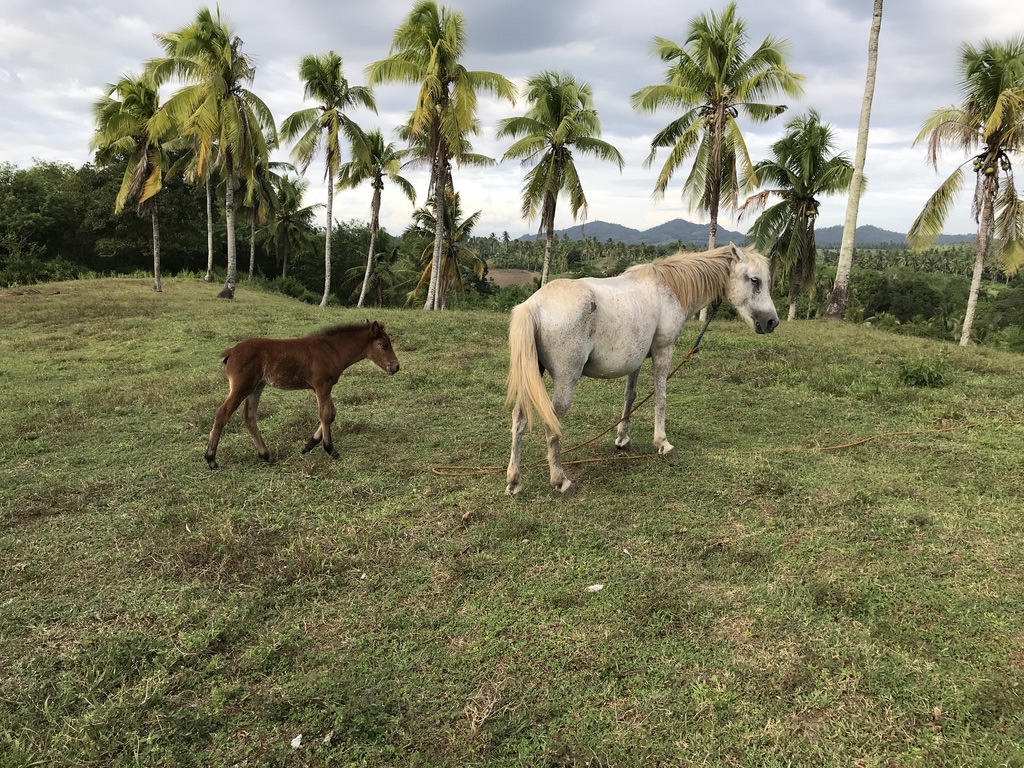
A cream-colored mare tethered on a grass hillside grazes beside her brown foal, with a row of coconut palms and distant mountains in the background. Photo taken by Nic Gabunada

More Than a Sport: How Horses Built Status, Settled Feuds, and Kept the Peace in Upland Mindanao

I still remember the first time someone told me, without a trace of irony, that horses had once settled a blood debt between two families in the uplands of Mindanao. Not a payment of cash. Not a formal apology delivered by elders. Horses — walked from one household to another, accepted as full and final restitution for a life lost. Growing up hearing stories like this, I assumed it was folklore, the kind of detail that gets embellished with every retelling. It wasn’t. Among the Lumad and upland farming communities of Mindanao, a horse has never just been an animal. It has been currency, dowry, peace offering, and proof of a man’s standing in his community — all at once. That’s the world I want

read more   →

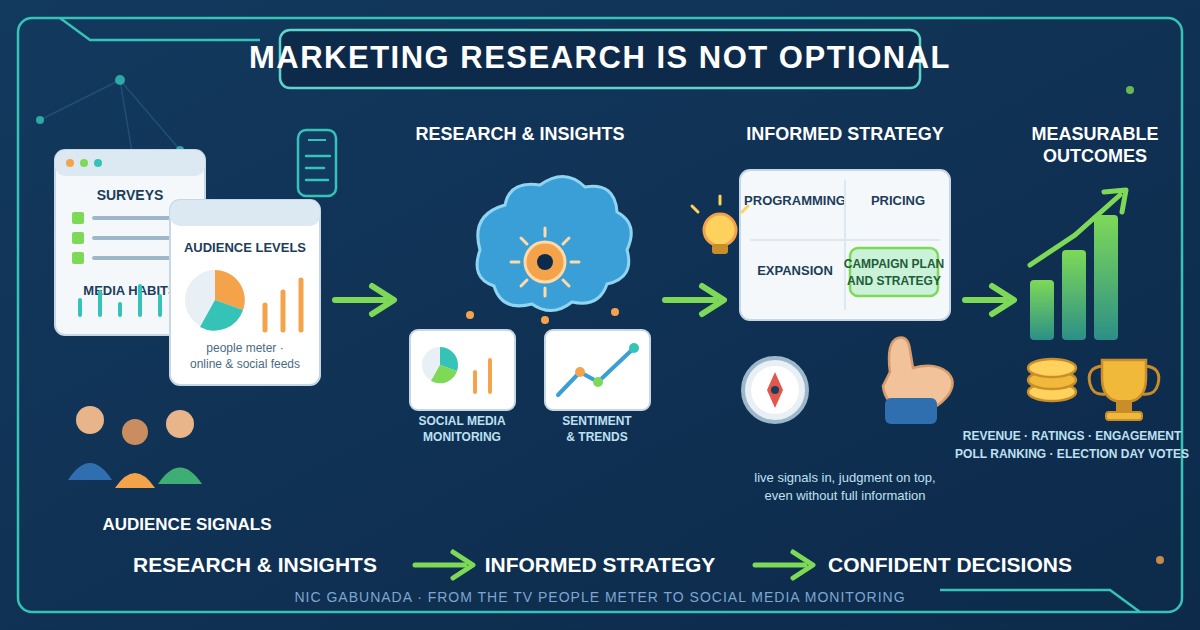
Research Is Not Optional: Every Media and Marketing Decision Needs Data

Key Takeaways: You cannot craft an effective message if you don’t know who you’re talking to — yet gut feel decisions remain rampant Helping set up the Philippines’ first TV people meter changed how the industry planned and bought media At ABS-CBN, research informed programming, expansion, and the groundworks for Studio 23, Sky Cable, Star Cinema and more Research done well is not a support function — it’s a strategic weapon But the best practitioners are data-informed, not data paralyzed: research reduces uncertainty,  it doesn’t replace judgment   I’m going to say something that might sound obvious. But I’ve seen enough campaigns crash and burn to know it’s not practiced nearly enough: you cannot craft an effective message if you don’t know who you’re talking

read more   →

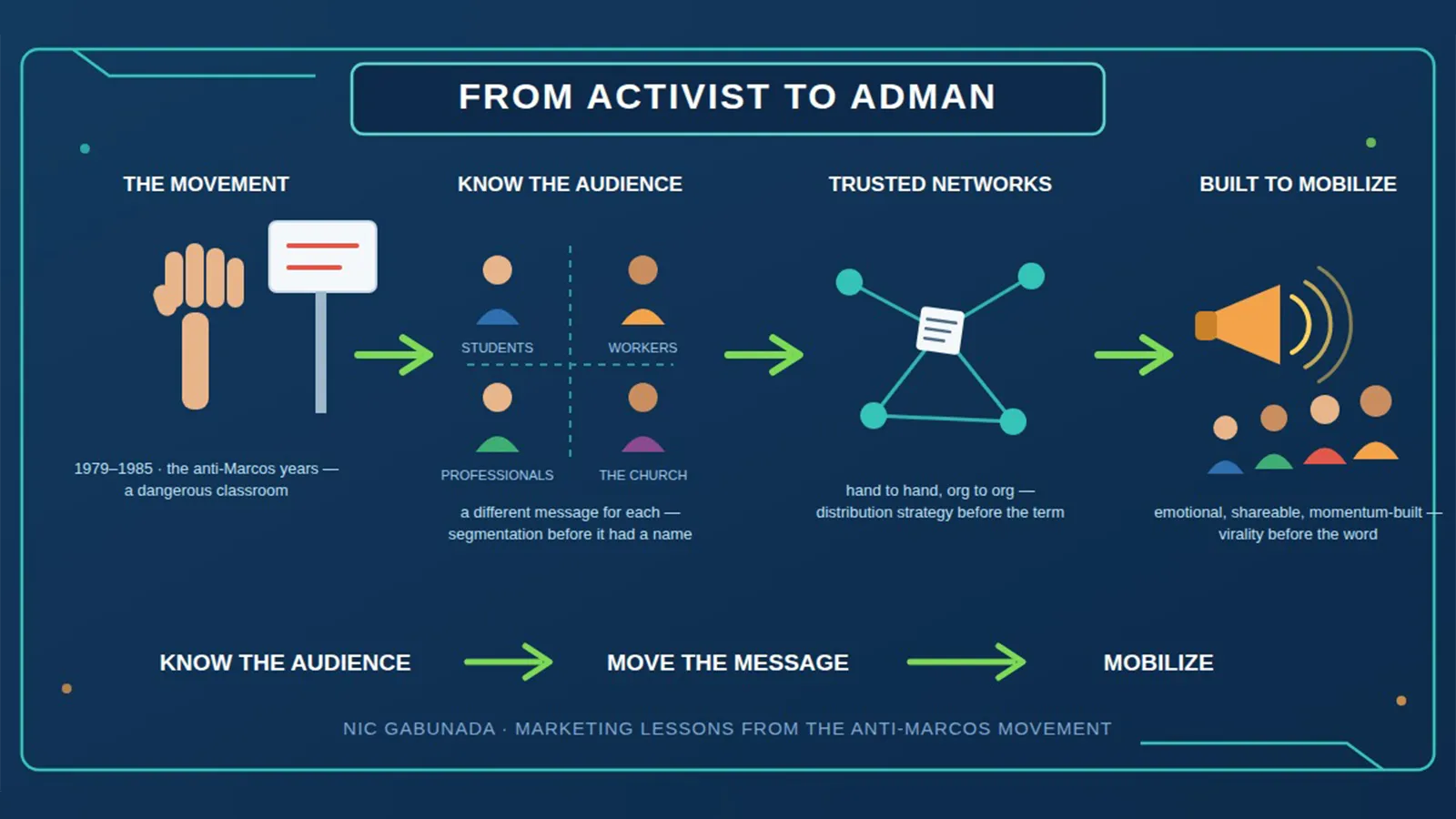
From Activist to Adman — How the Anti-Marcos Movement Made Me a Better Marketer

Key Takeaways: Some of the most valuable marketing training happens outside marketing –mine happened in the anti Marcos movement Every flyer and every rally had to land: that was audience segmentation before anyone called it that Distribution mattered as much as content — trusted networks were our channels The goal was never just to inform but to mobilize; that’s virality by another name Look behind history’s movements and you’ll find someone who understood audience, message and reach People are sometimes surprised when I tell them where I got my most valuable marketing lessons. It wasn’t a classroom. It wasn’t a boardroom. It was the Anti-Marcos movement — in the streets, in secret meetings, in the business of moving people when the stakes were life and

read more   →
Infographic showing a 2x3 crisis response grid based on incident intensity (high or low) and market sentiment (negative, neutral, or positive): Mobilize, Monitor, Amplify, Watch, Observe, Engage.

Data Is the New Oil — But Discernment Is the Refinery

There’s a moment in every crisis room I’ve been in — and I’ve been in more than a few — when someone opens a laptop, pulls up a dashboard of real-time social media data, and says something like: “We’re trending.” And then everyone looks at each other, because trending could mean anything. It could mean you’ve gone viral for doing something right. It could mean a false rumor is currently racing ahead of the truth at the speed of a share button. It could mean a journalist with a large following just posted something that is factually incorrect, emotionally charged, and already spreading fast. Data tells you that something is happening. Discernment tells you what to do about it. This is the distinction I’ve spent

read more   →
Black-and-white photo of Nicanor "Momoy" Gabunada Sr. and his bus conductor leaning against the front of their passenger bus, number 208.

The Bicycle I Never Got, and the Lesson That Mattered More

There was a year in grade school when my father promised me a bicycle if I topped my class. I studied like that bicycle was already mine. I never got it. What I remember, decades later, is that the promise itself — made by a man who probably didn’t have the money to keep it — taught me more than the bike ever could have. That was my Papang. Nicanor “Momoy” Gabunada Sr. left Cebu as a young man chasing a better future in Mindanao. He drove for a living, raised a family, and spent most of his life making sure we had food on the table — even when that wasn’t guaranteed. This Father’s Day, I want to tell you why a man who

read more   →

Manginhas: The Coastal Foraging Activity of My Youth

I remember manginhas from my youth. It feels like a lifetime has passed since I last did this simple yet rewarding activity. This coastal tradition is deeply rooted in my province’s way of life. For me, manginhas was more than a pastime; it was a direct connection to the sea and its abundance. What is Manginhas? The Riches of the Low Tide Manginhas is the local term for coastal foraging. It involves going to the beach or shallow areas during low tide. We collect exposed marine life entirely by hand. This included various shellfish, small fish, and seaweed left behind by the receding water. I fully enjoyed this activity for many reasons. First, it meant spending a good portion of the day on the beach.

read more   →

My First Exposure to the Media Industry

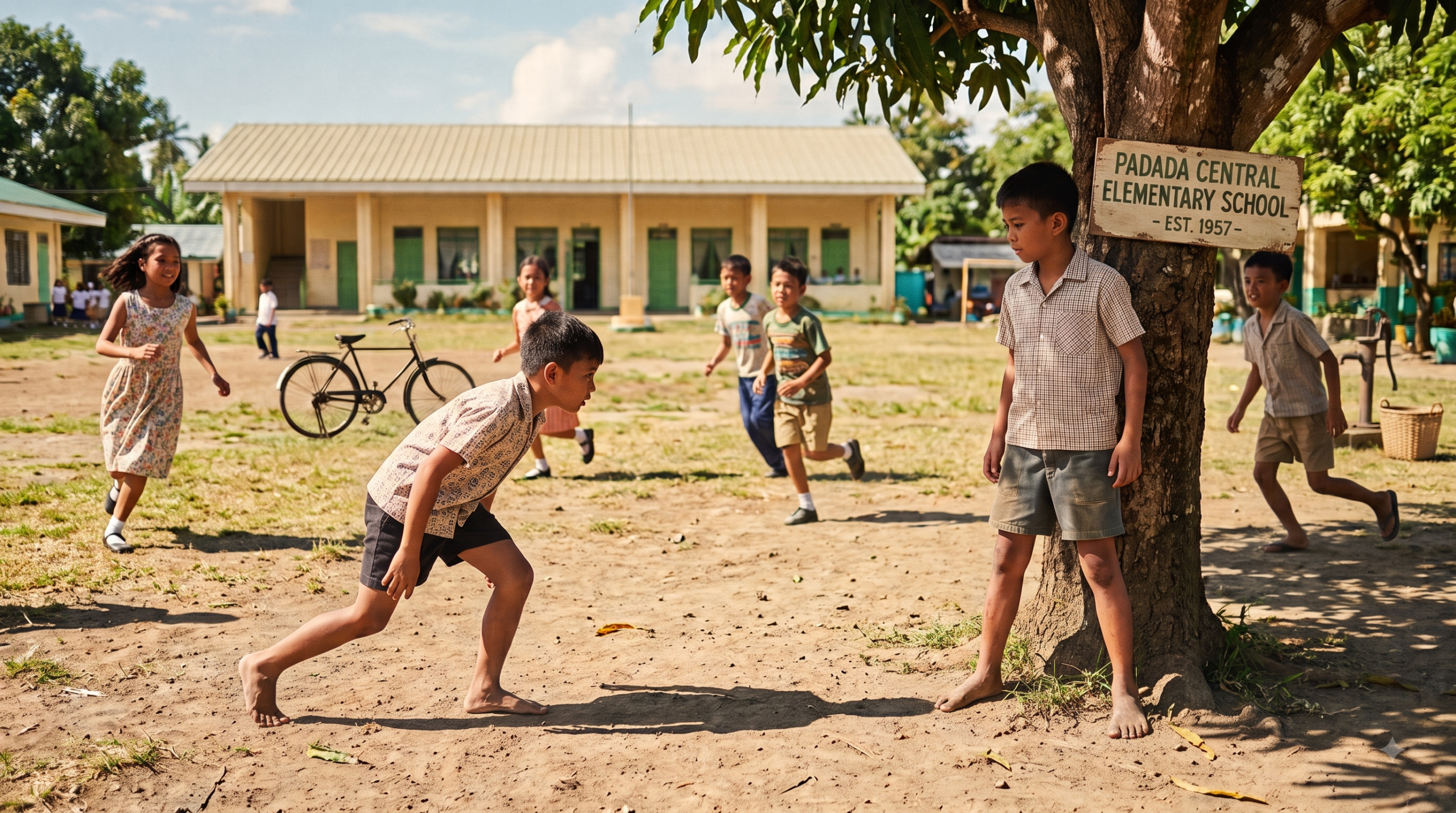
In my youth, back in Padada, I had a lot of odd jobs – specially during the time when Papang was bedridden because of his accident. At that time, we all had to pull our weight. We also had to figure out ways to earn money.  It was during this turbulent time that I had my first exposure to the media industry – specifically, print media. Of all the things I was throughout my life, my first media-adjacent job was as a Newspaper Boy. The late 60’s was a different time. Our town was more than two hours away from the city by bus. As a result, the day’s newspapers arrived at the town’s lone distributor shortly after lunch.  This stall was the only place

read more   →

Selling Homegrown Vegetables: A Lesson in Resourcefulness

A Childhood of Resourcefulness  Growing up, money was difficult, and resourcefulness was key to making ends meet in Padada. I often worked odd jobs like shining shoes or selling newspapers. However, one thing I will always be grateful for is that we had a large backyard. This meant we had land  to make the most of. The Value of Fresh, Homegrown Produce In our backyards, we grew vegetables.  We had some malunggay, alugbati, camote tops, okra, and eggplants. These veggies were easy to grow and were our staples.  Whatever we harvested, we cooked and ate. We also share some with our neighbors. That access to fresh produce, literally at our doorstep, is something I definitely miss now that I am living in the metropole. Turning

read more   →