
Key Takeaways:
- I was appointed Head of Sales and Marketing at ABS-CBN in February 1997–straight into an advertiser and ad agency boycott
- Lesson 1: understand what the aggrieved side actually needs before you defend or counter
- Lesson 2: trust is rebuilt through behavior, not statements — make moves that speak for themselves
- Lesson 3: a team that’s behind needs a clear goal, not a pep talk — we set the target and hoit it
- The turnaround grew into quadrupled revenues: from P266M to over P1B per month, without missing a target
February 1997. I had just been appointed Head of Sales and Marketing at ABS-CBN. It was a role I didn’t ask for, by the way.
Freddie Garcia called me into his office and told me that was my new job. I asked if I had a choice. He said no. Then he told me he’d teach me what I still needed to learn — and that he’d personally call his friends in the industry to mentor me.
I said yes. What else could I say?
Walking into a fire
What nobody told me at the time — or maybe I just didn’t fully appreciate — was that I was walking into a crisis.
ABS-CBN was in the middle of an advertisers’ and ad agencies’ boycott. Billings had stalled. Relationships were strained. The industry was sending a message. And the network needed to respond — not with a press release, but with real resolution.
So let me walk you through what that experience taught me. I believe it holds some of the most transferable crisis management lessons I’ve ever picked up: about negotiation, about trust, and about turning a bad situation into a launchpad.
Lesson 1: Understand what the other side actually needs
A boycott isn’t just about money. There are grievances underneath it — about process, about fairness, about respect.
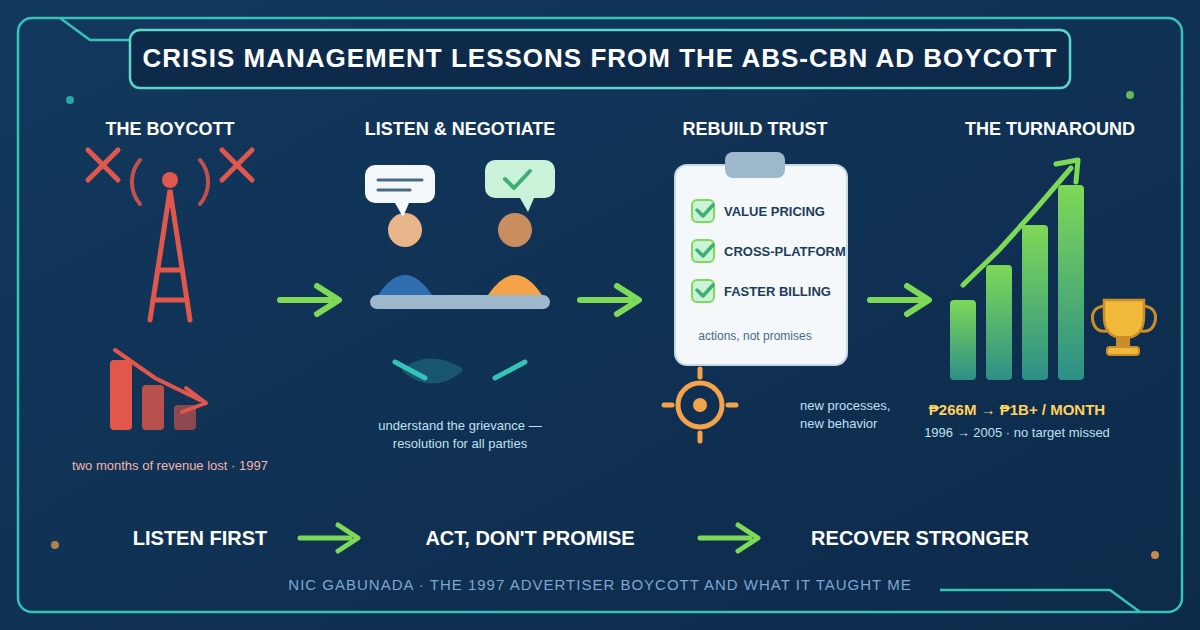
So my first job was to listen. Not to defend. Not to counter. Just to understand what was driving this, and what resolution would look like for everyone involved.
PR professionals, take note: the instinct in a crisis is to protect the principal. But the more useful instinct is to understand the aggrieved party well enough to find a real path forward.
Lesson 2: Rebuild trust through actions, not promises
I wasn’t in a position to throw money at the problem or offer sweetheart deals.
What I could do was show — through actions, through new processes, through the way we engaged — that the relationship would be different going forward.
Trust is rebuilt through behavior, not statements.
Lesson 3: Give the team a clear goal, not a pep talk
We lost more than two months of revenue because of that boycott. That’s a hole you can feel in the organization.
So what I told my Sales and Marketing team was simple: we have a revenue target for the year, and we are going to hit it. Not “let’s try our best.” We are going to hit it.
And we did.
Looking back, hitting that target — after everything that happened in the first quarter of 1997 — remains one of the proudest moments of my career. Not because of the number itself, but because of what it took from the team to get there.
The turnaround, in numbers
From there, the growth was significant. We quadrupled revenues — from ₱266 million per month in 1996 to more than ₱1 billion per month by 2005. In fact, we never missed a revenue target during my entire tenure.
Three moves made that possible. First, we developed a value-based pricing strategy that truly reflected the network’s audience delivery. Second, we formulated a cross-platform selling approach that leveraged our high-rating stations. Third, we cut our receivables days from 150 to 75 — which sounds like a finance detail, but it has enormous implications for cash flow and organizational health.
The takeaway: a crisis is a test
Here’s the bigger crisis management lesson for anyone running a brand, a network, a department, or a client relationship: a boycott, a controversy, a public falling-out is not the end. It’s a test.
Handle it with integrity, clear eyes, and real strategy — and you can come out the other side stronger than you went in.
We did.