Series: Game of Titos and Titas - Part 6
Key Takeaways
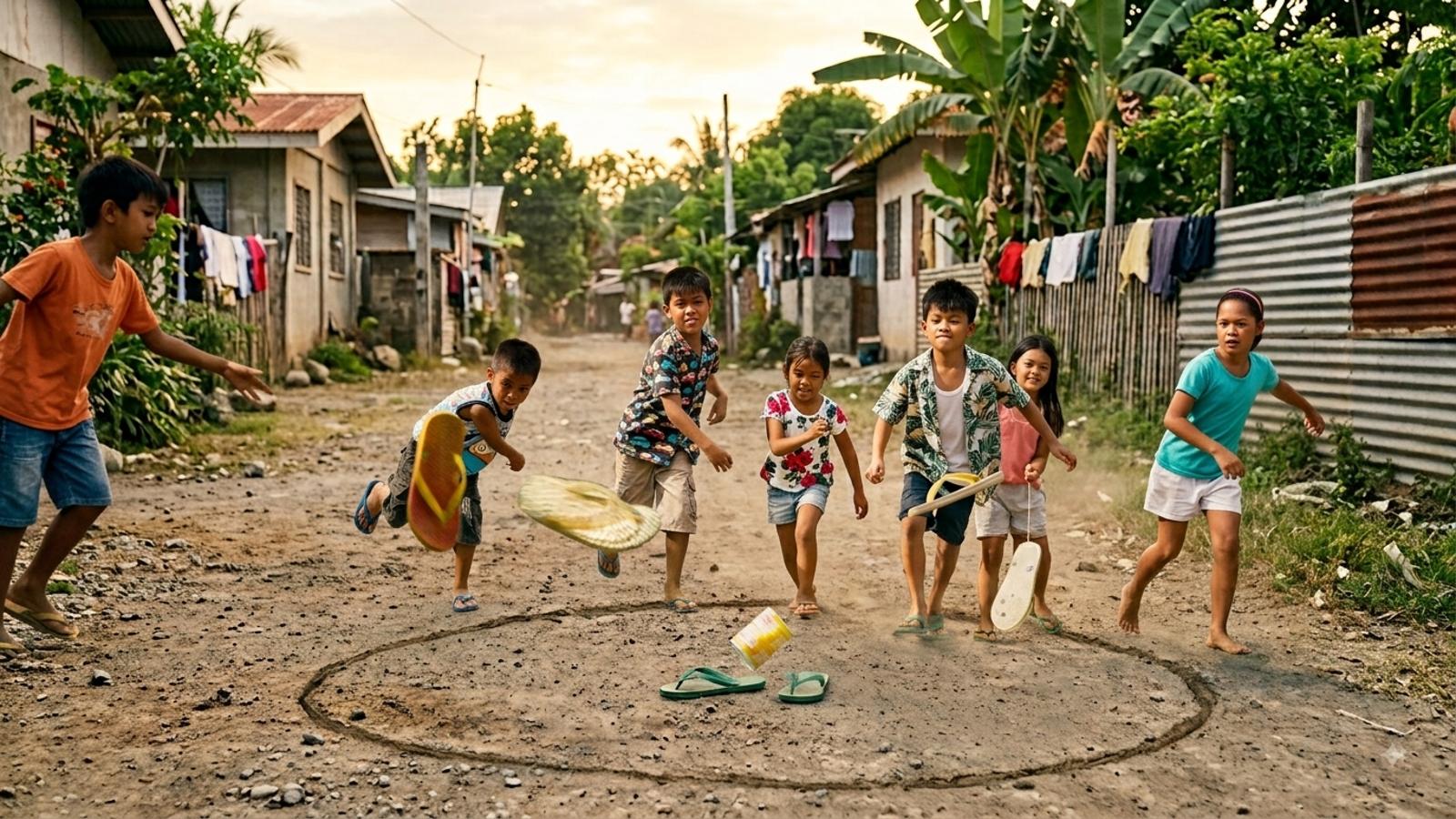
- In Padada we called it tumba lata — knock the can. In Tagalog areas it’s tumbang preso
- It was the easiest game to get going, because nobody had to fetch anything — the equipment was already on our feet and in the rubbish
- The equipment was an empty tin can and the slippers off your own feet — or flat stones, for the bolder games
- Your slipper is the pamato, the same word we used for the shooter in holen
- The bantay cannot tag anybody until he has stood the can back up, so every hit resets him and buys everyone a window
- A bantay who could never escape was called baboy — the same verdict a fumbling jackstone player got
Down here in Manila they call it tumbang preso — the fallen prisoner.
Back home in Padada we called it tumba lata. Knock the can. Less poetry, more instruction.
Same game either way. Same tin can, same slipper, and the same unfortunate child standing guard over it, knowing there is no winning — only escaping.
How a game got started
On weekends, or whenever there were no classes — and only once the household chores were done, which was a condition and not a suggestion — the neighbourhood children would gather in somebody’s backyard and work out what to play.
That deciding took longer than you would imagine. It always did. Everything had to be agreed before anything could begin.
Tumba lata was very often the answer, and the reason was plain logistics. It was the easiest game to get going, because nobody had to go and fetch anything. The equipment was already there, on our feet and in the rubbish.
What you need
- One empty tin can — evaporated milk, sardines, whatever the kitchen had finished with
- One slipper per player, the tsinelas off your own feet
- An open space: a street, a yard, a stretch of packed ground
- Chalk, or a stick, to draw a circle and a throwing line
For the bolder games we swapped the slippers for flat stones. A stone flies straighter, hits harder, and takes the can clean out of the circle — and it is also a stone, thrown across open ground, at a child standing next to a can. Nobody’s mother knew about the stone version.
Everyone played — girls and boys together, which was not true of every game we had. Holen was ours; jackstone was theirs. Tumba lata belonged to whoever turned up.
That is the whole inventory, and it’s worth sitting with for a moment.
The can is rubbish. It has already served its purpose and been discarded, and the game begins by giving it a second one. The slipper is on your foot. You are not equipped to play tumba lata; you are simply alive and outdoors, and that turns out to be enough.
I have thought about this a good deal since, in a working life spent around brands and budgets. The games we played best were the ones that cost nothing.
Your slipper is the pamato
The word turns up again here.
In holen, the pamato is your shooting marble — the lucky one, the one you never trade. In tumba lata, your pamato is your slipper.
It is the same idea wearing different clothes: the object you throw, the one that carries your chances. And in this game it carries a cost the marble never did, because the moment you throw it, it is lying out there in the open, and you are standing behind the line with one bare foot.
Your ammunition and your hostage are the same object. That is the whole tension of the game.
Setting up
- Draw the circle and stand the can inside it.
- Draw a throwing line a few metres back. Nobody’s toes cross it until their slipper has left their hand.
- Choose the guard. Everyone tosses a slipper toward the line. Whoever lands farthest away takes the post.
We called that person the bantay or the taya, more or less interchangeably. Bantay is the plainer word — the one who watches — and it is the one I still hear in my head.
Note what the selection does. The worst thrower gets the worst job, and the worst job is the one requiring the most work. There is no mercy in it, and nobody ever suggested there should be.
How to play tumba lata
- The bantay takes his post beside the can. Everyone else lines up behind the throwing line.
- Hitters throw in turn, trying to knock the can out of its circle.
- When the can goes down, the field opens. Everyone who has already thrown now has to retrieve their slipper and get back behind the line.
- The bantay must reset before he can do anything. He must stand the can upright inside the circle first. Only then can he tag anybody.
- Get tagged and you take his place — if you’re caught holding your slipper, or caught outside the line.
Why the bantay’s job is impossible
Rule four is the entire game, and it took me years to see why.
The bantay cannot chase anyone until the can is back on its feet. So every successful hit resets him. He turns his back, bends down, sets the can upright — and in those two seconds half a dozen children sprint in, snatch their slippers, and are gone.
He is permanently one move behind. He cannot defend the can, because defending it means standing still, and standing still means the next thrower takes her time and knocks it flat. He cannot chase, because chasing means abandoning the can.
There is no strategy that wins. There is only waiting for somebody to be greedy — to go for a slipper lying too far out, or to dawdle on the way back — and pouncing on that one lapse.
Which is why the best bantay were never the fastest players. They were the most patient.
Baboy
A bantay who could not get out — who reset the can, and reset it again, and watched the whole afternoon go by without catching anyone — earned a name.
Baboy. Pig. Called out cheerfully, by everybody, for as long as it kept being true.
In Tagalog areas the equivalent is balagong. But baboy is the one I keep running into. It is the same word thrown at a player who fumbled a round of jackstone, and I doubt that is coincidence. It seems to be the standard-issue Filipino childhood verdict on anyone who is visibly failing in front of their friends: not cruel exactly, not sympathetic either, just accurate and repeated until you fixed it.
The one who takes the fall
I have wondered since why the Tagalog name is tumbang preso — the fallen prisoner — when ours is merely a description of the action.
But I think the Tagalog name understands the game better than ours does. Somebody has to be the prisoner. Somebody stands in the middle while everybody else throws things at him, and the only way out is for somebody else to be careless enough to take his place.
We played that for entire afternoons and thought nothing of it.
______________________________________________________________________________________________________________
Frequently asked questions
What is tumba lata? Tumba lata is the Bisaya name for the Filipino street game known in Tagalog-speaking areas as tumbang preso. Players throw their slippers to knock down a tin can while one player guards it and tries to tag them.
Is tumba lata the same as tumbang preso? Yes. Tumba lata means “knock the can” and is used in Bisaya-speaking areas; tumbang preso, “fallen prisoner,” is the Tagalog name. The rules are the same.
What do you need to play tumba lata? An empty tin can, one slipper per player, an open space, and something to draw a circle and a throwing line with.
Why can’t the guard tag anyone straight away? Because he has to stand the can upright inside its circle first. That rule is what makes the position so difficult — every successful hit forces a reset while everyone else runs for their slippers.
What is the guard called in tumba lata? Bantay or taya, used more or less interchangeably in Bisaya-speaking areas. A bantay who cannot get out of the role is called baboy — a pig — and jeered for it. The Tagalog equivalent is balagong.
Can you play tumba lata with something other than slippers? Yes. Flat stones were used in rougher games; they fly straighter and knock the can further, but they’re considerably more dangerous.
What is a pamato in tumba lata? The slipper a player throws. It’s the same word used in holen for the shooting marble — in both games, the piece that carries your chances.
For the bona fide titos and titas out there — did you play tumba lata, or tumbang preso, or something else entirely? What did you call the poor soul guarding the can, and what did you call them when they couldn’t get out? Tell me in the comments.
___________________________________________________________________________________________________________
Game of Titos and Titas — the full series
- Lastiko: The Filipino Rubber Band Games We Played as Kids
- Birus: The Filipino Hide-and-Seek Played by Moonlight
- Holen: How to Play the Filipino Marble Game
- Syatong: How to Play the Filipino Stick Game
- Jackstone: The Game of Skill and Flair
- Tumba Lata: What We Called Tumbang Preso Back Home(you are here)