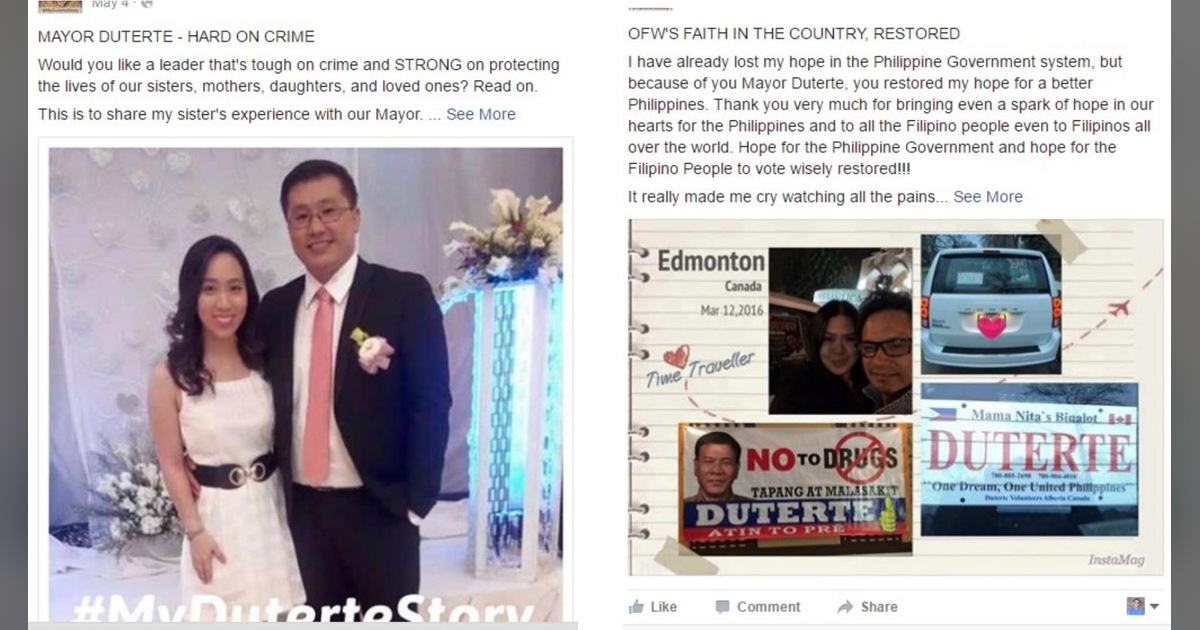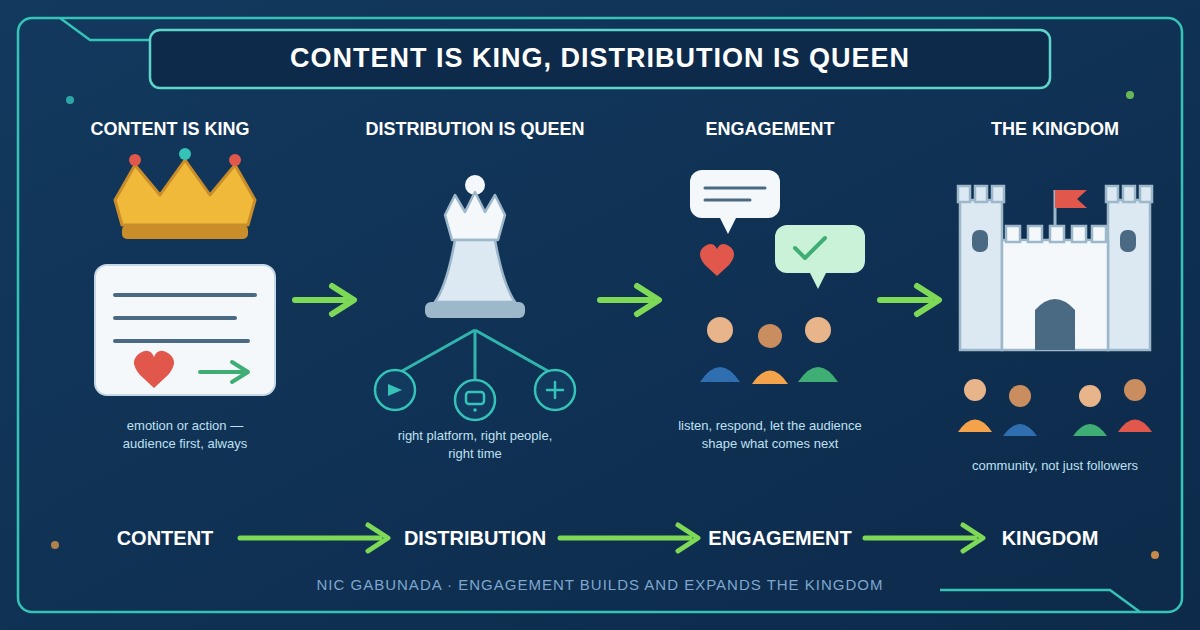
Infographic of a social media strategy framework: content as king, distribution as queen, engagement building a kingdom community

Content Is King, Distribution Is Queen: My Social Media Strategy

Key Takeways: Content is King, Distribution is Queen, Engagement builds the Kingdom — the architecture of every campaign I’ve run Good content evokes emotion or prompts action; format matters far less than the message Filipino cultural shorthand — hugot, kilig, pride — is what makes content travel here Most campaigns fail at distribution: everything spent on production, nothing on reach The marching orders never change: engage your audience, distribute cost-efficiently, and tell the truth   I know, I know — “content is king” sounds like something you’d see on a motivational poster. But bear with me. The way I think about it isn’t a slogan. It’s the actual architecture of a social media strategy. Here’s the framework I’ve used for years, and taught to every

read more   →
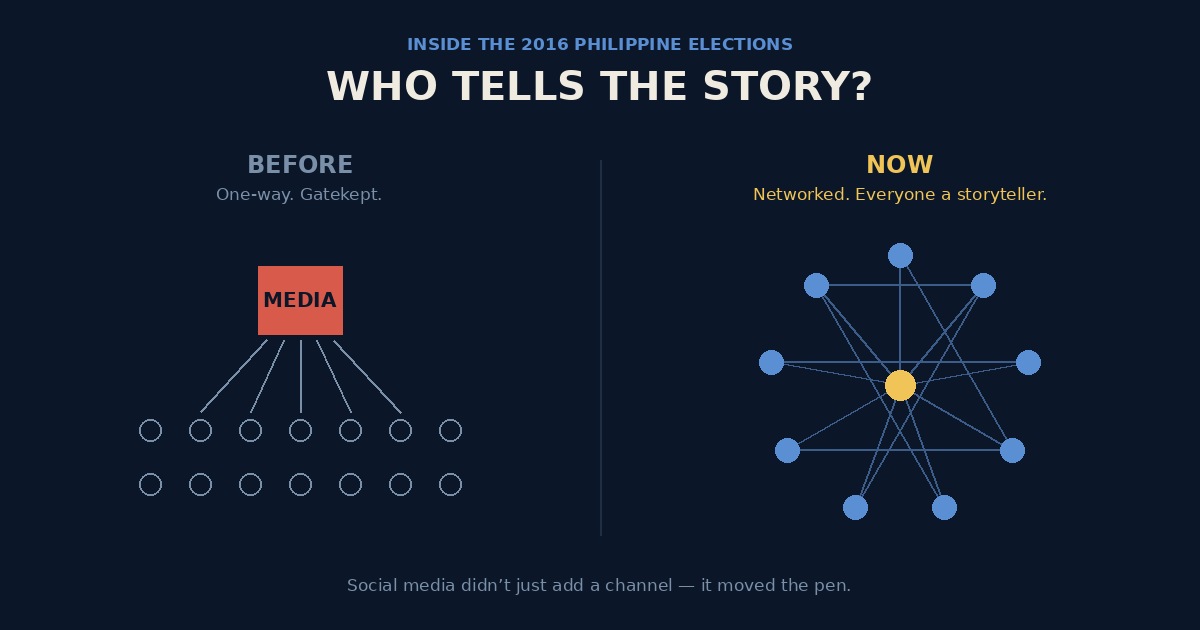
A dark blue infographic titled "Who Tells the Story?" contrasting two eras: "Before — one-way, gatekept," showing a single media broadcast node transmitting down to rows of passive audience members, and "Now — networked, everyone a storyteller," showing an interconnected web of nodes with a storyteller at the center.

The Democratization of Media in the Philippines: How Social Media Changed Narrative Making

The Democratization of Media in the Philippines: How Social Media Changed Narrative Making Series: Inside the Campaign Eighth of Ten Parts Key Takeaways Before social media, narrative making was controlled by big media companies — we were just the audience Social media made every Filipino with a smartphone a potential storyteller We seeded the MyDuterte story idea and let it multiply into thousands of authentic narratives The old model was message control. The new model is narrative cultivation The lesson: build something worth talking about, then give people a platform to talk about it   Let me take you back to how the media landscape in the Philippines functioned before 2016. It was a time of strict control and high barriers to entry. Before the

read more   →
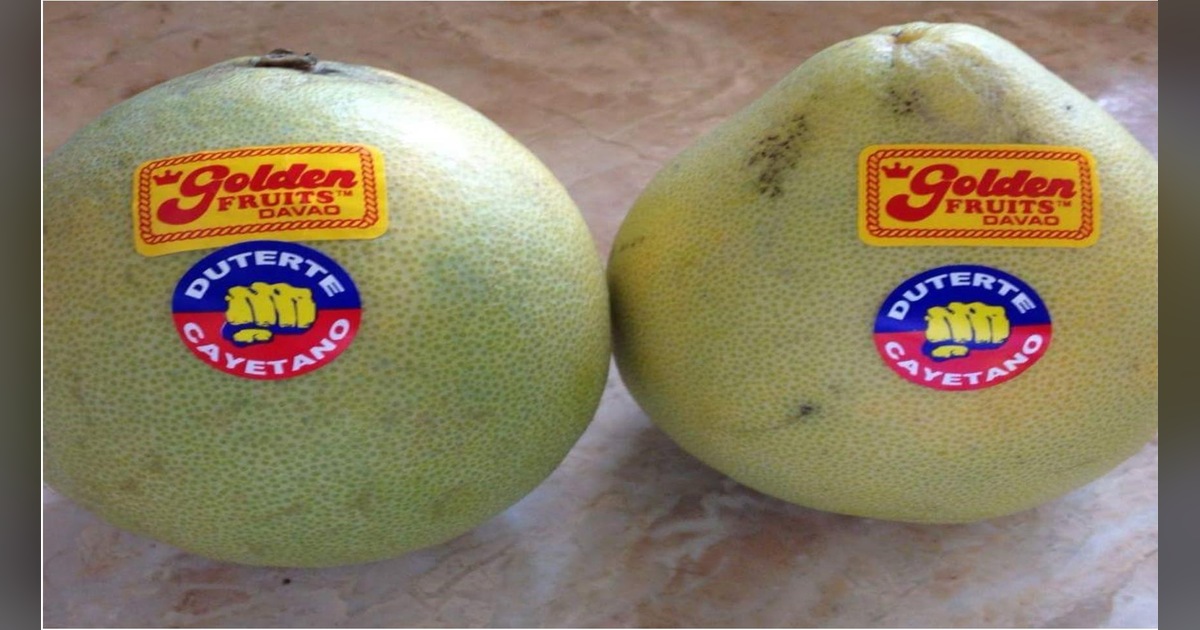
Two pomelos at a fruit stand with Duterte-Cayetano campaign stickers placed on their Golden Fruits labels.

How to Run a National Campaign with Almost No Budget — and Win

Series: Inside the Campaign Seventh of Ten Parts Key Takeaways Our first TV buy was ₱8M — used to test four regional cities, not flood national airwaves The leading spender spent ₱500M+ on advocacy ads. Our official spend was ₱371M — and our real media value was multiples of that Every peso constraint forced a more creative, more targeted decision The pomelo sticker, the apron, the bicycle man — zero-budget content that traveled further than a billboard The lesson: money buys reach. Belief builds movements. Scarcity is an editor, not just an obstacle Let me tell you about our first TV buy. ₱8 million. That was our initial television budget for what would become the most consequential presidential campaign in recent Philippine history. With ₱8

read more   →
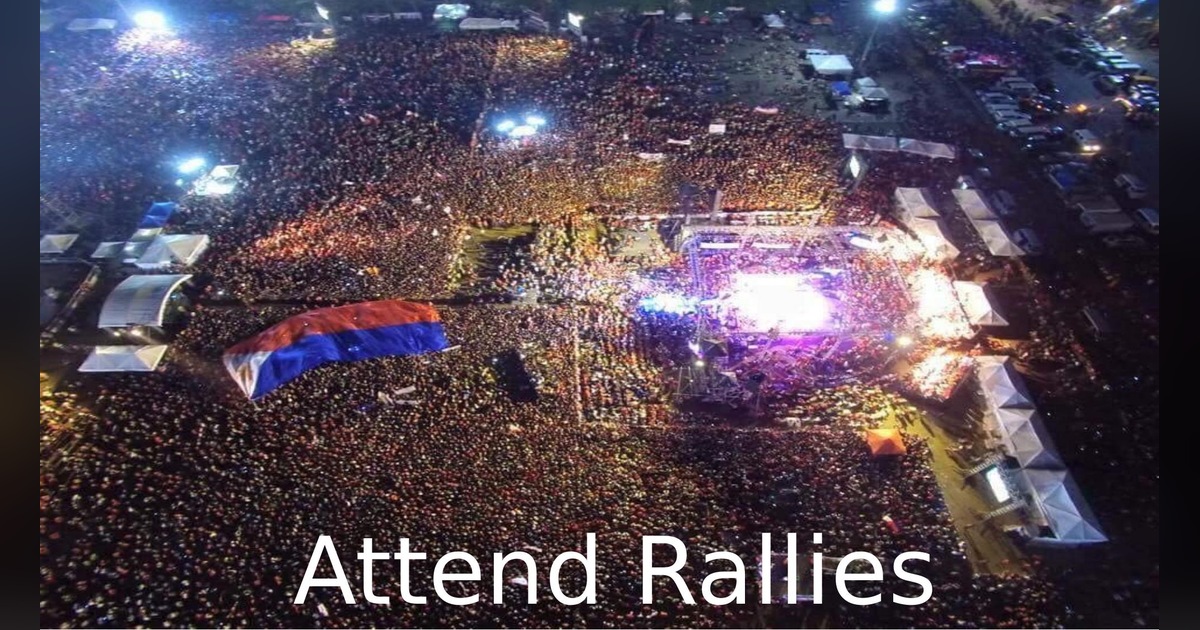
An aerial night photograph of a massive Duterte campaign rally crowd filling a public square, captioned "Attend Rallies."

Arouse, Organize, Mobilize: Turning Online Followers into Voters and Campaigners

Series: Inside the Campaign Sixth of 10 Parts Key Takeaways Engagement metrics are not the same as real-world impact — this distinction cost other campaigns dearly We used a three-stage framework: Arouse (emotion), Organize (structure), Mobilize (action) Online groups were aligned into four clusters: OFWs, Luzon, Visayas, and Mindanao — each with a coordinator Mobilization meant rallies, door-to-door, debate watch parties, and ballot guardianship The lesson: social media is the recruitment channel, not the campaign itself There is a trap in social media campaigning that I’ve seen consume well-resourced campaigns with sophisticated tools and impressive metrics: the trap of confusing engagement with action. Likes are not votes. Shares are not door-to-door visits. Passionate comment threads are not guardians of the ballot. And a Facebook group

read more   →
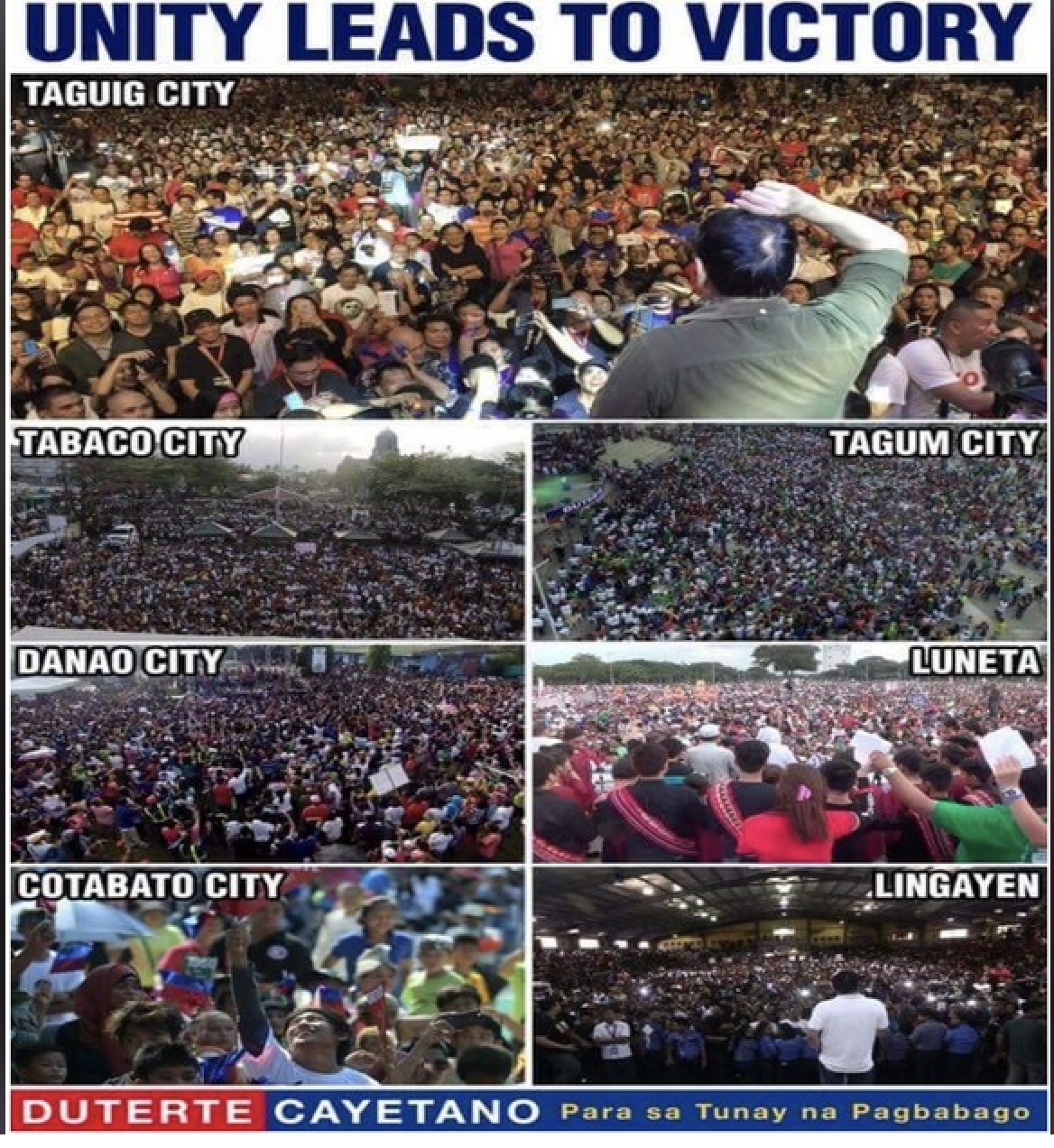
A volunteer-made campaign collage titled "Unity Leads to Victory" showing eight aerial and crowd photos of Duterte rallies in Taguig, Tabaco, Tagum, Danao, Luneta, Cotabato, and Lingayen, bordered with the Duterte-Cayetano campaign banner.

Let a Hundred Flowers Bloom: Why Consumer-Generated Content Beats Agency-Invented Campaigns

Series: Inside the Campaign Fifth of 10 Parts Key Takeaways Our best campaign content came from volunteers, not professionals Digital natives from each region created content that was believed because it was true Our central role was direction-setter and curator — not creator The result was a content ecosystem that felt alive, because it was The lesson: find your believers, give them a direction not a script, then get out of the way There is a fantasy that persists in the marketing and communications industry — that the best content comes from the best creative teams. That a campaign is only as good as the agency behind it. The 2016 Duterte campaign was, among other things, a refutation of that idea. We didn’t have the

read more   →
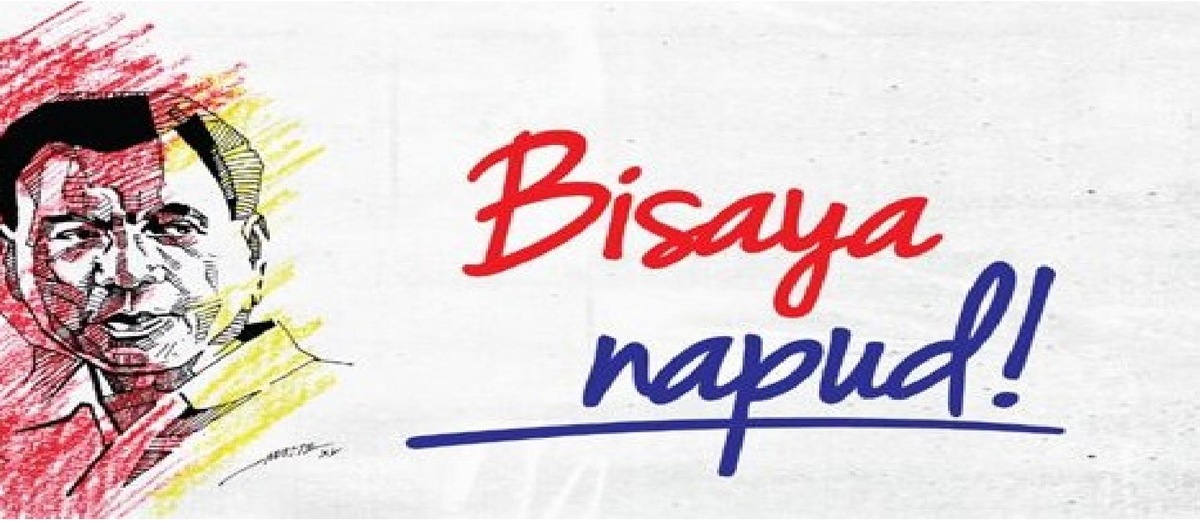
A hand-drawn red, yellow, and blue sketch portrait of Rodrigo Duterte beside the handwritten campaign slogan "Bisaya napud!" — it's the Bisaya's turn.

Exploiting Regional Identity in National Campaigns: The Bisaya Na Pud Movement

Series: Inside the Campaign Fourth of Ten Parts Reading time: 7 min read Key Takeaways The Philippines is not one market — treating it as one is a strategic failure For nearly six decades, the country had no Bisaya president. We named that gap and turned it into fuel Our geographic plan: fortify Mindanao, consolidate the Bisaya base, penetrate Metro Manila Identity claims mobilize people in ways policy arguments rarely can Social media makes regional precision possible at national scale — use it One of the enduring mistakes of national campaigns in the Philippines is treating the country as a single, homogeneous market. It is not. Anyone who has spent time outside Imperial Manila knows this. The issues that keep a voter awake in Cotabato

read more   →
A 2016 campaign strategy slide titled "Which Candidate Can Be the Right Type of Change," showing Mar Roxas, Grace Poe, Jejomar Binay, and Duterte positioned on a spectrum from continuity to radical change, with each candidate's change profile, enemy, and winning condition listed below.

How We Framed the Field: The Art and Science of Political Positioning in a Crowded Race

Series: Inside the Campaign Third of 10 Parts Key Takeaways In a crowded race, your most powerful move is positioning your competitors — not just yourself We anchored our frame in real voter emotions: fear, frustration, and exhaustion with the status quo The question wasn’t “Who is Duterte?” — it was “What kind of future do you want?” Every competitor’s position was grounded in publicly known facts, not manufactured attacks The lesson: find the emotional terrain voters already stand on, then give it language When I joined the Duterte campaign in early 2015, our candidate was — by any objective measure — a long shot. He was a regional mayor from Davao with low awareness levels in Luzon and the Visayas, no national political machinery,

read more   →
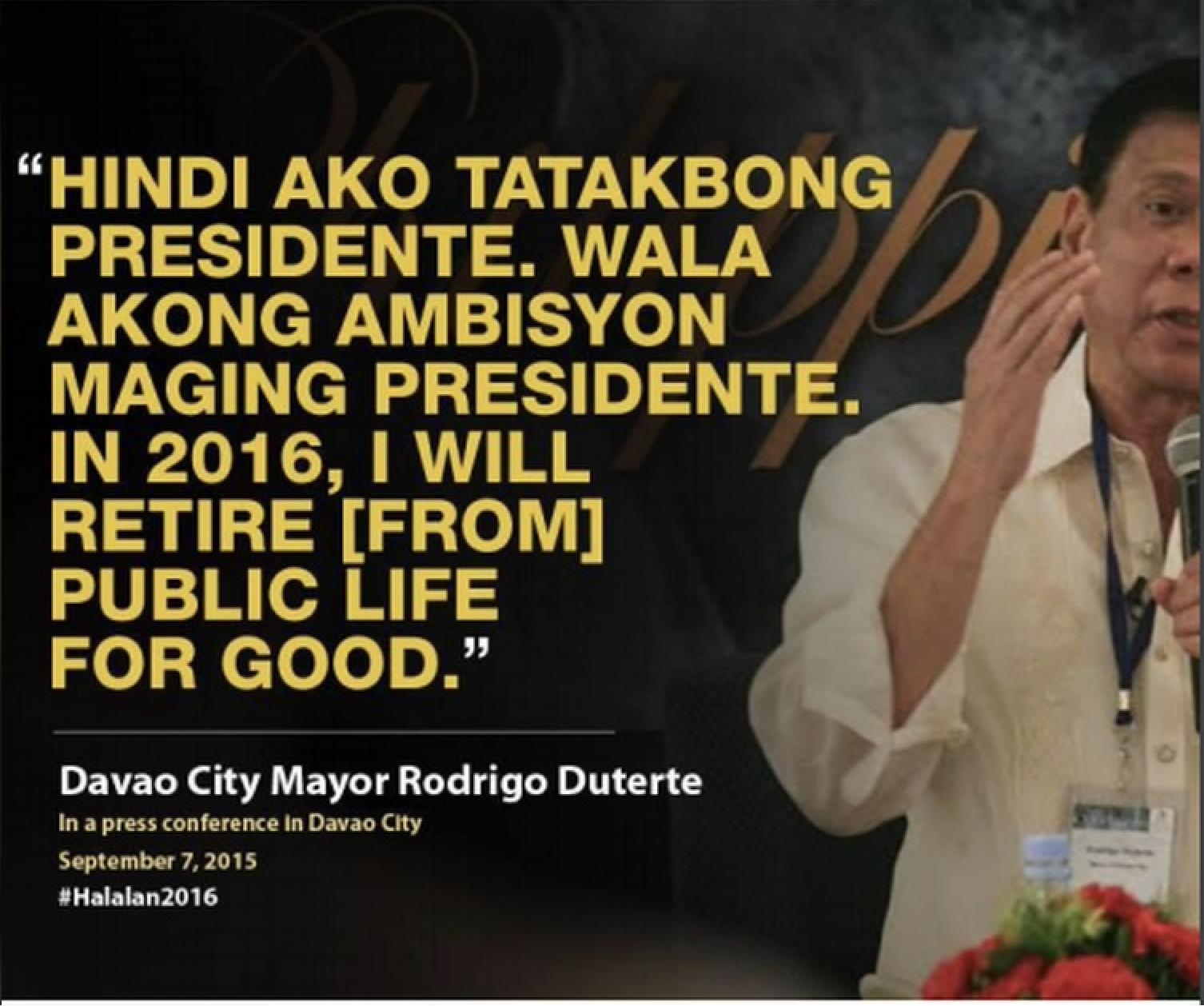
Davao City Mayor Rodrigo Duterte gesturing at a September 2015 press conference beside his quoted statement: "Hindi ako tatakbong presidente. Wala akong ambisyon maging presidente. In 2016, I will retire from public life for good."

Authenticity as the Most Powerful Campaign Strategy: Lessons from Duterte’s “As-Is, Where-Is” Approach

Series: Inside the Campaign Second of 10 Parts Key Takeaways Duterte told us directly: don’t package me differently from who I am We presented both sides of the candidate — unflinchingly — and let voters decide Research confirmed: authenticity was the #1 thing voters liked about him Manufactured relatability fails — voters have finely tuned authenticity detectors The lesson: authenticity is a strategic commitment, not a communications style   There is a standard playbook in political communications. You take the candidate. You identify their strongest qualities. You amplify those. You sand down the rough edges. You package them into something the broadest possible audience can accept. We threw that playbook out from day one. Not because we were contrarian. Not because we were underfunded —

read more   →

From Activist to Adman — How the Anti-Marcos Movement Made Me a Better Marketer

Key Takeaways: Some of the most valuable marketing training happens outside marketing –mine happened in the anti Marcos movement Every flyer and every rally had to land: that was audience segmentation before anyone called it that Distribution mattered as much as content — trusted networks were our channels The goal was never just to inform but to mobilize; that’s virality by another name Look behind history’s movements and you’ll find someone who understood audience, message and reach People are sometimes surprised when I tell them where I got my most valuable marketing lessons. It wasn’t a classroom. It wasn’t a boardroom. It was the Anti-Marcos movement — in the streets, in secret meetings, in the business of moving people when the stakes were life and

read more   →

Why Social Media Was the Real Tipping Point of the 2016 Philippine Elections

Series: Inside the Campaign First of 10 Parts Key Takeaways: Social media in 2016 was no longer a youth or elite medium — it reached every corner of the Philippines With 42 million active social media users and free Facebook from telcos, the platform was effectively free for millions We spent a fraction of what our competitors did on traditional media — and won Social media scales both authentic messages and disinformation equally — discipline is non-negotiable For strategists: stop treating social as supplementary. In many campaigns, it IS the campaign. For years, the conventional wisdom in Philippine politics was simple: if you want to win, you dominate television. TV was king. Radio was queen. Everything else was a footnote. The 2016 presidential elections changed

read more   →