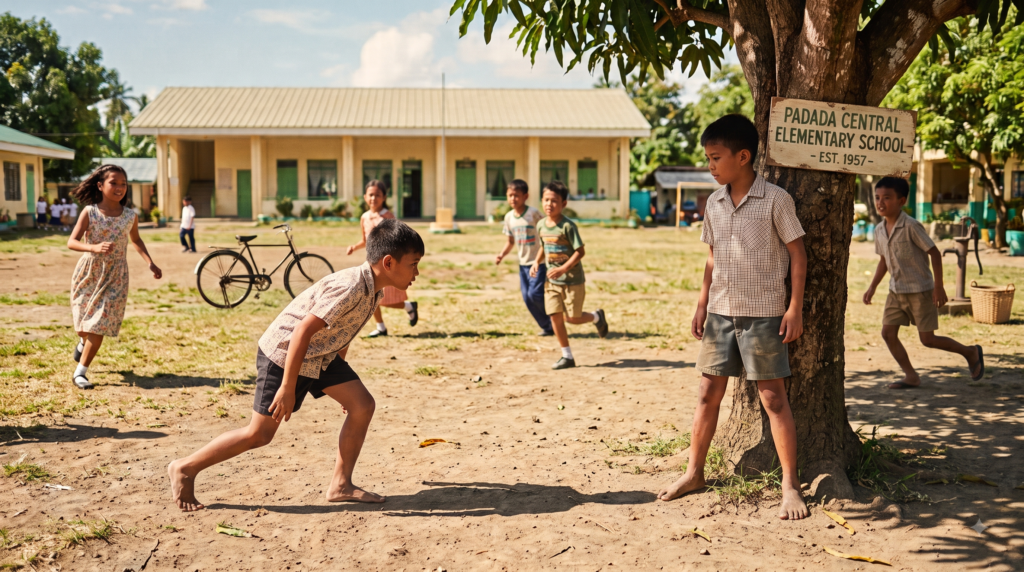
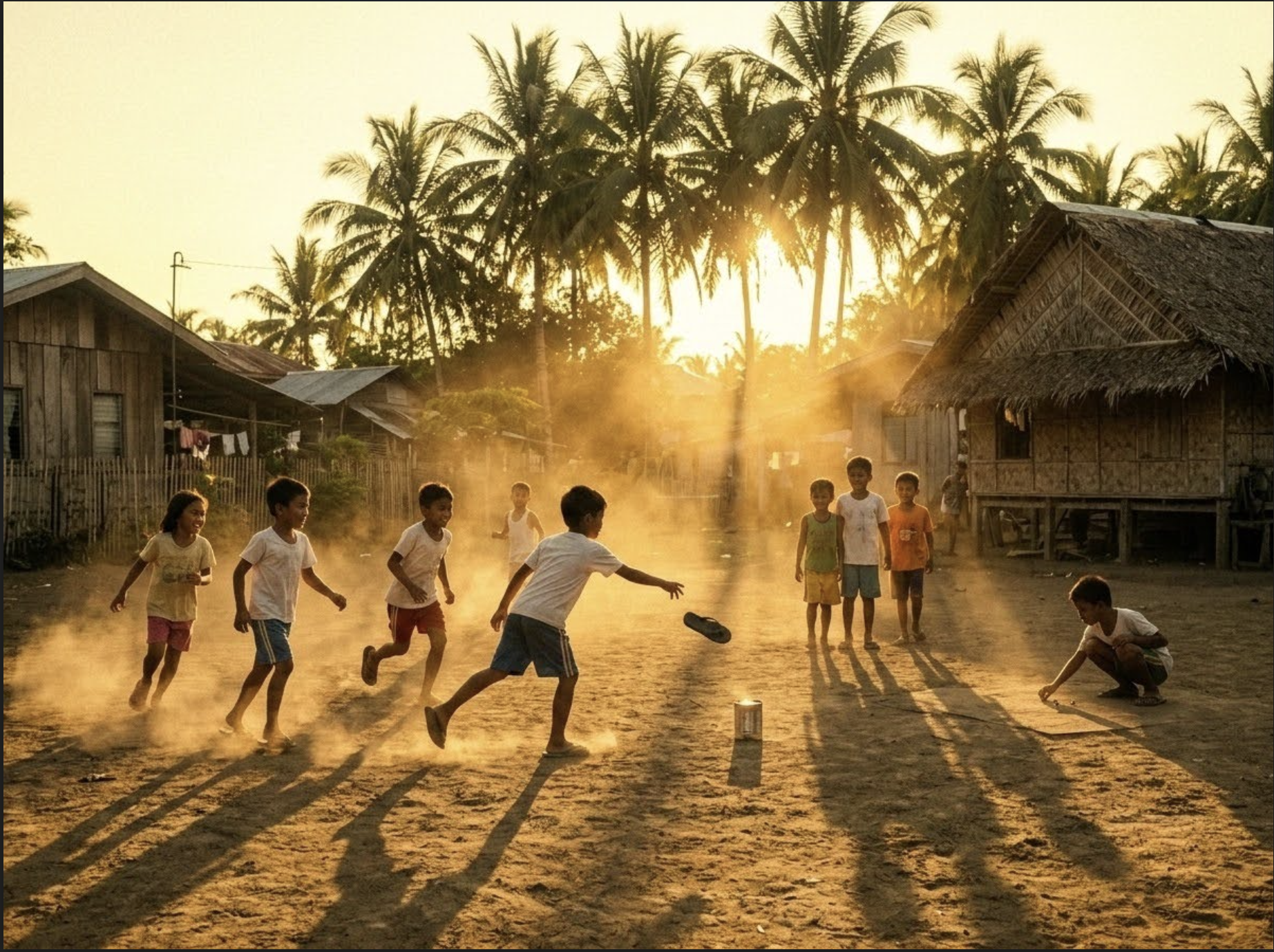
Before video games, smartphones, and tablets, children played outside, engaging in Larong Pinoy—the traditional Filipino games that defined our childhood.
We didn’t need anything expensive. For most games, all you needed were a few friends. If a game required equipment at all, you found it around the house or in the yard — sticks, stones, bottle caps, rubber bands. If you had to buy something, it cost centavos.
From habulan and patintero to tumbang preso, there is a whole inventory of traditional Filipino games that children across the country once played without being taught. You learned them the way you learned to swim in the river: by being handed the sticks and told to figure it out.
These days it seems only the titos and titas remember them.
I can still see the image clearly: the late afternoon in Padada, when the shadows stretched long across the packed-earth yard. It was usually just after the merienda hour, and the air was thick with the scent of woodsmoke and the distant, rhythmic sound of neighbors calling their children home. I remember standing there, heart racing, waiting for the older boys to decide which direction we would run—the tension of the moment more vivid than any video game I’ve played since.
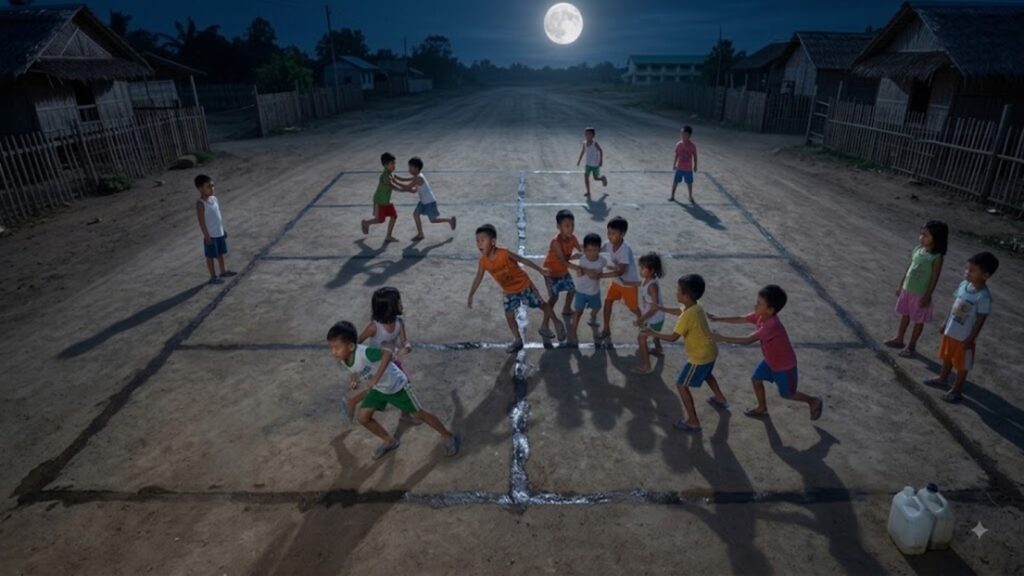
I can still see the dusty patches of ground where we would sneak off the moment the afternoon chores were done or the second our parents turned their backs. We filled every pocket of unclaimed time — school lunch breaks, the frantic minutes before dinner, and those golden nights when the full moon provided the only light we needed to stay outside.
Having shared five of these stories already, I am now launching a weekly series to document five more before they fade entirely.
Why Preserving Traditional Filipino Games Mechanics Matters
There is a real risk of losing this. Not the names — the names survive in listicles. What disappears is the actual mechanics: how you decide who goes first, what counts as a point, what the loser has to do afterward.
Those details were never written down. They were passed hand to hand in vacant lots and schoolyards, and they varied from town to town.
I found this out writing the series. When I tried to recall what birus meant, I had nothing — it was simply the word we shouted, and in all those years none of us thought to ask where it came from. There is nobody left who was told, because nobody thought to ask.
So this series is partly documentation and partly a trip down memory lane. I’m setting down the rules as we played them in our part of the Philippines — Padada, Davao del Sur, in the years when a full moon was reason enough to stay out late.
If your version was different, that difference is worth recording too. The comments are open.
How We Learned Larong Pinoy: The Oral Tradition
It was only when I came to write about kasing — the spinning top you carved yourself from guava or camachile — that I understood how all of this actually reached me.
No adult taught me to make one. There was no lesson, no father sitting me down with a bolo, no shop class. I learned by watching the older boys carve theirs: sitting near them while they worked, seeing where the blade went, listening while they told me I was holding the glass at the wrong angle.
That was the whole system. Older boys carved, younger boys watched, and in a few years the younger boys were the older ones and somebody was watching them.
Every game in this series travelled that way. Nobody wrote the rules down because nobody needed to. There was always someone slightly bigger who already knew, and always an afternoon in which to find out.
Which explains something that puzzled me while writing these posts. I cannot tell you what birus means. I cannot tell you why the syatong punishment had no name, or where the jackstone exhibitions came from.
The words arrived without explanations attached, and it never occurred to any of us to ask for one — because the person teaching you was nine years old and did not know either.
And it explains why it is going.
I used to assume these games were disappearing because children now have screens. That is part of it. But the deeper problem is that the knowledge never lived in anybody’s head. It lived in an arrangement: the older children, the younger ones, the free afternoon, the same yard, week after week, for years.
Take the arrangement apart — different schools, scheduled activities, fewer children on the same street, less unclaimed time — and the knowledge has nowhere to sit. There is no book to fall back on, because there was never a book.
That is really why I am writing these down. Not for the nostalgia, though there is plenty of that. Because the transmission system has stopped, and what it carried is only in the memory of people my age.
A note on names
Almost every game here goes by several names.
Syatong in Bisaya is syato or shatong through much of Luzon. Holen is jolen in Tagalog areas. Birus I have rarely heard called anything else, and rarely heard of outside Mindanao at all.
Where a game has a widely used alternative name, I’ve flagged it. Where the rules diverge regionally, I’ve said so rather than pretending one version is definitive. None of them are.
The games in this series
| Game | Also known as | Players | What you need |
|---|---|---|---|
| Lastiko | Dampa, pitik | 2 or more | A fistful of rubber bands, smooth concrete |
| Birus | — | Two teams | A wide field, ideally a full moon |
| Holen | Jolen, marbles | 2 or more | Glass marbles, one pamato, a flat patch of ground |
| Syatong | Syato, shatong, tsato | 2 players or 2 teams | Two sticks, a shallow ditch, open ground |
| Jackstone | Jacks, sintak | 2 to 10 | Ten metal stones, one small rubber ball |
| Tumba Lata | Tumbang preso | 3 or more | An empty tin can, a slipper each |
| Tubig-Tubig | Patintero | Two teams | A grid drawn in water or chalk, and a full moon |
| Tigso | Agawan base | Two teams of 5–8 | Two rocks, two trees, or two poles |
| Takyan | Sipa | 2 or more | A washer, plastic ribbons, a rubber band |
| Kasing | Trumpo, spinning top | 2 or more | A top you carved yourself, and string |
There will be more to come— giyera-giyera, tabanog, piko and others.
Each post covers the equipment, the rules step by step, how scoring works, and what the losers had to endure.
Because there was always a punishment, and it was always the best part.
The ceremony was on the losing side
That last point turns out to be the thread running through all of them.
There was no trophy in any of these games. No title, no ritual for the winner. What every one of them had instead was an elaborate, well-rehearsed procedure for humiliating whoever lost.
Lose at syatong and you run the length of the field shouting “syatong” in a single breath — which cannot be done, which everybody knows cannot be done, and which everybody gathers to watch you fail at. Fumble a round of jackstone and you are called baboy, a pig, immediately and by everyone. Lose your marbles at holen and you walk home with nothing while the winner counts his.
I don’t think that was cruelty. I think it was how the games stayed fair without a referee. The penalty was public, immediate, and survivable — and because it was survivable, you came back the next afternoon.
What these games actually taught us
The absence of adults did more than move the knowledge around. It shaped the games themselves.
I want to resist the easy nostalgia here, because the interesting thing about larong Pinoy isn’t that it was wholesome. It’s that it was unsupervised.
No adult refereed a game of syatong. There was no rulebook to appeal to. So before you could play, you had to negotiate: how far apart the lines go, how many points wins, how many tries you get.
You argued it out, you agreed, and then you were bound by what you had agreed to.
You learned to settle disputes without an authority. You learned that a rule you talked your way into was a rule you had to live with. You learned to lose in front of your friends and show up again the next afternoon.
That is not a small curriculum.
Start here
Whether you’re a bona fide tito or tita revisiting your own childhood, a parent looking for something to teach your kids, or a teacher putting something together for Buwan ng Wika — start anywhere. The games stand alone.
Game of Titos and Titas — every post in the series
- Lastiko: The Filipino Rubber Band Games We Played as Kids
- Birus: The Filipino Hide-and-Seek Played by Moonlight
- Holen: How to Play the Filipino Marble Game
- Syatong: How to Play the Filipino Stick Game
- Jackstone: The Game of Skill and Flair
- Tumba Lata: What We Called Tumbang Preso — forthcoming
- Tubig-Tubig: The Game We Drew With Water — forthcoming
- Tigso: The Golden Hour of Our Lunch Breaks — forthcoming
- Takyan: The Sound of Our School Courtyards — forthcoming
- Kasing: The Top You Made Yourself — forthcoming