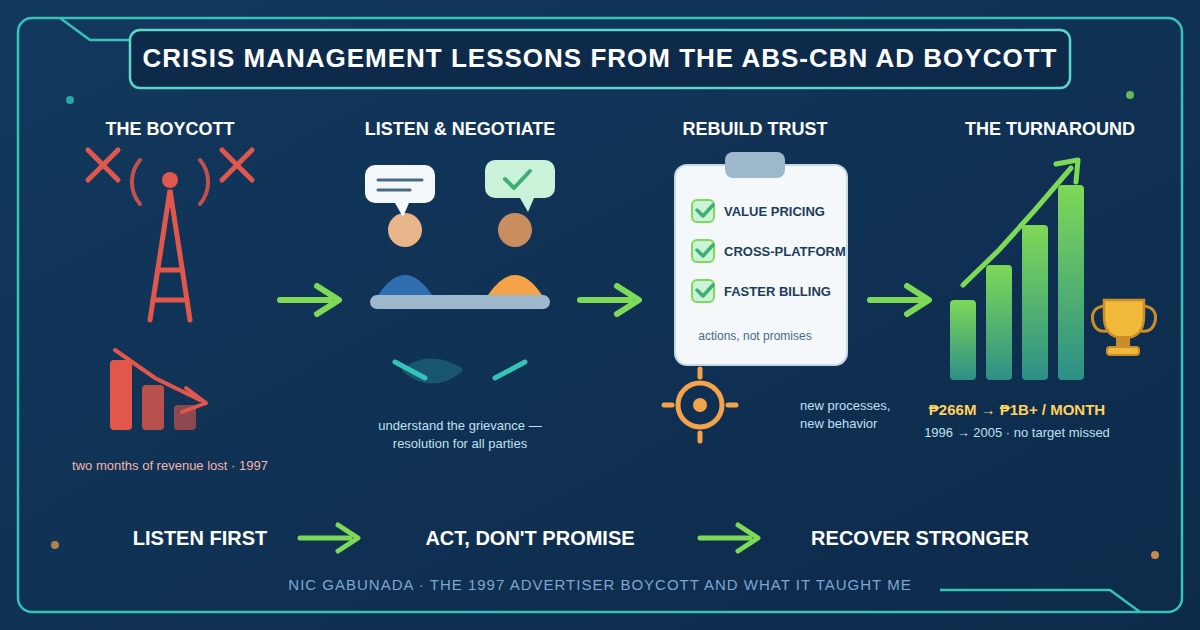
Infographic of the ABS-CBN ad boycott crisis: listening, rebuilding trust, and a revenue turnaround from ₱266M to ₱1B a month

Crisis Management Lessons From the ABS-CBN Advertiser Boycott

Key Takeaways: I was appointed Head of Sales and Marketing at ABS-CBN in February 1997–straight into an advertiser and ad agency boycott Lesson 1: understand what the aggrieved side actually needs before you defend or counter Lesson 2: trust is rebuilt through behavior, not statements — make moves that speak for themselves Lesson 3: a team that’s behind needs a clear goal, not a pep talk — we set the target and hoit it The turnaround grew into quadrupled revenues: from P266M to over P1B per month, without missing a target   February 1997. I had just been appointed Head of Sales and Marketing at ABS-CBN. It was a role I didn’t ask for, by the way. Freddie Garcia called me into his office and
read more   →
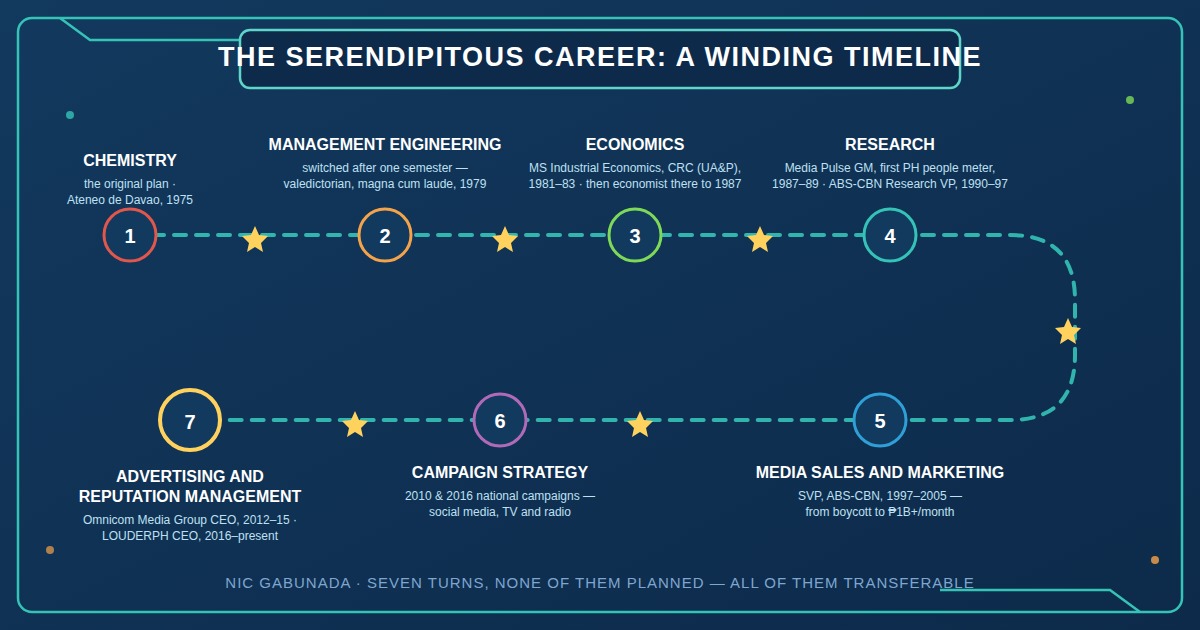
Winding timeline of Nic Gabunada's seven career stages from chemistry to advertising and reputation management

The Serendipitous Career: Why a Non-Linear Career Path Wins

Key Takeways: I enrolled in BS Chemistry; two professors talked me into Management Engineering — the first serendipitous turn of many From activist detention in Davao to economics at CRC to Media Pulse to ABS-CBN: none of it was planned When Freddie Garcia handed me Sales and Marketing with no sales background, mentorship made ‘yes’ posible Non-linear career are failure of planning — they’re evidence of adaptability The market rewards specialists, but it deeply needs sympathizers who transfer knowledge across fields   I wanted to be a chemist. That’s the truth. When I enrolled at Ateneo de Davao University, I signed up for BS Chemistry. I had a plan. I had a direction. And then the plan changed — the first turn in what became

read more   →

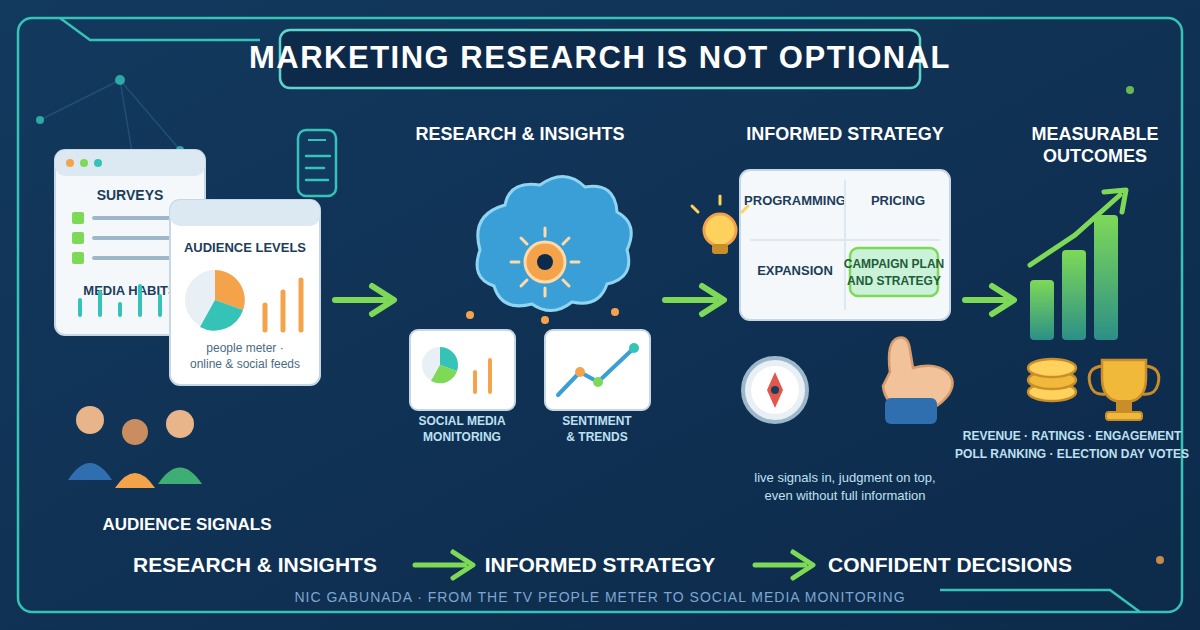
Research Is Not Optional: Every Media and Marketing Decision Needs Data

Key Takeaways: You cannot craft an effective message if you don’t know who you’re talking to — yet gut feel decisions remain rampant Helping set up the Philippines’ first TV people meter changed how the industry planned and bought media At ABS-CBN, research informed programming, expansion, and the groundworks for Studio 23, Sky Cable, Star Cinema and more Research done well is not a support function — it’s a strategic weapon But the best practitioners are data-informed, not data paralyzed: research reduces uncertainty,  it doesn’t replace judgment   I’m going to say something that might sound obvious. But I’ve seen enough campaigns crash and burn to know it’s not practiced nearly enough: you cannot craft an effective message if you don’t know who you’re talking

read more   →
A 2016 campaign strategy slide titled "Which Candidate Can Be the Right Type of Change," showing Mar Roxas, Grace Poe, Jejomar Binay, and Duterte positioned on a spectrum from continuity to radical change, with each candidate's change profile, enemy, and winning condition listed below.

How We Framed the Field: The Art and Science of Political Positioning in a Crowded Race

Series: Inside the Campaign Third of 10 Parts Key Takeaways In a crowded race, your most powerful move is positioning your competitors — not just yourself We anchored our frame in real voter emotions: fear, frustration, and exhaustion with the status quo The question wasn’t “Who is Duterte?” — it was “What kind of future do you want?” Every competitor’s position was grounded in publicly known facts, not manufactured attacks The lesson: find the emotional terrain voters already stand on, then give it language When I joined the Duterte campaign in early 2015, our candidate was — by any objective measure — a long shot. He was a regional mayor from Davao with low awareness levels in Luzon and the Visayas, no national political machinery,

read more   →
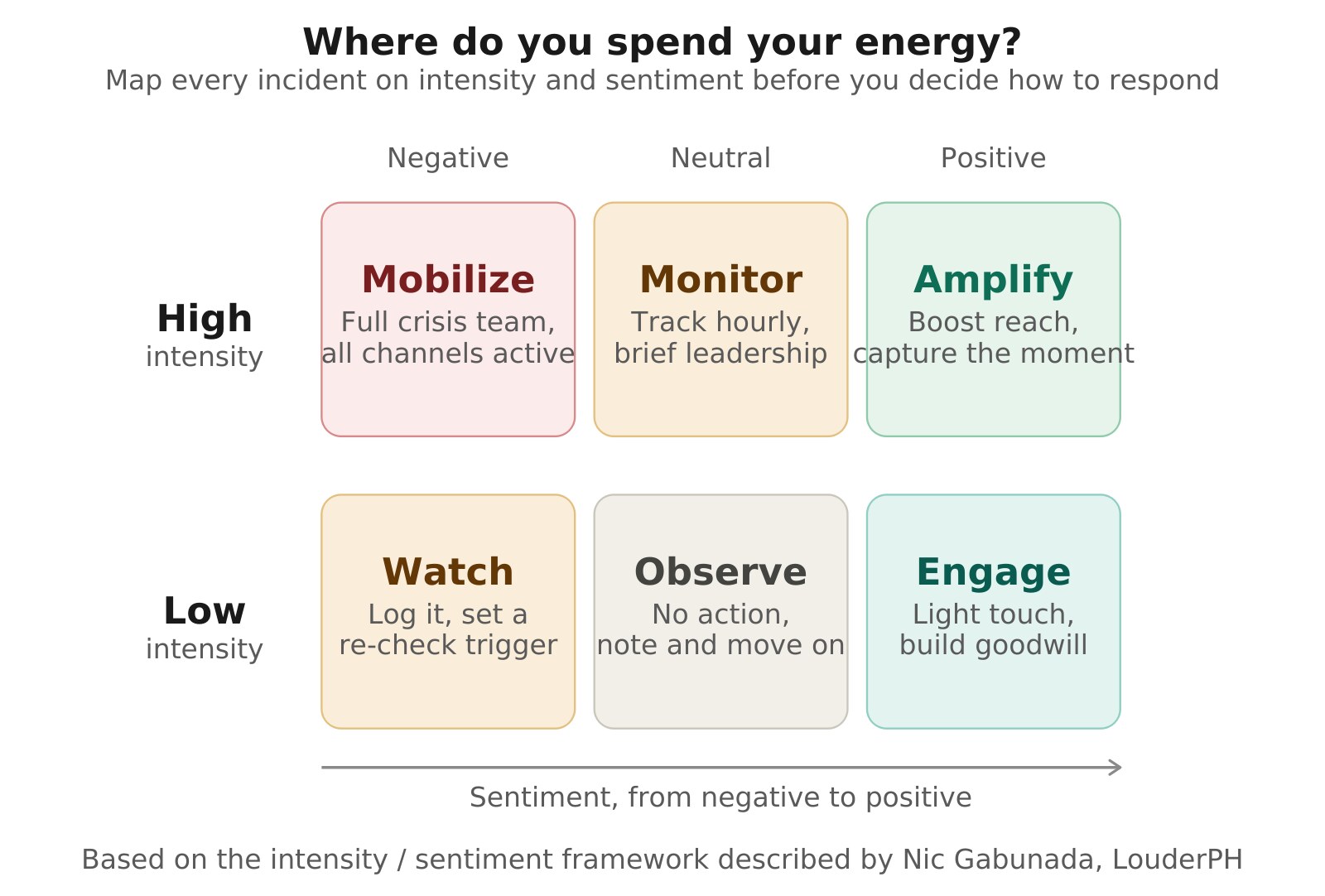
Infographic showing a 2x3 crisis response grid based on incident intensity (high or low) and market sentiment (negative, neutral, or positive): Mobilize, Monitor, Amplify, Watch, Observe, Engage.

Data Is the New Oil — But Discernment Is the Refinery

There’s a moment in every crisis room I’ve been in — and I’ve been in more than a few — when someone opens a laptop, pulls up a dashboard of real-time social media data, and says something like: “We’re trending.” And then everyone looks at each other, because trending could mean anything. It could mean you’ve gone viral for doing something right. It could mean a false rumor is currently racing ahead of the truth at the speed of a share button. It could mean a journalist with a large following just posted something that is factually incorrect, emotionally charged, and already spreading fast. Data tells you that something is happening. Discernment tells you what to do about it. This is the distinction I’ve spent

read more   →
Dark storm clouds hanging low over a wide, open ocean, with faint silhouettes of ships on the distant horizon

Rene Was One of Ours: What Ateneo de Manila Forgot About Cura Personalis

I keep coming back to one small, unbearable fact. Before Rene Clert Baterbonia was a name on a national headline, before he was a “Blue Eagles recruit” and then, God help us, a body pulled from the surf in Dipaculao, he was a boy from Talacogon, Agusan del Sur, who wore the same blue we wear here in Davao. He was an Ateneo de Davao product. He led our region to a Palarong Pambansa gold and took home the MVP. He was, in the truest and most literal sense, one of ours. So no, I can’t write about this the way a columnist writes about a distant tragedy in Manila. This one landed at home. And that’s exactly why I need to write it honestly,

read more   →
Abstract illustration of a glowing signal cutting through scattered noise, representing a clear narrative breaking through misinformation during a crisis.

When the Casino Is on Fire and Twitter Thinks It’s ISIS: A Crisis Manager’s Playbook

It was past midnight on June 2, 2017, when a lone gunman walked into Resorts World Manila, set fire to casino tables and slot machines, stole chips, and then took his own life. Thirty-eight people died — almost entirely from the stampede and smoke inhalation in the chaos that followed. Within hours, a journalist who billed herself as a terrorism expert reported that an ISIS faction had claimed responsibility for the attack. Her report went viral. It wasn’t ISIS. It was a debt-ridden former civil servant named Jessie Javier Carlos who had run out of options and made the most catastrophic of choices. But by the time the facts caught up with the story, the narrative had already taken on a life of its own

read more   →