
There’s a moment in every crisis room I’ve been in — and I’ve been in more than a few — when someone opens a laptop, pulls up a dashboard of real-time social media data, and says something like: “We’re trending.”
And then everyone looks at each other, because trending could mean anything. It could mean you’ve gone viral for doing something right. It could mean a false rumor is currently racing ahead of the truth at the speed of a share button. It could mean a journalist with a large following just posted something that is factually incorrect, emotionally charged, and already spreading fast.
Data tells you that something is happening. Discernment tells you what to do about it.
This is the distinction I’ve spent the better part of four-and-a-half decades learning to make — and it may be the single most valuable professional asset I have.
From Padada to the Nerve Centers of Philippine Media
I didn’t grow up thinking about reputation management. I grew up in Padada, Davao del Sur, studied Management Engineering at Ateneo de Davao University, graduated as Valedictorian, and then got myself arrested in September 1980 for organizing an anti-martial law rally.
That experience — the activism, the detention, the scholarship at the Center for Research and Communication that followed — gave me something that no MBA program was going to teach me: the understanding that data, communication, and power are not separate disciplines. They are the same discipline in different clothes.
When I eventually joined Pulse Research Group, the country’s leading market research firm at the time, and later moved into the executive ranks of ABS-CBN, I was essentially doing the same work I had done as a student activist — trying to understand how people think, what they need to hear, and how to reach them. The tools got more sophisticated. The underlying question never changed.
The Media Landscape Nobody Prepared You For
Let me paint you a picture of what information management looks like today.
Think of a teenager with two cellphones — one in each hand — talking to a friend, while the television is on in the background. You’ve probably seen this in your own household. That teenager is, in a very real sense, the model for how all of us now consume information.
There are no more 4 o’clock PM editorial deadlines. No more gatekeepers deciding what counts as news. Anyone with a phone and a Wi-Fi connection is now a source, a publisher, and a distributor. They can reach their own network of followers, pages, and chat groups — instantly, at any hour, on any topic, with any degree of accuracy.
For those of us in reputation management, this changed everything. Not the principles — truth, empathy, speed, and accountability remain what they always were. But the execution of those principles now requires something that most organizations are genuinely underprepared for: the ability to capture data in real time, evaluate it quickly, and act on the right things while letting the rest scroll past.
This is where the phrase “data is the new oil” begins to earn its cliché status — but also where it shows its limits.
Raw Oil Is Useless. So Is Raw Data.
Oil in the ground doesn’t power anything. It requires extraction, refinement, and distribution before it becomes useful. Data is exactly the same.
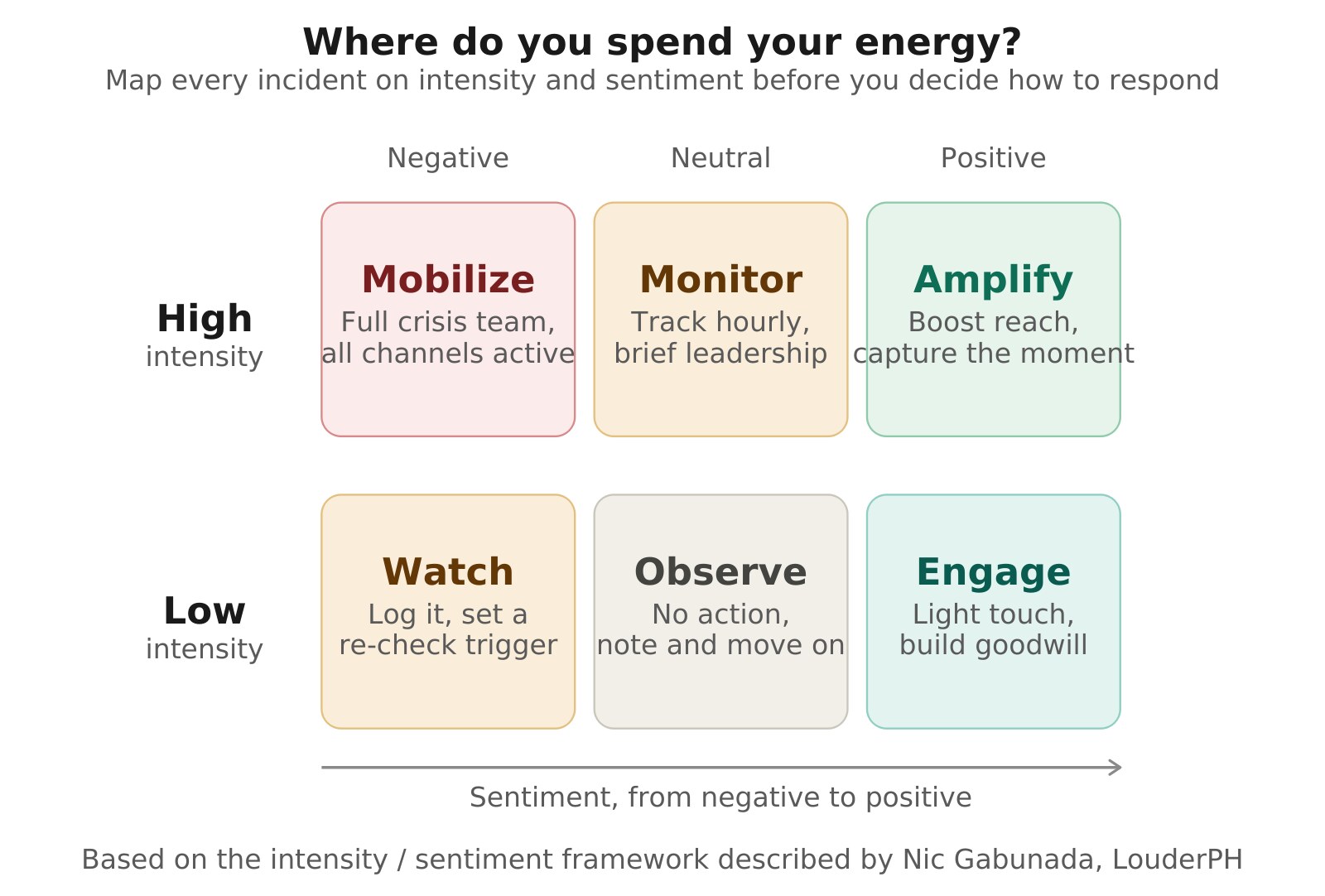
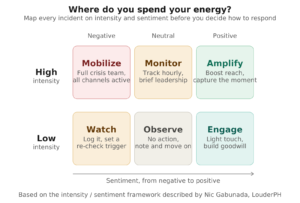
In the reputation and crisis management work my team at LouderPH does for clients — malls, banks, politicians, personalities, brands — we track incidents on a two-axis grid. On one axis: the intensity of the incident (low, medium, or high). On the other: the sentiment of the market toward it (negative, neutral, or positive). The intersection of those two axes determines what we do next — whether we observe, engage, or mobilize.
That framework sounds simple. It is, by design. But the judgment calls inside it — knowing when a low-intensity incident is actually a high-intensity one in disguise, knowing when neutral sentiment is about to tip negative, knowing when engagement will amplify a problem rather than resolve it — that’s the refinery. That’s the discernment.
I’ve seen organizations respond to every negative mention with a full crisis protocol, burning through goodwill and resources on incidents that would have faded on their own. I’ve also seen organizations do nothing while a manageable situation metastasized into something that cost them their license, their leadership, or their reputation. Both are data failures — not failures of data availability, but of data interpretation.
What Politics Taught Me That Marketing Didn’t
In 2015, I made what I consider the most consequential decision of my professional life: I joined the campaign team of Rodrigo Duterte.
People ask me why. The honest answer is that I believed — and still believe — that Mindanao had been carrying its grievances for a very long time, and that Duterte was the candidate with the clearest-eyed view of what those grievances were. Whether you agreed with the political outcome or not, what happened in that campaign was, from a strategic communications standpoint, a case study in the use of data and social media at a scale and speed Philippine politics had never seen before.
Campaigns — like crises — are, at their core, data problems. Who are your voters? What do they care about? Where do they get their information? What messages resonate and why? Political work sharpens your instincts for all of this, because the feedback loops are unforgiving. You find out very quickly whether your model of the audience is correct.
What politics added to my understanding of marketing — and what I brought back to the world of PR and reputation management — was a much more granular appreciation for what I call the sentiment beneath the data. Numbers tell you what happened. The right questions tell you why. And the answer to why is almost always more emotionally complex than the chart suggests.
The Things We Don’t Do
There’s a dimension of this work that doesn’t show up in any framework or framework deck, and I want to name it directly because I think it matters, especially for those of you at the beginning of your careers.
The most consequential decisions I’ve made in my professional life are not the ones where I acted. They are the ones where I chose not to.
Not attacking detractors, even when we had the ammunition. Not exploiting the grief of victims’ families, even when it would have been strategically advantageous. Not accepting work from clients whose intentions I didn’t trust, even when the retainer was attractive.
These are not just ethical choices. They are also, I would argue, strategic ones — because reputation, like trust, is built in the long run on consistency. And an organization (or a person) that is willing to cross certain lines when it’s convenient is not actually in the reputation management business. They’re in the reputation damage business, just operating on a delay.
I share this not because I’ve always gotten it right — I haven’t — but because in the twilight of a long career, I can tell you that the moments I felt most at peace with my work were almost never the moments of biggest victory. They were the moments when I looked at a decision we could have made, and chose a harder and better path.
That’s not just a moral position. In an industry where your currency is trust, it’s the only sustainable business model.
The Discernment Advantage in an Age of Information Overload
Here’s what I want to leave you with, if you’re a marketer, a digital strategist, a PR professional, or anyone whose work involves navigating the space between an organization and its public:
The competitive advantage in this field has shifted. It used to be access — who had the data, who had the research, who had the media relationships. That gap has largely closed. Data is everywhere. Media is fragmented but accessible. Research tools that cost millions a decade ago now have free-tier versions.
What hasn’t been democratized is judgment. The ability to look at a stream of incoming information and know what matters, what’s noise, what requires action, and what requires restraint — that is still scarce. It is built through experience, through intellectual rigor, and through a commitment to seeing the human being on the other side of every data point.
Develop that. Protect it. It is worth more than any dashboard.
→ If this resonated with you, share it with your team or network. And if you’re building a crisis preparedness plan and want a second opinion, reach out to me at my email: nicgabjr@gmail.com or my X account: @nicgabunada.com— sometimes a conversation is the best place to start.
Nic Gabunada Jr. is the CEO of LouderPH and one of the Philippines’ most experienced voices in advertising, PR, and reputation management. With over 45 years spanning research, broadcasting, political strategy, and crisis communications, he brings both depth and candor to the conversation about how organizations survive — and thrive — in the age of hyper-information.