

It was past midnight on June 2, 2017, when a lone gunman walked into Resorts World Manila, set fire to casino tables and slot machines, stole chips, and then took his own life. Thirty-eight people died — almost entirely from the stampede and smoke inhalation in the chaos that followed. Within hours, a journalist who billed herself as a terrorism expert reported that an ISIS faction had claimed responsibility for the attack. Her report went viral.
It wasn’t ISIS. It was a debt-ridden former civil servant named Jessie Javier Carlos who had run out of options and made the most catastrophic of choices. But by the time the facts caught up with the story, the narrative had already taken on a life of its own — and Resorts World Manila was staring down the barrel of a suspended operating license, congressional investigations, and a public that was equal parts terrified and furious.
I was called in to help manage that crisis. And what happened in the next 27 days — from the attack to the lifting of the PAGCOR suspension — is still one of the clearest demonstrations I know of what crisis communication is really for.
The First and Most Dangerous Mistake: Letting Someone Else Define Your Story
In reputation management, the first 24 hours are not just important. They are often determinative.
When the Resorts World attack happened, social media was on overdrive. Any gap in the official narrative would be filled — instantly, enthusiastically, and not always accurately — by anyone with a smartphone and a strong opinion. Our first order of business wasn’t to hold a press conference or draft a legal statement. It was to correct the ISIS label, which had the potential to spike fear, deepen panic, and permanently color how the incident was remembered.
That’s a lesson I wish more brands and organizations would internalize before they’re in the middle of a fire (sometimes literally): the narrative vacuum doesn’t wait for you to be ready. Someone will fill it. The only question is whether it’s you or someone with worse information and better reach.
The Three-Part Framework That Actually Works Under Pressure
Across my 45 years in research, marketing, and reputation management — from ABS-CBN’s executive suite to the halls of Resorts World — I’ve found that every crisis, no matter how unique, ultimately comes down to three imperatives:
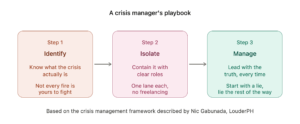
1. Identify What the Crisis Actually Is
This sounds obvious. It isn’t. When a crisis hits, there are usually multiple fires burning simultaneously, and the instinct is to run toward whichever one is generating the most heat. Resist that instinct.
In the Resorts World situation, we weren’t the police. Capturing the gunman (who was already dead) or running the security investigation wasn’t our crisis to manage. Our crisis was a narrative one — restoring public confidence, caring for victims’ families, and demonstrating institutional accountability.
Knowing the difference between the crisis you can manage and the one you can’t is not a small thing. It’s the whole game.
2. Isolate It
Once you know what your crisis is, you work to contain it. This means a laser-sharp focus: one team talking to mainstream media, another to social media, another to legislators preparing for congressional hearings, another devoted entirely to the families of victims. Everyone with a clear lane and no one freelancing.
In the Resorts World case, the company’s owners and officers immediately reached out to the families of those who died and the injured, in some cases even personally visiting them. They established a fund for the dependents of the deceased. They also offered psychological support to affected employees. These were not PR moves — they were the baseline of human decency, and they made the difference between a company that looked like it was hiding and one that was clearly taking responsibility.
3. Manage It — with Truth as Your Non-Negotiable
This is where I want to be direct with you, because I’ve seen the alternative play out enough times to know how it ends: start with a lie, and you will have to lie the rest of the way. You will trip. You will not come out victorious.
At Resorts World, the decision in that first crisis meeting was to review every second of camera footage and reconstruct exactly what happened. Not to cover lapses, but to identify them, own them, and announce what would be done about them. That transparency — paired with constant press releases, a singular narrative, and genuine care for the victims — is what got the operating license reinstated within 27 days. By September 2017, daily visitorship had returned to near pre-attack levels.
But What About Before the Crisis? The Five Things You’re Probably Not Doing
Here’s the uncomfortable truth about most organizations: they are completely unprepared for crisis, until they’re in one. Then they scramble, improvise, and wonder why it cost them so much.
The smart move is preparation. It’s not glamorous. Nobody wants to spend budget on crisis simulations when things are going fine. But consider it the insurance policy you desperately hope you’ll never need — and desperately wish you had when you do.
Five steps every organization should already have in place:
Crisis Communications Team — Define who is on it, what their roles are, and who backs them up if they’re unavailable. PR, Legal, HR, and Operations must all have a seat. The bench matters as much as the starters.
Risk Assessment — Map out every plausible crisis your organization could face: natural disasters, personnel scandals, financial irregularities, accidents. Naming them in advance removes the paralysis that comes with surprise.
Stakeholder Mapping — Who needs to hear from you during a crisis? Your employees, customers, investors, suppliers, media, regulators, and the general public all have different information needs and different trust thresholds. Know them before you need to address them.
Communication Channels — Which channels reach which stakeholder groups fastest? What’s your protocol for each? Do you lead with social media, email, press release, or all three simultaneously?
Training and Simulation — Treat it like a fire drill. Run it. Find out where your plan breaks down before the real crisis does.
The Chinese military strategist Sun Tzu is often quoted in business contexts until he isn’t. But this one holds: to not be prepared is the greatest of crimes.
The Bottom Line
Whether you’re managing a brand, running a political campaign, or leading a company through turbulence, the principles of crisis communication are not mysterious. They are, in fact, remarkably consistent across industries, decades, and media landscapes.
What changes is the speed. What changes is the noise level. What doesn’t change is that people — your customers, your stakeholders, the public — can tell the difference between an organization that is genuinely accountable and one that is simply performing accountability.
Be the former. Prepare before you have to. And when the crisis arrives anyway — because it will — remember that the narrative doesn’t wait for you to be ready.
Neither should you.
→ Found this useful? Share it with a colleague who’s still writing their crisis plan. Or better yet — subscribe for more insights on PR, strategy, and the intersection of data and decision-making.
Nic Gabunada Jr. is the CEO of LouderPH, a leading advertising, public relations, and reputation management firm. He has over 45 years of experience spanning market research, network broadcasting, political strategy, and crisis communications.
Email: nicgabjr@gmail.com X: @nicgabunada.com