The Democratization of Media in the Philippines: How Social Media Changed Narrative Making
Series: Inside the Campaign
Eighth of Ten Parts
Key Takeaways
- Before social media, narrative making was controlled by big media companies — we were just the audience
- Social media made every Filipino with a smartphone a potential storyteller
- We seeded the MyDuterte story idea and let it multiply into thousands of authentic narratives
- The old model was message control. The new model is narrative cultivation
- The lesson: build something worth talking about, then give people a platform to talk about it
Let me take you back to how the media landscape in the Philippines functioned before 2016. It was a time of strict control and high barriers to entry.
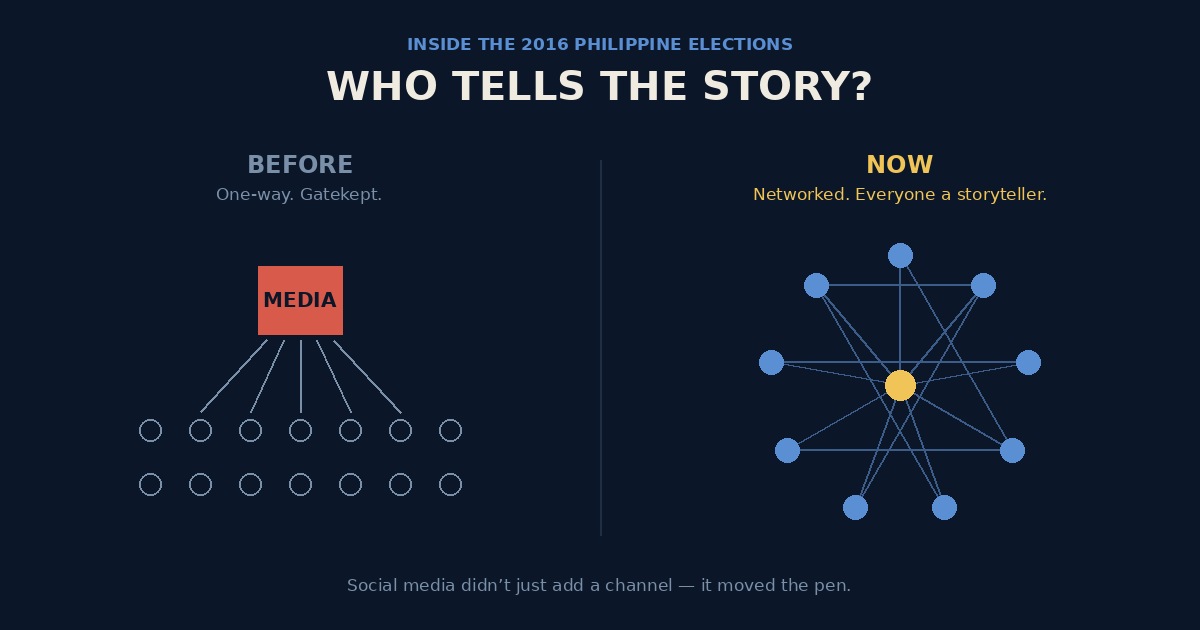
Before the digital explosion, narrative making was a privileged activity. Big media companies—the networks, broadsheets, and radio stations—controlled what the public consumed. Editors decided the news, and journalists told the stories.
Public opinion was shaped by those with the expensive infrastructure to reach millions. If you didn’t own a printing press or a broadcast tower, your voice remained small.
The rest of us were simply the audience. We could write letters to the editor or call radio stations, hoping for a brief moment of participation. However, the true storytelling power stayed with the gatekeepers. We consumed content, but we did not create it.
That era is over.
The Shift in Social Media Storytelling
Social media fundamentally restructured the architecture of public narrative. It gave every Filipino with a smartphone and a Facebook account the tools to become a storyteller. This enabled a massive democratization of media in the Philippines.
Suddenly, individuals could reach national and global audiences instantly. This shift moved the power from centralized institutions to the hands of the people.
This change was more than a technical upgrade; it was a civilizational shift. It altered who gets to tell the story and which perspectives gain prominence in the public square.
The media landscape of the Philippines in 2016 served as the primary stage for this transformation. During the presidential election, we witnessed how social media narrative making in the Philippines could change the course of history.
Implementing a Public Narrative Strategy
In the Duterte campaign, we embraced this new reality early on. We didn’t just push our own messaging. Instead, we encouraged supporters to tell their own stories.
We asked for personal encounters with the Mayor and memories of Davao. We invited people to share their fears about the country and their hopes for the future. We gave them the agency to define what “change” looked like for them.
The response was overwhelming. Authenticity powered the movement through Facebook notes, phone videos, and DIY infographics. Stories flowed in Tagalog, Bisaya, Ilonggo, and Ilocano from every corner of the country and the diaspora.
The “MyDuterte” idea transformed a single campaign into thousands of credible, individual narratives. This level of authentic engagement is something no traditional PR firm could manufacture.
PR and Communications in the Digital Age
Traditional PR relied on narrative control. You crafted a message, trained a spokesperson, and managed the media to ensure only that message reached the public. In the digital age, that model is obsolete.
Today, the focus must shift to narrative cultivation. You cannot control every word said about your brand or campaign. Instead, you must create the conditions for truth and goodness to flourish.
Seed your stories and amplify existing positive voices. By building a community of genuine believers, you create a narrative more powerful than any press release.
The gatekeepers are gone. The storytellers are everyone. The question is whether you have built something worth talking about.
You can no longer manage the narrative entirely. The real question is: Have you built something worth talking about? If you have, give your audience the platform to tell that story for you.
In 2016, we did. The results speak for themselves.
Previously: Post 07 — How to run a national campaign with almost no budget → Next: Post 09 — The MyDuterte story campaign: one idea, thousands of narratives →