Manginhas: The Coastal Foraging Activity of My Youth

I remember manginhas from my youth. It feels like a lifetime has passed since I last did this simple yet rewarding activity. This coastal tradition is deeply rooted in my province’s way of life. For me, manginhas was more than a pastime; it was a direct connection to the sea and its abundance. What is Manginhas? The Riches of the Low Tide Manginhas is the local term for coastal foraging. It involves going to the beach or shallow areas during low tide. We collect exposed marine life entirely by hand. This included various shellfish, small fish, and seaweed left behind by the receding water. I fully enjoyed this activity for many reasons. First, it meant spending a good portion of the day on the beach.

read more   →

My First Exposure to the Media Industry

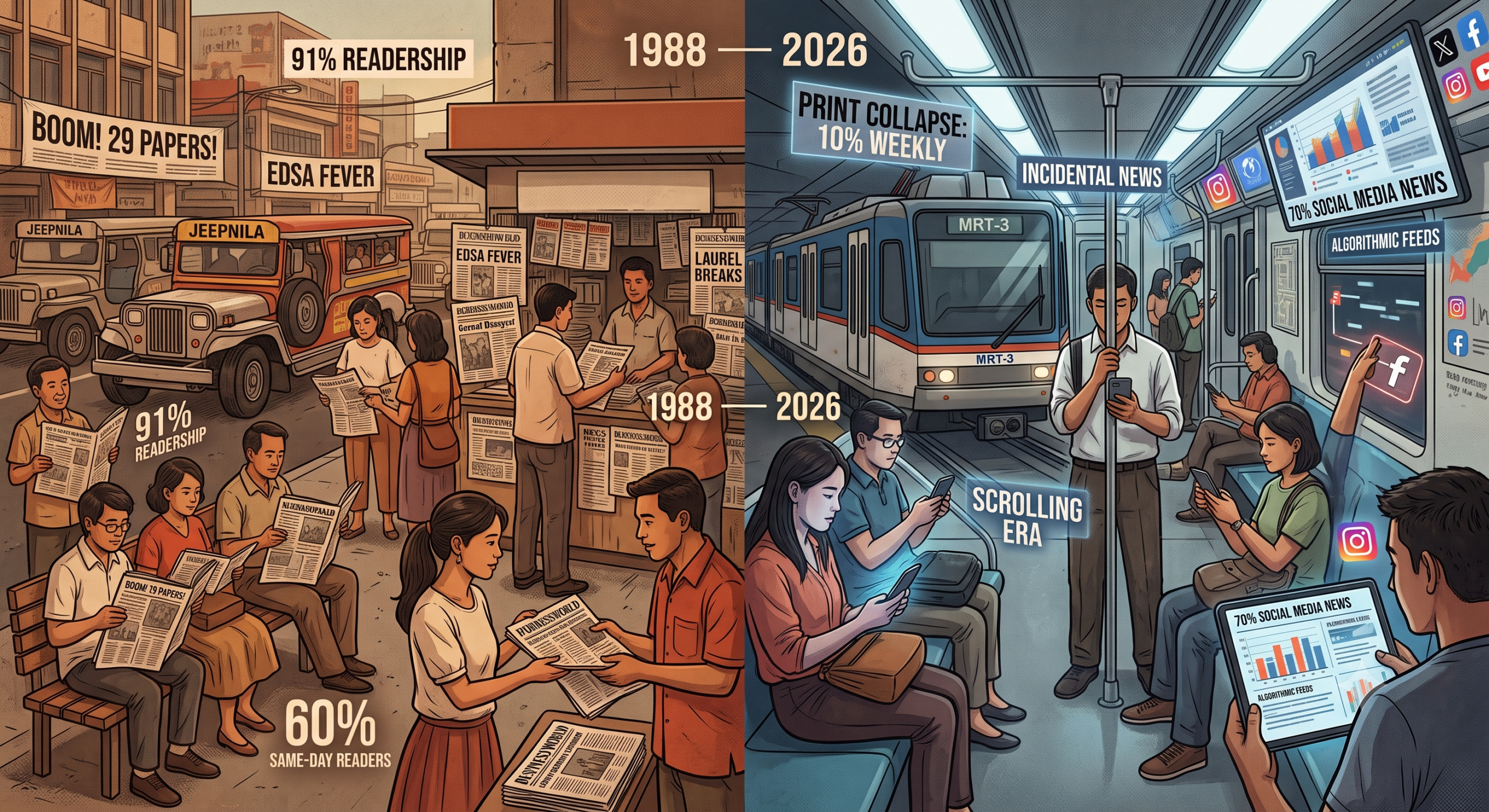
In my youth, back in Padada, I had a lot of odd jobs – specially during the time when Papang was bedridden because of his accident. At that time, we all had to pull our weight. We also had to figure out ways to earn money.  It was during this turbulent time that I had my first exposure to the media industry – specifically, print media. Of all the things I was throughout my life, my first media-adjacent job was as a Newspaper Boy. The late 60’s was a different time. Our town was more than two hours away from the city by bus. As a result, the day’s newspapers arrived at the town’s lone distributor shortly after lunch.  This stall was the only place

read more   →

Martin Romualdez Refuses ‘Scapegoat’ Role in Flood Control Scandal: A Political Rupture

When former House Speaker Ferdinand Martin Romualdez declared that he would “not allow myself to be turned into the scapegoat”, it wasn’t just a denial – it was a signal. “I will not go quietly, and I will not go alone. I will not be the fall guy for other people’s corruption.” This statement signals that this is no longer the quiet investigation into anomalous infrastructure projects. Philippine political scandals tend to follow a pattern: first, the revelations, and then the investigations. Next come the denials, and finally, the narrowing of responsibility to a handful of individuals. Some take the blame, maybe get some time in prison, all’s well that ends well.  But what we are seeing now disrupts that pattern. Escalating Blame Game: Romualdez,

read more   →

Domestic Turbulence: 7 Domestic Crises Unfolding Now

While the world’s eyes remain glued to the escalating US-Israel-Iran conflict, the Philippines is currently weathering its own perfect storm of domestic crises. From high-stakes legal showdowns at the Supreme Court to the dramatic fall of high-profile political figures, and an economy struggling for stability, the headlines at home are exhausting. The global situation is the backdrop, but for Filipinos, these political and economic headwinds have become the main event. Here is a detailed breakdown of the 7 major domestic crises currently unfolding: 1. Supreme Court Legal Showdown: Petitions vs. Unprogrammed Funds The Supreme Court has become a theater of high-stakes legal sparring. At the center of the storm are the petitions questioning the unprogrammed funds in the 2024, 2025, and 2026 national budgets.   During

read more   →

​Navigating the Hike: What the BSP Interest Rate Increase Means for You

Let’s talk about something hitting close to our wallets. The Bangko Sentral ng Pilipinas (BSP) recently hiked interest rates. While “rate hikes” might sound like dry financial jargon, this move directly impacts how we spend, save, and plan for the future. Why the change? ​This move primarily aims to tame inflation. In simpler terms, the BSP is working to stabilize the cost of goods and services, ensuring that the prices of our daily essentials don’t spiral out of control amidst global economic challenges. How does this affect you? ​It’s a balancing act for the economy, and the impact depends on your current financial goals: For Borrowers: If you’re planning to take out a loan for a new home or a car, you may notice higher interest

read more   →

Selling Homegrown Vegetables: A Lesson in Resourcefulness

A Childhood of Resourcefulness  Growing up, money was difficult, and resourcefulness was key to making ends meet in Padada. I often worked odd jobs like shining shoes or selling newspapers. However, one thing I will always be grateful for is that we had a large backyard. This meant we had land  to make the most of. The Value of Fresh, Homegrown Produce In our backyards, we grew vegetables.  We had some malunggay, alugbati, camote tops, okra, and eggplants. These veggies were easy to grow and were our staples.  Whatever we harvested, we cooked and ate. We also share some with our neighbors. That access to fresh produce, literally at our doorstep, is something I definitely miss now that I am living in the metropole. Turning

read more   →

Mangopras: The Backbreaking, But Rewarding, Process of Making Copra

The process of making copra from coconuts, popularly known as mangopras, is a backbreaking process. I know how demanding the work is because I used to do it many years ago, The process of turning the coconut fruit—which is technically a drupe, not a nut—into a sellable product is what we call mangopras. This term mangopras encompasses all the steps involved. The Seven Steps of Copra Production The complete process of turning a coconut into copra involves seven or eight primary, sequential steps: Sungkit (Harvesting): Hooking the coconut from the tree using a panungkit (a long, sectional bamboo pole). Tapok (Gathering): Collecting the fallen coconuts into a heap. Hakot (Transporting): Bringing the gathered coconuts to the processing area, known as the koprasan. Preparasyon (Preparation): This

read more   →

Mananggi – it’s all about Corn, and One Neighbor’s Generosity

  For most Filipinos, the staple food was rice; for us, rice is a luxury. Corn was our staple. In my childhood, pre-1972, we only ate rice during very special occasions, and when we did, it was either lugaw or champorado. Milled corn was our main source of carbohydrates; our only food, in fact, on most days.  I remember our neighbor, Nong Peping, had a plot of corn right behind our neighborhood’s cluster of houses. It was his sister’s land, but he was the one who farmed corn on it. He got ⅔ of the harvest, while his sister got the other ⅓. Nong Peping told us that this sharing was fair, and is actually the standard practice in all landlord-tenant relations.  When the corn

read more   →
To show that on thei HOly Week 2026, we pause to consider the ongoing war in the Middle East.and its unexpected impact on us.

Holy Week Reflections: Finding Empathy Amidst Global Conflict and Rising Prices

The scent of frankincense and the quiet hum of the Pabasa usually define our Holy Week. This year, however, those traditional reflections feel heavier. We pause to consider the ongoing war in the Middle East and its unexpected impact on us. The country traditionally pauses collectively during this time. Traffic softens, businesses slow, and families journey quietly.  Some return to their provinces, others visit churches for Visita Iglesia, and many simply choose stillness at home. Why the Middle East Conflict Hits Close to Home in the Philippines Today, the world’s troubles feel unusually close. The war in the Middle East is more than a distant headline; its shockwaves touch our daily lives. We feel this impact in several ways: News articles show fuel prices rising

read more   →

The Philippine Oil Crisis: Exposed, Unprepared, and Still Without a Long-Term Strategy

  The Philippines is reacting to the global oil shortage, not managing it. The crisis, triggered by the war in the Middle East, exposes how dangerously unprepared the country is. As former Finance Secretary Carlos Dominguez bluntly stated, solving an oil crisis is harder than fighting COVID-19. His quote sums up the difficulty: “you can quarantine a virus, but you cannot quarantine the global oil market.” The government’s current response suggests this is being treated as a temporary disruption, not a structural crisis. Unprepared and Knee-Deep: The Reactive Response The country was caught completely off-guard. Reports show that the Philippines has only about 45 days of fuel reserves. Given that we import nearly all of our oil, mostly from the Middle East, this limited reserve

read more   →