Regulatory Friction in the Philippines: The Hidden Cost of Doing Business

Starting a business in the Philippines is a struggle and one of the biggest reason is regulatory friction. This makes the process more complicated for entrepreneurs. I previously wrote about how corruption discourages Foreign Direct Investments (FDIs) in the Philippines, especially judicial and regulatory corruption. While true, that’s just the surface of a much bigger problem. The reality is that starting and operating a business is a struggle for everyone, including local Filipino entrepreneurs. There’s a massive barrier to entry that most people simply accept as “part of doing business.” For many entrepreneurs, regulatory friction and “SOPs” (which we’ll call bribery or grease money) are normalized as necessary operating costs. Furthermore, this normalization is the true hurdle for the ease of doing business in the

read more   →

The Modern Orwellian Reality: Social Media and the New Big Brother

Redefining “Orwellian”: From Government Surveillance to Social Platforms Traditionally, the term “Orwellian” has referred to a government that controls and monitors every aspect of its citizens’ lives, much like the world depicted in George Orwell’s renowned novel 1984. Many believe this dystopian future is a distant threat, yet we may not realize that this reality is already here—though the threat no longer solely comes from governments. Without much thought, we voluntarily interact with Orwell’s concept of Big Brother every single day. We willingly provide companies with access to our personal data: our locations, actions, and even our thoughts. In return for this constant stream of information, we receive entertainment, memes, instant messaging, and endless cat videos. Even More Powerful than Governments It may sound alarmist,

read more   →

The Structural Consequences of Sara Duterte’s Early Declaration

Introduction After four decades in marketing and PR, observing and participating in campaigns, managing narratives, reading survey data, and watching political cycles rise and collapse, one lesson becomes clear: timing is rarely accidental. Context and Timing On February 18, 2026, Sara Duterte declared her candidacy for president. While the announcement itself was expected, the timing caught many by surprise. Declaring amid an active impeachment effort was not an act of theatrical defiance—it was a deliberate structural repositioning. Political and Structural Shifts In market research, perception frames outcome. In political communications, context determines interpretation. Before her declaration, impeachment could be discussed as a legal matter. After her declaration, it became inseparable from the electoral picture. That shift matters. Once a public official becomes a declared presidential

read more   →

At 25

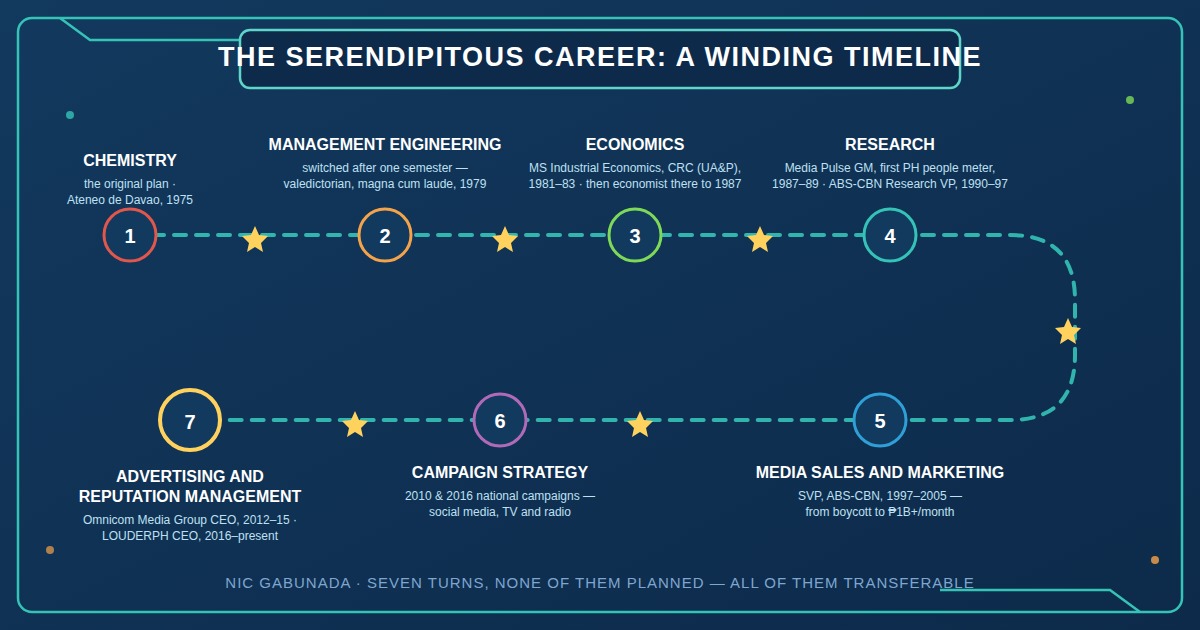
              Today as I turn 67, let me share with you a feature article about me, published in the Business Mirror in December 11, 2016.  The discussions with Roger covered my professional life from the time I joined CRC to the time I left Omnicom Media Group to volunteer in the Duterte presidential campaign. Much has happened after that, and I think I should be writing about it in a separate blog. Roger Pe, a veteran Creative Director, wrote this piece about what I was like around the time when I was 25. We had an initial face to face interview after which he sent me a set of questions via email and asked for a photo of me

read more   →

What Drives Away Foreign Investments in the Philippines

What deters foreign direct investments in the Philippines? I came across this “Investment Climate Statement” of the U.S. Department of State for the Philippines in 2025, and what struck me is this passage that is very disappointing, yet not at all surprising, for anyone who has tried to do business in the Philippines: “Some U.S. investors describe business registration, customs, and immigration processes as burdensome. Customs processes, in particular, can present challenges and the Embassy has received multiple reports from U.S. businesses of overly invasive searches, inconsistent customs charges, and solicitations of “facilitation fees” (e.g., bribes) from some customs officials.” Horrible. But again, not surprising.  This is a reality that most businesses have to deal with in our country. There have been attempts to address

read more   →

The Staggering True Cost of Inflated Public Contracts

Corruption is the single greatest barrier to national progress in the Philippines. The most obvious symptom is the artificially high cost of public infrastructure projects. Taxpayers often pay up to three times the actual value for roads, bridges, and government buildings. While the immediate financial cost is staggering, the hidden, long-term consequences of this systemic corruption are even more devastating to the country’s economic future. The Economic Damage of Inflated Government Contracts Inflated public infrastructure contracts severely damage the entire national economy. Corruption distorts fair market prices and lowers capital efficiency. Projects meant to be long-term assets become expensive liabilities. Many projects are “completed” on paper but quickly fail or deteriorate. This drains government funds without providing real public benefit. This waste is not just

read more   →

Five Decades Later, and the Audience is Still the Product

“If you’re not paying for the product, you’re not the customer – you’re the product being sold.”  This idea is at the heart of the concept known as audience as the product. It’s an old quote, that is often brought up when talking about advertising. One of the earliest instances of this idea is in this 1973 short video by artists Richard Serra and Carlota Fay Schoolman called Television Delivers People.  The video is a critique on popular media as a control tactic, for the benefit of “the mass corporations and those in power”. It’s interesting, because the two artists actually bought some airtime to broadcast this almost 7-minute piece, playing it on the medium it actually criticizes.  The video is just text scrolling on

read more   →

Beyond Theft: The Quiet Corruption of White Elephant Public Spending

Not all corruption involves under-the-table cash envelopes or missing funds. Some of it hides in plain sight – in government projects that are fully-funded, proudly inaugurated, and loudly celebrated. Yet, these projects quietly fail to deliver real value to the public. Economists call these White Elephants. For the purpose of this discussion on public spending and governance, we will use the Merriam-Webster definition of a “property requiring much care and expense and yielding little profit.” According to this extensive blog entry, the term originated from actual white elephants in Southeast Asia. While normal elephants served as beasts of burden, white elephants were sacred to Buddhists—so rare and valuable that only kings could own them.  The problem? Elephants are costly to maintain, and a sacred white

read more   →

May 2026 be the Year our Hopes Catch Up with Reality

After the noise of Media Noche dies down and the plates are cleared, I find it helpful to pause and reflect on the year that was, and to define what I want 2026 to be. This reflection is vital to appreciate the why behind what we do. As we enter 2026, my wishes feel clearer, heavier, and more deliberate than before. On this blog, I spent much of the past year writing about things that frustrated me, worried me, and sometimes kept me up at night. I wrote because staying silent felt wrong. I wrote so future generations could live in a country that values accountability, true public service, and refuses to accept failure or corruption as normal.   One can hope, and should hope,

read more   →

Choosing Hope Together – A Short Christmas Message

As Christmas arrives, I find myself reflecting on 2025. It was a year that tested our patience, our trust in institutions, and sometimes, even our faith in each other as Filipinos. 2025 was a difficult year, marked by scandal after public scandal. The flood control issue, in particular, was painful to watch: billions allocated, yet communities remained submerged, lives disrupted, and livelihoods washed away—with thin explanations and even thinner accountability. This blatant and systemic corruption reminded us how deeply rooted our problems still are, and how costly they have become for ordinary families who simply want safety, dignity, and a fair chance. Yet even amid this turbulence, I found moments that reaffirmed why I write in this space. This blog is where I share what

read more   →