I remember manginhas from my youth. It feels like a lifetime has passed since I last did this simple yet rewarding activity. This coastal tradition is deeply rooted in my province’s way of life. For me, manginhas was more than a pastime; it was a direct connection to the sea and its abundance.
What is Manginhas? The Riches of the Low Tide
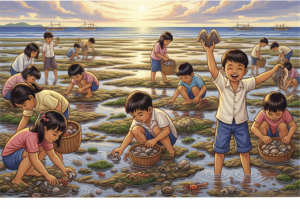
Manginhas is the local term for coastal foraging. It involves going to the beach or shallow areas during low tide. We collect exposed marine life entirely by hand. This included various shellfish, small fish, and seaweed left behind by the receding water. I fully enjoyed this activity for many reasons.
First, it meant spending a good portion of the day on the beach. We would swim in the cool, clear water while waiting for the tide to retreat. Then, under the warm tropical sun, we would wade through the newly exposed mudflats and rocky areas. It was an invigorating break from the ordinary. This activity made me feel truly alive.
The true magic of manginhas was its dual benefit: recreation and sustenance. It was satisfying to know we were foraging for real food while having fun. The marine life we gathered served as viand (the side dish to rice) for our family. Our collection often lasted for several days.
Foraging at the Fish Pond: Pait-Pait and Bagungon
Our foraging grounds sometimes extended beyond the open beach. We often gathered specific shells like pait-pait and bagungon. We found these in the punong (fish pond) owned by the Ilonggos in our town. This created a beneficial arrangement for everyone.
The owners considered these shells pests. They multiplied fast and competed with the juvenile bangus (milkfish) for supplemental feeds. Their presence harmed the fish farm’s profitability.
To us, however, these prolific little shells were a dinner gift. The Ilonggo owners happily allowed us to collect as much as we wanted. The only challenge was carrying the haul during the three-kilometer walk home. This perfectly showed resourcefulness. One person’s pest was transformed into another’s meal.
The Variety of Shore Shellfish
During low tide, the shore was a veritable treasure trove. The variety depended on the specific season. The array of seashells one could find was amazing. We could find litob (a type of clam) and punaw (another bivalve variety). There was also ugpan (tongue shell with a crunchy tail). Many other species could only be identified by locals. You just needed to know where to look. This meant checking sandy patches, coral fragments, or pockets of mud.
On a very good day, with an exceptionally low tide, conditions were perfect. We could easily fill baskets full of our preferred seashells. We favored these natural catches over the pait-pait from the fish ponds. The natural catches offered a richer flavor and greater variety.
Manginhas was much more than a childhood game. Looking back, it was a profound life lesson. It was filled with fun, laughter, sun, and the therapeutic rhythm of waves. Best of all, it gave us the added benefit of feeling useful. We were not just playing; we were actively contributing. We enjoyed a wonderful day and brought home tangible food for the table.
Economically, those were certainly hard times. But they were also fun times. They were characterized by a simplicity and self-reliance rare in today’s world. This experience proves that people in the province never go hungry. They simply need to possess the fundamental quality of resourcefulness. The sea always provided. We were taught to ask for its blessing through our own hard work.
Email: nicgabjr@gmail.com X: @nicgabunada.com