
Series: Game of Titos and Titas - Part 2
Key Takeaways
- Birus is hide-and-seek escalated — played in teams, and finding someone isn’t enough
- You have to chase them, tag them, then sprint back to base and call it out before the catch counts
- It was a full-moon game, and the reason is more practical than mystical
- It has largely died out because it needs three things that are now hard to assemble: open space, a crowd of children, and an entire free evening
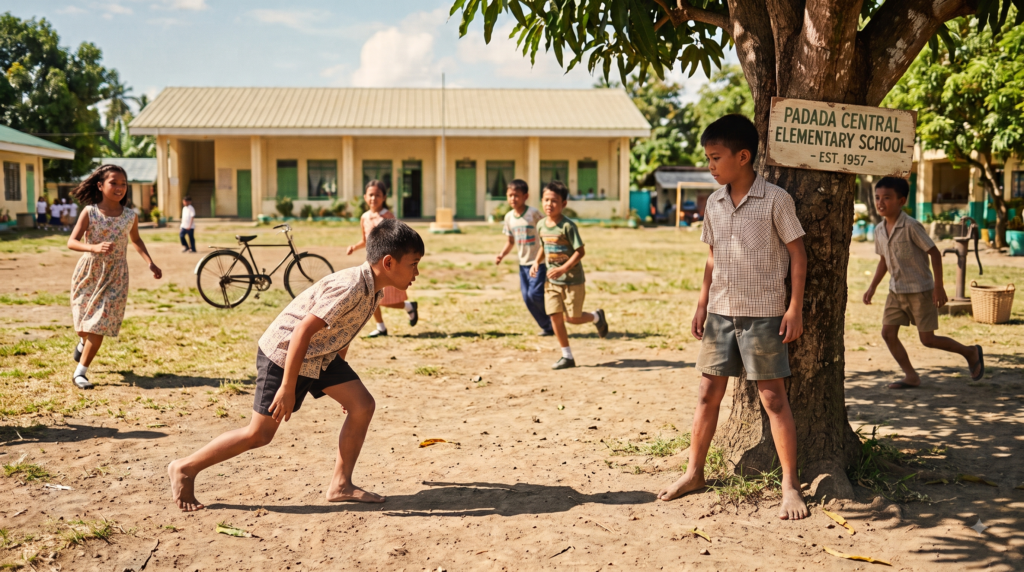
Everyone has played hide and seek. Very few can say they’ve played birus.
Birus takes the ordinary childhood game and adds teams, tagging, a sprint back to base, and a running time measured in hours rather than minutes. Winning takes stealth, speed, and endurance in roughly equal measure.
It is the extreme cousin of hide and seek, and I have rarely heard of it being played outside Mindanao.
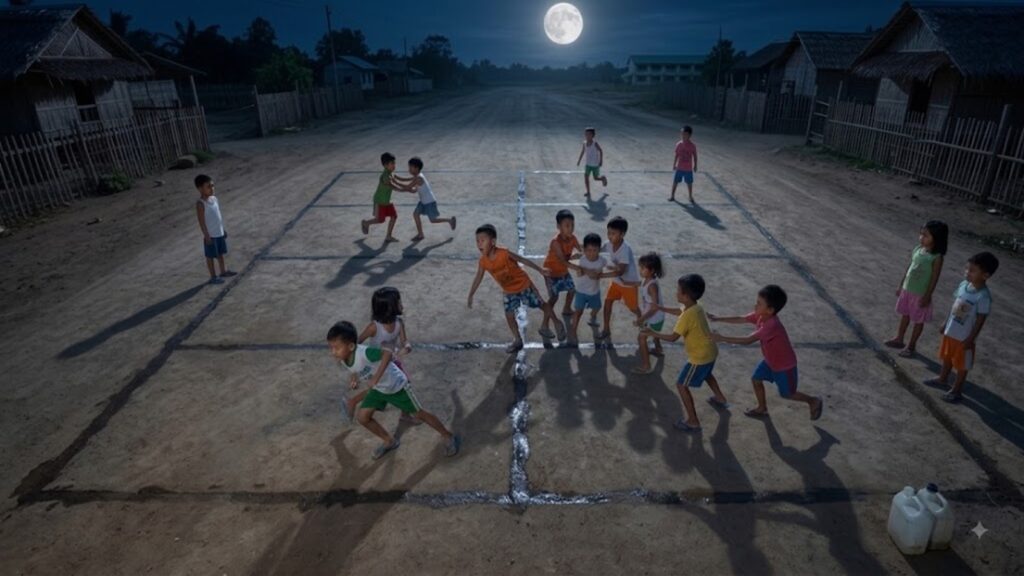
Played by the full moon
For reasons I have never heard properly explained, birus was a full-moon game.
The practical theory is that darkness makes it easier to hide. But we played it in the afternoon too, and it worked perfectly well — so I suspect the real answer is simpler. A full moon in a province without much electric light is bright enough to run in. And a night bright enough to run in is not a night you spend indoors.
The moon gave you permission.
What you need
- A wide field, or a neighbourhood with plenty of corners
- Two teams
- One agreed base
- Ideally, a full moon
Three things that make birus harder than hide and seek
It’s a team game. In hide and seek there is one “it.” In birus, an entire team is “it” while the other team hides.
Finding isn’t enough. Spotting an opponent gains you nothing. You have to chase them down and tag them.
And you have to get home. After tagging, the catcher runs back to base and calls out “(name) birus save.” Only then does the catch count.
That last rule is what transforms the game. The chase doesn’t end at contact — it ends at the base. Which means a tagged player is not out until you have also outrun the distance back, and every single catch costs you a full sprint.
How to play birus
1. Form two teams and agree on a base.
2. The seeking team closes their eyes and counts while the hiding team scatters.
3. Hunt. The seekers spread out to find opponents. Finding is the easy part.
4. Chase and tag. A found player runs. The seeker has to catch them.
5. Run back and call it. The seeker sprints to base and shouts “(name) birus save.” The tag is now official.
6. Repeat until every hider has been caught and called in.
7. Switch. Only when all hiders are accounted for do the teams trade roles.
Why nobody plays it anymore
Birus takes time. A single full round runs several minutes at best, and often the better part of an hour.
Hiders are easy to find and hard to catch. On a wide field with big teams, one determined runner can keep three seekers occupied for a very long while — and every successful tag still costs that sprint back to base.
That’s the problem. Birus needs a large open space, a large number of children, and an entire evening with nothing else claiming it.
Those three things used to be ordinary. Getting all three lined up on the same night is now nearly impossible.
It is tremendous fun. It simply requires a kind of unstructured time that has mostly stopped existing.
What does birus mean?
I should be honest: I don’t know.
That was simply the word. We shouted it a hundred times a night — “(name) birus save” — and in all those years it never once occurred to me, or to anybody else as far as I can remember, to ask what it meant or where it came from. It was the name of the game the way the sky was the sky.
That is how these things travel. A child doesn’t need a word to mean something. He needs it to work. You pick it up from whoever is already playing, you use it correctly, and you hand it on without ever opening it up to see what’s inside.
It’s also how a word like this disappears. There is nobody left who was told, because nobody thought to ask.
If you know, I would like to hear it.
Frequently asked questions
What is birus? A Filipino team-based variant of hide and seek, played mainly in Mindanao. Seekers must find, chase, and tag opponents, then return to base and call the tagged player’s name for the catch to count.
How is birus different from hide and seek? Three ways: it’s played in teams rather than one-against-all, tagging is required rather than just finding, and the tagger must run back to base and announce the catch before it counts.
Why is birus played during a full moon? Tradition mostly, plus practicality — moonlight in a province with little electric lighting is bright enough to run and hide by. It plays perfectly well in daylight.
What does the word birus mean? I don’t know, and I never found out. It was the name we used and the word we shouted, and none of us thought to ask where it came from. If you know its origin, I’d be glad to hear it.
How long does a game of birus last? Anywhere from several minutes to about an hour, depending on the size of the field and the number of players.
For the bona fide titos and titas out there — did you play birus in your youth? Was it called something else where you grew up, with a different set of rules? Tell me in the comments, or drop a note at nicgabjr@gmail.com
Game of Titos and Titas — the full series
- Lastiko: The Filipino Rubber Band Games We Played as Kids
- Birus: The Filipino Hide-and-Seek Played by Moonlight (you are here)
- Holen: How to Play the Filipino Marble Game
- Syatong: How to Play the Filipino Stick Game
- Jackstone: The Game of Skill and Flair