For most Filipinos, the staple food was rice; for us, rice is a luxury.
Corn was our staple. In my childhood, pre-1972, we only ate rice during very special occasions, and when we did, it was either lugaw or champorado. Milled corn was our main source of carbohydrates; our only food, in fact, on most days.
I remember our neighbor, Nong Peping, had a plot of corn right behind our neighborhood’s cluster of houses. It was his sister’s land, but he was the one who farmed corn on it. He got ⅔ of the harvest, while his sister got the other ⅓. Nong Peping told us that this sharing was fair, and is actually the standard practice in all landlord-tenant relations.
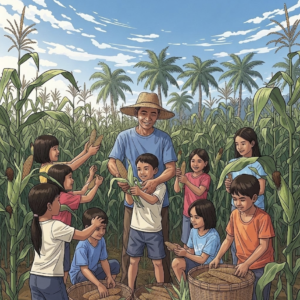
When the corn was ready for harvest, he picked out several rows of corn and called out to us neighborhood kids to help him harvest it.
It was a fun task helping out Nong Peping – we took out the ears of corn, gathered them in piles, and brought them to a central area under his house. We then counted how many bukag or baskets of corn we gathered. We got one bukag for every ten harvested. Not a bad sharing scheme at all, considering we all had fun doing it.
After the harvest, Nong Peping would cut down the remaining stalks, keeping some for this carabao to eat in the next few days, and burning the rest. However, before he does that, he encourages us kids to make hagdaw – basically, go through the fields again and check if there are ears of corn that were left unharvested, or have fallen to the ground. Whatever we gather, we get to keep.
Once we have our bukag, we bring it home and start processing the corn. We strip the outer cover and expose the actual corn. We then let these dry out for a few days.
Once dried, we start taking out kernels from the ears – a process we call lobo. It’s very labor-intensive, and blisters on the hands are normal whenever we do this. We dry the kernels some more, and bring them to the miller.
I’m grateful to Nong Peping, as he was generous enough to share his harvest with us, so we had food on the table.