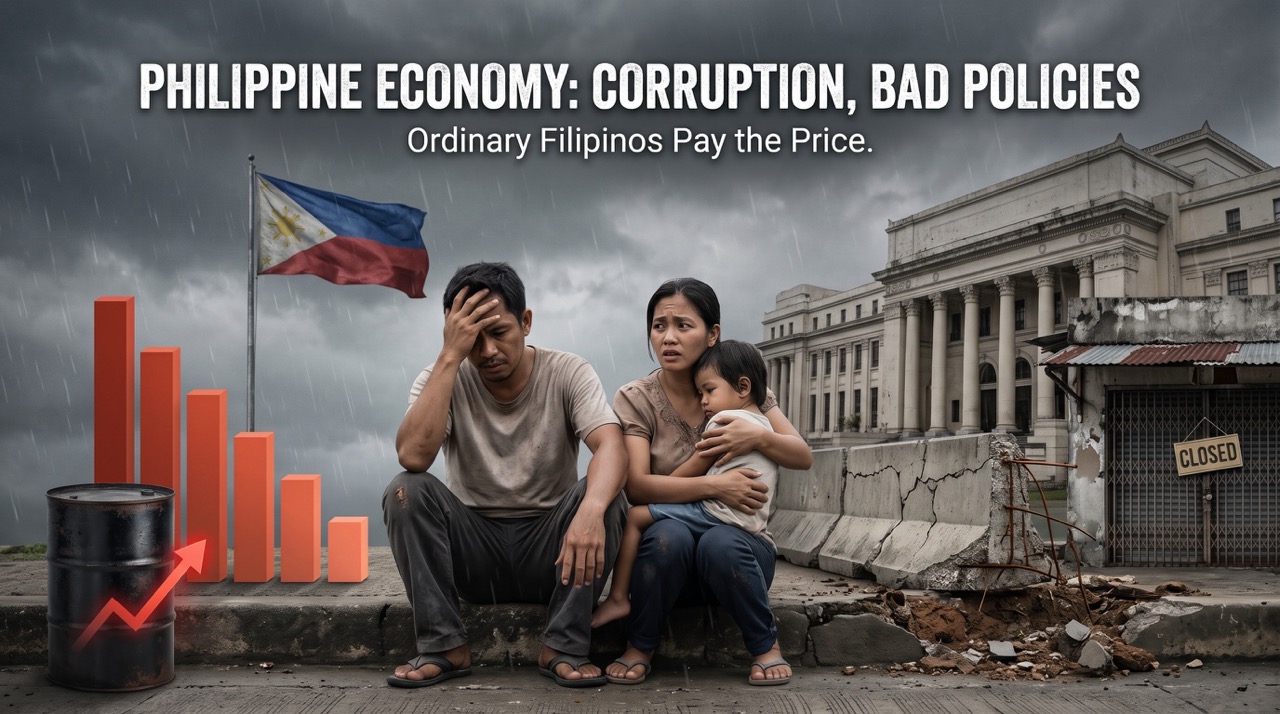
Philippine Economy: Corruption, Bad Policies, and the Price Ordinary Filipinos Pay
In September, ABS-CBN announced it would retrench about 200 employees, or 7% of its workforce. Two months earlier, about 800 workers at San Miguel Integrated Logistics Services were reportedly placed on floating status. That means they still have a job on paper, but no work and no assured pay.
Meanwhile, Sunday Punch has reported small business owners closing stores, salons, and restaurants they had run for years.
Something is seriously wrong with the Philippine economy. The government blames the Middle East conflict and high oil prices. That is true, and I wrote earlier about how unprepared we were for the oil crisis. But it is only half the story. The other half is corruption and bad policies here at home.
What the Philippine Economy Numbers Say
The latest figures from the Philippine Statistics Authority are hard to read calmly:
- Growth: The economy grew only 2.1% in the third quarter of 2026, down from 4.0% a year earlier. Compared with the previous quarter, it grew just 0.1%. In plain terms, it barely moved.
- Prices: Inflation hit 7.8% in October, up from 1.7% a year ago. Transport costs jumped 20.1%. Housing, water, electricity, and fuel rose 9.3%.
- Jobs: Unemployment reached 5.4% in September, up from 3.8%. That is about 2.86 million Filipinos without work.
- Underemployment: Another 5.56 million have jobs but need more hours or more income.
So the pamasahe costs more, the electric bill is higher, and the sweldo buys less. Even those with jobs are not earning enough.
Corruption Is Not a Victimless Crime
The flood control scandal showed us where much of our money went. I have been keeping notes on the economic effects of corruption in the Philippines since the scandal broke, and the picture has only become worse.
Flood control projects are supposed to protect homes, shops, and livelihoods. However, a 2026 OECD assessment, citing a University of the Philippines policy brief, discusses irregularities in flood control projects worth more than ₱545 billion since 2022. The allegations include projects that do not exist, projects that were poorly built, and contracts that kept going to the same few firms.
The same assessment cites estimates that corruption drains ₱42 billion to ₱118 billion from flood control spending every year. These are estimates, not final audited figures. Still, the scale is staggering.
The harm does not stop with the missing money. When contracts go to the well-connected, honest contractors lose. It is the same padrino system I described in my post on nepotism and political patronage. The dike never gets built properly. And investors learn not to trust us.
The World Bank said as much in August 2026. It found that policy uncertainty was holding back business investment, private-sector confidence, and foreign investment. When investors stay away, the factories, offices, and jobs they would have brought stay away too.
A crooked contract may enrich a few people. Millions pay for it.
Bad Policies Made It Worse
Corruption is only part of the problem. How the government responded also hurt us.
After the scandal, agencies slowed down the checking, bidding, and payment of projects. Some caution was necessary. Nobody wants questionable projects to continue. But caution turned into paralysis. Public construction fell 15.1% in the third quarter, its sixth straight quarter of decline.
When public works stop, the pain spreads. Construction workers, suppliers, truckers, and nearby stores all lose income.
On top of that, the 2026 national budget was passed and released late. Economic Planning Secretary Arsenio Balisacan himself acknowledged that these delays hurt the economy. The budget is also where the leaks begin, as I explained in my post on the real cost of pork barrel.
We need a government that can do two things at once: guard public money and spend it well. Spending well also means no more white elephant projects that cost much and deliver little. Right now, it is failing at both.
We Buy More Than We Make
There is a deeper weakness too. For years, our growth has leaned on three things: household spending, remittances from OFWs, and services such as BPOs. These matter. However, they cannot replace farms and factories that produce what we need.
The third-quarter figures show the gap:
- Agriculture shrank 4.8%.
- Industry was flat, down 0.003%.
- Services grew 3.7%.
- Household spending grew only 2.4%.
- Investment fell 0.2%.
Because we produce too little, we import too much. As a result, every jump in world oil prices hits our fares, our food, and our electric bills. The World Bank has also pointed out that our high electricity costs hurt both businesses and households.
Other countries face the same oil prices. The difference is how prepared they are. We cannot control a war in the Middle East. We can control how we govern ourselves.
What Must Change
I would start with six things:
- Punish the corrupt. Hearings are not enough. File cases where the evidence supports them, whoever is involved.
- Get public works moving again. Check projects carefully, but finish the checking and build.
- Invest in farms and factories. Better irrigation, storage, and roads bring down food prices and create jobs.
- Help small businesses survive. Simplify the rules, open up financing, and bring down the cost of power and logistics.
- Protect workers. Enforce the law on retrenchment, floating status, and separation pay. Link retraining to real job openings.
- Earn back trust. Investors and citizens believe results, not press releases.
The Bottom Line
The Philippines still has what it takes: a young workforce, a large market, and people who know how to hustle.
However, the cost of bad governance always lands on those who did nothing to cause it. They are the employees holding retrenchment notices. They are the owners closing shops they spent years building. They are the families stretching every sweldo. They are the young graduates who cannot find decent work. And they are the taxpayers whose money was supposed to build something.
Corruption is not a victimless crime. Bad policy is not just a mistake on paper. Both are measured in lost jobs and smaller lives.
Kaya dapat tayong maningil. We should demand accountability and real reform now, before more businesses close and more families run out of lifelines.