The Sara Duterte Impeachment Trial: A Mid-Game Rule Change and Why Due Process Still Matters
Commentary as of November 15, 2026
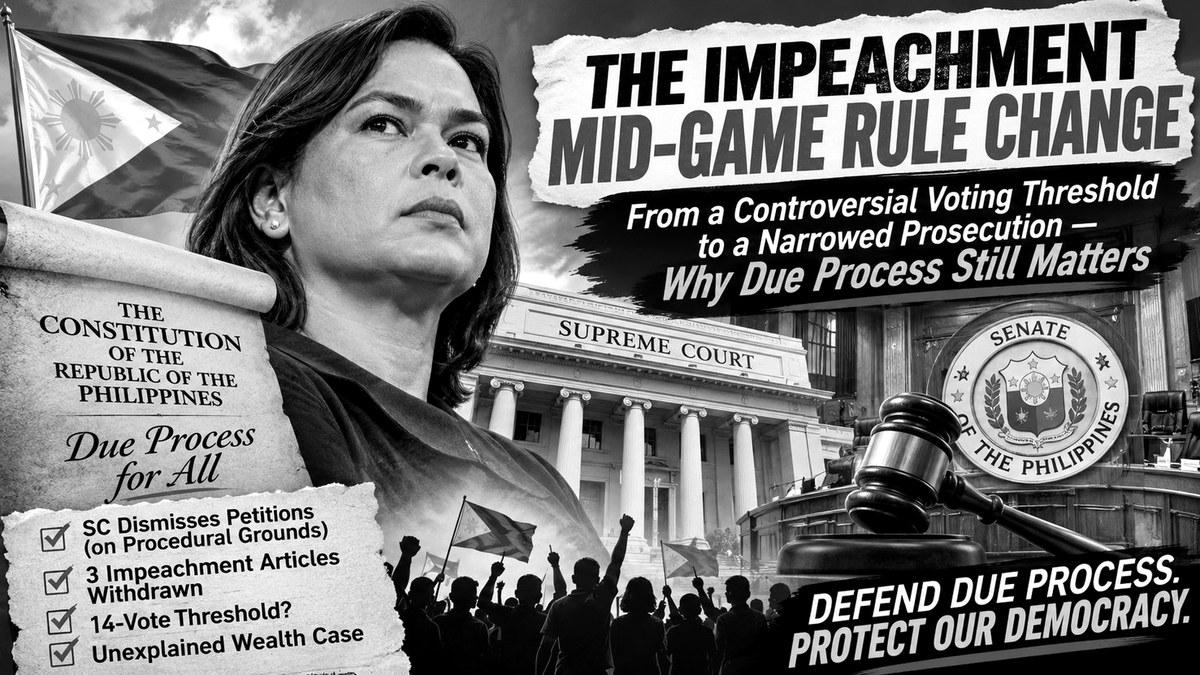
The Sara Duterte impeachment trial has entered a new phase. In late September, the story was the Senate’s new reading of the two-thirds rule. The Supreme Court then declined to step in.
Six weeks later, the story is bigger. The prosecution has dropped three of its four charges. The case now rests on a single article: alleged unexplained wealth. And the Vice President’s lawyers have begun presenting her defense.
My question has not changed. Can a trial be fair when the rules for conviction are reinterpreted midway, and the prosecution then narrows its case after months of hearings?
I believe that question matters more now, not less.
Where the Sara Duterte impeachment trial stands
Here is the timeline that matters:
- September 23. The Senate impeachment court voted 13-1 to count only senators who are “legally and actually able” to take part. With 20 senator-judges counted, conviction now needs 14 votes instead of 16.
- September 30. The Supreme Court dismissed three petitions against that ruling on procedural grounds.
- October 13. House prosecutors withdrew Articles I, III and IV. Only Article II remains.
- November 6. The court admitted most of the prosecution’s financial records and restored the gag rule on all four articles.
- November 9 to 12. The defense presented six witnesses in four hearing days.
- November 19. The trial resumes after the ASEAN Summit.
The two-thirds vote: the math changed, the question did not
The Constitution says no one shall be convicted without the concurrence of “two-thirds of all the Members of the Senate.” For most of this trial, everyone read that as 16 of 24.
In August, the court’s own spokesman, Atty. Regie Tongol, warned against touching that number while the trial was running. As he put it: “Hindi na natin pwedeng gawin ngayong mid-game.”
A month later, the court did exactly that. Thirteen senator-judges voted for the new reading. Presiding Officer Chiz Escudero voted against it, and six did not take part.
This is not just arithmetic. Does “all the Members” mean the 24 seats the Constitution created? Or only the senators available for one particular trial? In a divided Senate, two votes can decide the fate of an elected Vice President.
Then came the Supreme Court. It dismissed the petitions for lack of standing and prematurity. However, it did not rule on the merits. It never said the Senate’s reading was correct.
That distinction matters. A procedural dismissal is not a judicial blessing. The 14-vote rule governs this trial for now, but the constitutional debate remains open.
The issue is also bigger than Sara Duterte. The same rule will apply to future presidents, vice presidents and Supreme Court justices.
Three charges withdrawn after 38 trial days
On October 13, the prosecution dropped three of its four articles:
- Article I: alleged misuse of confidential funds.
- Article III: alleged bribery.
- Article IV: alleged grave threats against President Marcos, the First Lady and former Speaker Martin Romualdez.
The court granted the withdrawal. According to the Manila Bulletin, Articles I and IV were dropped with prejudice and Article III without prejudice.
The prosecution’s reason was simple. Lead prosecutor Rep. Gerville Luistro said Article II is strong enough to stand alone.
Fair enough. Prosecutors may choose their case. Still, the timing raises honest questions.
Why spend 38 trial days and dozens of witnesses on charges you will abandon? Lead defense counsel Sheila Sison raised that point in court. She also warned that the Vice President can no longer rebut allegations the senator-judges have already heard.
That concern deserves serious thought. I wrote about the right to a complete defense when the charges were dropped. To be clear, the withdrawal does not prove the charges were false. Nor does it prove bad faith. But the public deserves to know what changed, and why.
The ₱817 million question: evidence must be tested
The entire case now rests on money.
Forensic analyst Alexander Cabrera estimated ₱817.87 million in alleged unexplained wealth. The figure covers the Vice President and her husband, lawyer Manases Carpio, from 2022 to 2025. The defense disputes it.
Remember what that number is. It is the estimate of a prosecution expert. It is not a finding of the court.
On November 6, the court admitted a long list of records:
- Statements of Assets, Liabilities and Net Worth (SALNs).
- Bureau of Internal Revenue records.
- Anti-Money Laundering Council records.
- Securities and Exchange Commission documents.
- Financial records from nine banks.
- Land titles, insurance and investment records.
The court also set limits. Records from 2007 to 2021 may only establish a financial baseline. Documents tied to the withdrawn charges were excluded.
More importantly, the court’s spokesman said admission does not mean the allegations are true. Even the prosecution’s private counsel agreed that admissibility and probative value are different things.
That is the heart of due process. Evidence must be authenticated, explained and cross-examined before it can justify a verdict.
A discrepancy is not automatically corruption. A business link is not automatically an unlawful interest. And a large number, however alarming, must come with a credible computation.
But the burden cuts both ways. The defense cannot simply cry political persecution. It must answer documents with documents.
The defense’s challenge: witnesses and credibility
The defense is led by Atty. Sheila Sison, with Atty. Michael Poa as counsel. It first listed 24 witnesses.
By November 12, it had presented six witnesses over four hearing days. Sison told the court that eight to ten more would follow.
Meanwhile, the defense dropped every bank official on its list, 16 by most counts. That included a Bank of the Philippine Islands executive. Prosecutors had wanted to question him about alleged dollar accounts.
Here is the uncomfortable part. VERA Files observed that the first six witnesses never directly confronted the ₱817 million estimate.
So the remaining witnesses matter a great deal. The goal is not to fill a witness list. The goal is a coherent, verifiable account of the family’s finances.
The gag rule and the public’s right to know
When the three articles were dropped, the court lifted the sub judice rule on them. On November 6, it reversed course. The restriction under Rule XVIII now covers all four articles again.
In fairness, the Vice President herself told the court on November 4 that she was not waiving the rule’s protection.
Still, an impeachment trial is not an ordinary criminal case. It is a constitutional process about a nationally elected official. Protecting the trial and confidential bank data is legitimate. So is the public’s right to understand how its officials are being judged.
Transparency and fairness must go together.
What happens next
The trial resumes on November 19 and 20, after the ASEAN Summit.
The prosecution says it sees no need for more witnesses or rebuttal evidence for now. Its lead prosecutor hopes to finish the trial by year-end.
A conviction would remove Duterte from office and bar her from holding public office. That would end her plan to run for president in 2028.
Nothing is certain. Fourteen votes are easier to reach than 16. Securing them is another matter entirely.
What the defense must do now
The battle has changed. The Supreme Court route gave no immediate relief. Therefore, the defense must now win on evidence while keeping its constitutional objections alive. I see five priorities:
- Preserve the threshold objection. Put it on record at every stage. A procedural dismissal did not settle the issue.
- Dismantle the ₱817 million narrative. Challenge the method. Show where the assets came from. Expose any error in attribution, valuation or accounting.
- Demand consistency from the prosecution. Ask why charges that filled 38 trial days were abandoned.
- Protect the right to a meaningful defense. Speed must never become an excuse for denying a fair hearing.
- Build the record. Preserve every objection and ruling. Any later court challenge must rest on a real constitutional injury, not merely an unfavorable verdict.
In short, the defense must win the argument on evidence, not on rhetoric.
A dangerous precedent for Philippine democracy
Impeachment is a legitimate constitutional tool. Public officials must answer for their conduct. No one is above the law.
But accountability cannot become a license to abandon due process. The Constitution does not allow anyone to decide guilt first and work backward.
Nor should popularity set the standard of fairness. The rules must be the same for officials we like and officials we oppose.
There are legitimate questions on both sides. The prosecution has the right to present evidence. The Vice President has the right to defend herself. The senator-judges have the duty to decide impartially.
A fair impeachment trial is not one that guarantees acquittal. It is one that guarantees fairness, whatever the outcome.
Stand up for due process
This is no longer only about one Vice President. It is about the safeguards that protect every Filipino from the arbitrary use of political power.
Whether you support Sara Duterte or oppose her, here is what you can do:
- Demand transparency. Follow the actual proceedings, not just the headlines.
- Hold senators accountable. Ask your senator-judges to explain their reading of the Constitution.
- Separate allegations from established facts. Do not swallow the prosecution’s claims or the defense’s denials whole.
- Defend constitutional safeguards. Insist that impeachment rules be applied consistently.
- Participate responsibly. Share verified information, whichever camp it helps.
The trial is still unfolding. The real test is whether the Senate can show that its verdict rests on the Constitution, credible evidence and impartial judgment.
We must never allow the pursuit of accountability to become an excuse for sacrificing due process.
The Constitution must protect everyone, including those we disagree with. That is what separates a constitutional democracy from government by political expediency.
The question Filipinos must ask
Can this trial remain fair when the voting threshold was reinterpreted midway, three of four charges were withdrawn after months of hearings, and the remaining case leans on a disputed computation?
Should the Supreme Court revisit the Senate’s voting rule when a proper case arrives?
I welcome your thoughts. Let’s keep the debate on due process and the rule of law.
Share this article if you believe that no political objective is more important than the Constitution.
#ProtectTheConstitution #DueProcess #RuleOfLaw #SaraDuterte #PhilippineDemocracy