Series: Game of Titos and Titas - Part 7
Key Takeaways
- A kasing is a spinning top, and you made your own — guava or camachile, shaped with a bolo and finished with a shard of broken glass
- The nail was sharpened differently depending on what the top was for: a point for fighting, a blunter tip for spinning
- Most of us kept two tops, one to fight with and one for show, because the wood that survives a blow isn’t the wood that looks best
- The string was the only part anybody bought — everything else was found, cut, salvaged or given
- A kasing took about two weeks of afternoons, and nobody taught you: you learned by watching the older boys carve theirs
- It is the only game we played where the winner takes nothing. You don’t gain his top. You just ruin it.
Every other game in this series is played with something you found, won, or already had.
Rubber bands you won off your friends. Marbles you won or lost. A tin can out of the rubbish, a stick cut from anywhere, ten metal jackstones from the sari-sari store.
The kasing (Bisaya for Trumpo) was different. You made it. And before anybody spun anything, you were already being judged on how well you had made it.
Making a kasing
1. Decide the size. This is the first decision and it shapes everything after. A bigger top carries more mass into a hit; a smaller one is quicker to get spinning and easier to control.
2. Find your wood. Guava or camachile. Both are dense, both grow in somebody’s yard, and neither costs anything — provided you know where the tree is and get there first.
They are not interchangeable, and we argued about it constantly. Camachile is harder and takes a blow better. Guava is finer-grained and easier to work, so it carves cleaner and holds a better shape.
Which is to say the wood that survives a fight is not the wood that looks best. We had no words for grain or density. We just knew, and we disagreed loudly.
3. Cut a branch of roughly the right size, and start shaping.
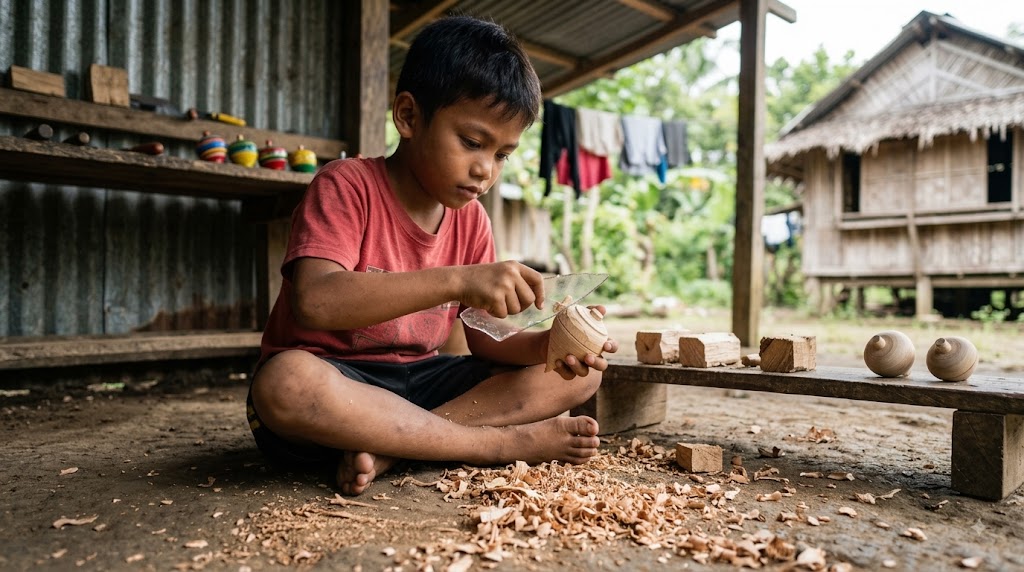
4. Rough it out with a knife or a bolo. Get the cone. This is the crude stage, and it goes quickly.
5. Refine it with broken glass. A shard held at an angle, drawn along the wood, takes a fine curl off and leaves a surface a blade cannot. Sandpaper would have been better. We very rarely had sandpaper.
This is the part I would want anyone reading to sit with. A piece of a broken bottle, which is rubbish and also a hazard, is a genuinely excellent wood-finishing tool. Somebody worked that out, and then every boy in the barrio knew it, and none of us thought it remarkable.
6. Set the nail into the body. The right size for the top — too heavy and it will not spin, too light and it will not bite.
Nails came from whatever was lying about the house, or from a friend who had a spare. Nobody bought a nail for a kasing.
7. Sharpen the nail for the job. Here is where the top becomes one thing or another. A fighting kasing wants a sharp point, to catch and dig into whatever it lands on. A spinning kasing wants a blunter tip, which holds a long, steady, humming spin.
The same top cannot do both. Which is why most of us kept two.
8. Paint it, if there is paint. Usually there was not.
The one thing we bought
The string came from the Chinese merchandise store in the market. It was the only part of a kasing anybody paid for.
Everything else was found, cut, salvaged or given. The wood grew in a yard. The nail came out of the house or off a friend. The bolo was already in the kitchen and the glass was already broken. And then, at the end of all that scrounging, you walked to the market and bought a length of cord.
I like that the one purchased component is the one you cannot improvise. You can find wood, you can find a nail, you can finish a curve with a bottle shard. You cannot make string.
Two weeks, in between everything else
A kasing took about two weeks to make.
Not two weeks of work — two weeks of elapsed time, because you worked on it between classes and on weekends, in the gaps left over after chores. A little shaping after school. A little more on Saturday. Back to it the following weekend.
Nobody was in a hurry, and there was nothing else to spend the time on.
Nobody taught us
Here is the part I find most striking now, looking back.
No adult taught me to make a kasing. There was no lesson, no father sitting me down with a bolo, no shop class. We learned by watching the older boys carve theirs — sitting near them while they worked, seeing where the blade went, and listening while they explained how to do it properly.
That was the whole system. Older boys carved, younger boys watched, and in time the younger boys were the older boys and somebody was watching them.
It is the answer to a question this series keeps circling. How did any of this survive? Not through books, and not through parents. Through a nine-year-old sitting on his heels beside a twelve-year-old, being told he was holding the glass at the wrong angle.
And it is also the answer to why it is disappearing. The knowledge did not live in anybody’s head so much as in the arrangement — the older boys, the younger boys, the free afternoon, the same yard. Take away the arrangement and the knowledge has nowhere to sit.
Why every boy kept two
The fighting top was expendable. It was expected to come home marked, and eventually to come home in pieces.
The show top was never risked. That one you spun for its own sake, and for other people to look at.
Nobody sat down and reasoned this out. We just found ourselves making two, and the reason is that the game asked two different questions and no single object could answer both. You cannot optimise for surviving a strike and for looking beautiful while humming on a flat stone. So we stopped trying, and specialised.
I have run into that problem many times since, in work that had nothing to do with wood.
How the fighting worked
There was no fixed format. We simply agreed on one before we started, the way we agreed on everything else.
The duel. One player spins his top. The other throws his down onto it, trying to strike it. Then they change places.
The circle. Tops are placed inside a drawn circle. The opponent spins his own top into the ring, trying to hit them.
If the second one sounds familiar, it should. It is the holen ring exactly — a pot in the middle, a shooter thrown in from outside. Different game, different objects, same architecture. I do not think anybody designed that. It is just a shape children keep arriving at.
What the winner wins
Nothing.
This is what makes kasing different from everything else in this series, and it took me a long time to notice.
Lose at lastiko and your rubber bands go to somebody else. Lose at holen and he takes your marbles. Even the syatong punishment gives the winners a spectacle to enjoy. Something changes hands. Somebody is up.
At kasing, nothing transfers. The winner does not take the loser’s top — by then it is split, or pocked with holes, or simply too ugly to want. The wood you chose, the hours with the bolo, the shard of glass, the paint if you were lucky: gone, and gone into nobody’s hands.
You do not gain. He simply loses.
I do not know what to make of that entirely, except that it was the only game we played where the point was destruction rather than acquisition, and it was also the game that asked the most of you before you could even play. Two weeks of afternoons, and a bought length of string, to make the thing another boy could ruin in a second.
We queued up for it.
And it never had a name
I cannot recall what we called the fighting game. Not the top — the top is the kasing. The contest itself had no name that I can remember. We just agreed to do it.
Nor was there a word for a top that came out of it split, or deformed, or riddled with holes. A fumbled round of jackstone gets you called baboy. A bantay who cannot escape gets called baboy. But a ruined kasing was simply a ruined kasing, and nobody needed to say anything about it.
That keeps happening in these posts. The syatong punishment had no name. Birus had no meaning anyone could explain. Children name what they have to shout across a field, and nothing else — and there is nothing to shout when a boy is standing over two halves of a thing he spent a fortnight on.
Frequently asked questions
What is a kasing? Kasing is the Bisaya word for a spinning top, known as trumpo in Tagalog. Traditionally it was hand-carved from hard wood with a nail set into the base as the spinning tip.
What wood is used for a kasing? Guava and camachile were the popular choices — both dense hardwoods. Camachile takes a blow better; guava carves cleaner and holds a finer shape.
How do you make a kasing? Cut a branch of guava or camachile to the size you want, rough out a cone shape with a knife or bolo, refine the surface with a shard of broken glass, then set and sharpen a nail into the base. Paint it if paint is available.
Why sharpen the nail differently? A sharp point is for fighting, so the top bites into whatever it strikes. A blunter tip gives a longer, steadier spin. Because one top can’t do both well, players often kept two.
How long does it take to make a kasing? About two weeks — not of continuous work, but of elapsed time, since it was done in the gaps between classes, chores and weekends.
How did children learn to make a kasing? By watching. Older boys carved their tops where younger ones could see, and explained the technique as they worked. There was no adult instruction and nothing written down.
Does the winner take the loser’s kasing? No. Unlike marbles or rubber bands, nothing changes hands — the losing top is split or badly marked, and nobody wants it.
For the bona fide titos and titas out there — did you make your own kasing? What wood did you swear by, and what did you call the fighting game? Tell me in the comments. I’ve never been able to remember its name.
_________________________________________________________________________________________________________________
Game of Titos and Titas — the full series
- Lastiko: The Filipino Rubber Band Games We Played as Kids
- Birus: The Filipino Hide-and-Seek Played by Moonlight
- Holen: How to Play the Filipino Marble Game
- Syatong: How to Play the Filipino Stick Game
- Jackstone: The Game of Skill and Flair
- Tumba Lata: What We Called Tumbang Preso Back Home
- Tubig-Tubig: The Game We Drew With Water
- Tigso: The Golden Hour of Our Lunch Breaks
- Takyan: The Sound of Our School Courtyards
- Kasing: The Top You Made Yourself, and the Boy Who Split It (you are here)