
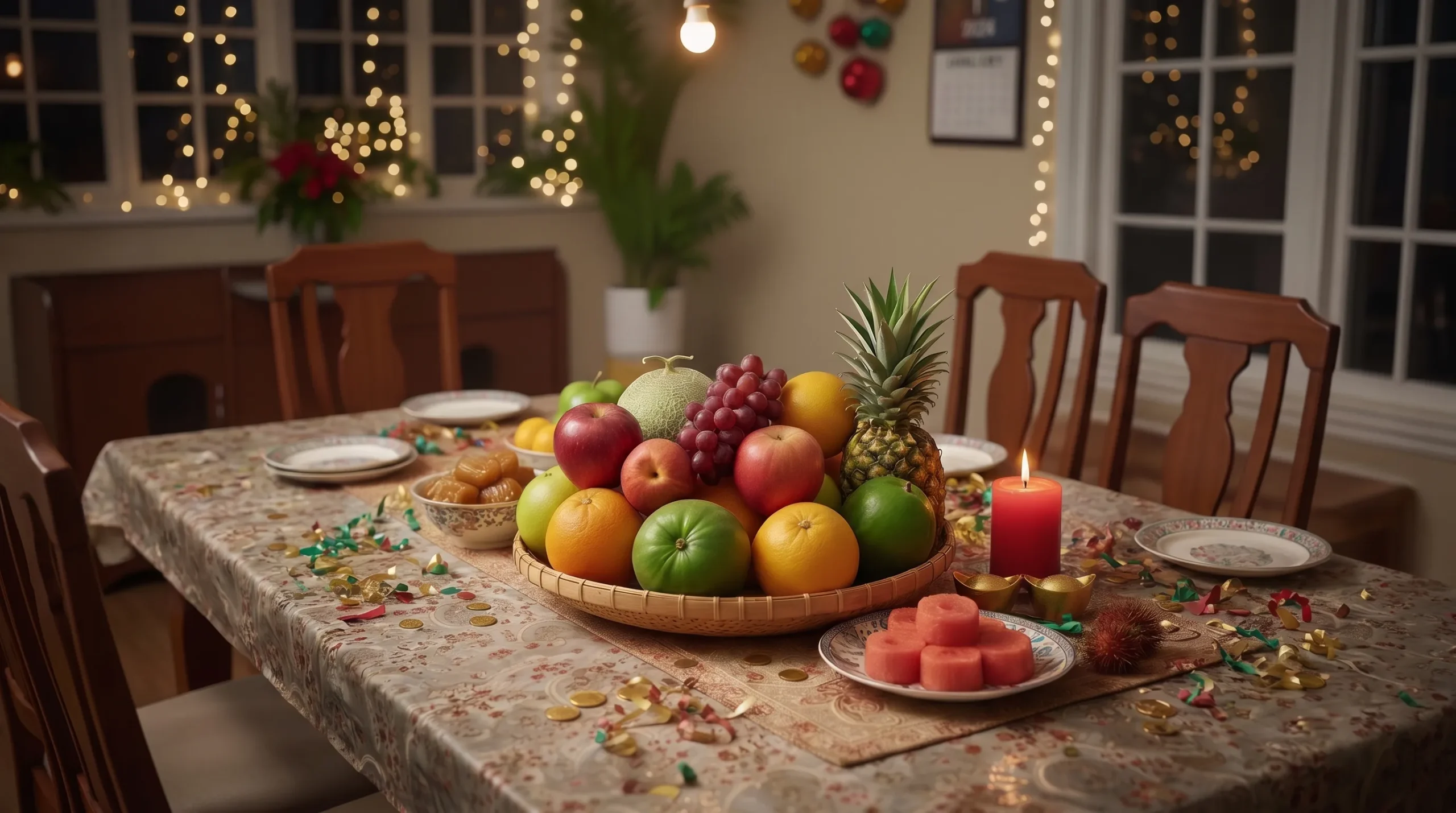
Much like Christmas, Filipinos everywhere also have a special way of celebrating New Year’s. We have our traditions that are uniquely Filipino, and no one else in the world does.
You may feel like it’s borderline superstition, but we Filipinos just believe in certain things we must do as we welcome the new year. Here are a few common Filipino New Year’s Traditions you may or may not know.
Media Noche
Let’s start with something that Filipinos love – eating, and specifically, eating together. The Media Noche, Spanish for “Midnight”, is the second feast that Filipinos have every year in the holiday season.
Much like Christmas’s Noche Buena, the Media Noche has its own quirks. It’s also a feast that starts at midnight, although some families just end up extending from dinnertime, and it’s another opportunity to gather and spend time with your loved ones.
What some Filipino families do it is that they alternate which side of the family they celebrate it with. If, for example, they spent Christmas Eve and Noche Buena at the dad’s side of the family, they then spend New Year’s Eve and Media Noche at the mom’s side. Each family has their own rule, to make sure that no side experiences “tampo”.
The Media Noche is the stage where almost all of the New Year’s traditions are done – starting with the food that is prepared.
Something Sticky
Out of all the spread laid out, some Filipinos believe that there should be something sticky that is served. It’s easy because sticky rice is a staple in some Filipino sweets.
We believe that eating something sticky during Media Noche would strengthen family bonds. Family is important for Filipinos; we want our families to be harmonious and inseparable, much like how the sticky rice in biko sticks together, or how the different layers of sapin-sapin all neatly fit.
Twelve Round Fruits
Another Filipino New Year’s tradition revolving around food is our belief in preparing twelve round fruits during Media Noche.
It may be influenced by the Spanish New Year tradition of eating twelve grapes at the stroke of midnight – las doce uvas de la suerte, or the twelve grapes of luck, one for each month of the year. But Filipinos don’t just stop at preparing grapes.
For Filipinos, we display twelve round fruits on the dinner table, to attract luck and prosperity for each of the twelve months of the year. You can have your basic, circular fruits like grapes, oranges, melons, and watermelons. And then you can have your classic Filipino fruits like lanzones, rambutan, kiat-kiat, dalanghita, or suha. Some prepare cherries or kiwis. Even bananas are considered round, if you look at it from the top or bottom.
Other Circular Things
Following the theme of circles, some Filipinos believe that polka dots on New Year’s Eve also help attract good fortune – maybe because some associate the circle with coins and money.
At Media Noche, some people wear polka dots – but some go beyond that and change sofa covers and bed sheets to polka dots for that extra bit of prosperity.
Fireworks and Loud Sounds
Traditionally, Filipinos also love setting off fireworks on New Year’s, with the belief that the loud sounds drive off bad spirits. Classic Filipino fireworks like the Kwitis, or the borderline dangerous ones like Super Lolo or Sinturon ni Hudas, are staples for some families.
However, in recent years, some local government units and communities have banned fireworks altogether. Most Filipinos stick with the classic torotot to make noise on New Year’s.
Some Filipinos turn up the volume and blast music from their stereo components; some rev their cars and motorcycles.
If all else fails, some Filipinos just straight up shout “Happy New Year” at the top of their lungs to drive the bad spirits away.
Jumping at Midnight
Another pretty popular New Year’s Tradition for Filipinos is jumping up and down at the stroke of midnight. Why jump? To grow taller, of course.
This is probably the first New Year’s tradition that every Filipino knows, as kids are encouraged to jump up and down at midnight.
It’s not limited to children though. Even adults, who, at the off chance of adding a few more inches to their height, will jump as enthusiastically as when they were kids.
Throwing Coins and Other Money Matters
And finally, another well-loved tradition is the throwing of coins at the start of the New Year. Every family does it differently.
For some, while everyone is jumping and screaming Happy New Year, the titos or titas will bring out their big bag of coins and start tossing and throwing the money around. The children, and most of the time even the adults, will scramble and try to get as much of the coins as they can. The more generous tito/tita would sometimes even include bills in the money they are tossing, much to the excitement of everyone.
Some families are more superstitious about it. They open the front door of the house, and throw coins inwards to attract even more money and luck into the house. No one is allowed to get the money; they are left there for a day. After, the money is collected, but should not be spent; it is instead kept in a wallet or a bag to ensure that luck and prosperity are attracted throughout the year.
A Wish for Prosperity and Luck
These traditions have been part of the New Year experience of Filipinos, no matter where they are in the world. It doesn’t hurt to believe in them – in fact, it’s a great way to welcome the year. Why not try it for yourself? It wouldn’t hurt to get that extra bit of luck and prosperity to face the incoming year.
Together with friends and family, the Filipino New Year is a time of great joy and hope. It’s giving thanks to the year that has been, and diving head first in the year that’s coming in, with a wish of prosperity and a little bit of luck for yourself and for the people you hold dear.
Did I miss any of the Filipino New Year’s Traditions? What is your experience of the New Year’s in your part of the world?