There is no Christmas like a Filipino Christmas. Every Filipino knows that the season officially starts during the “Ber Months”, making it the longest Christmas celebration in the world.
It’s becoming a tradition that on September 1, you can expect the Jose Mari Chan memes to pop up on your feed, marking the start of the season. During this time, malls and other public spaces already start putting up Christmas decor, a full three months before December even starts. It’s funny, because nowhere in the world will you see Christmas decorations come up even before the Halloween decor – in some places, they even just put them up side by side.
But beyond the decorations, the months-long celebration, and the memes, there is a rich tradition that has always been part of Filipino Christmas.
This is a list of those Filipino Christmas Traditions. For you, my non-Filipino reader, this is a sort of crash course on the basics of what Christmas is like in our part of the world. And for you, kabayan, who clicked on this to see what I have to say about our traditions, hopefully, this gets you in the spirit of the season.
Simbang Gabi
Let’s start with Simbang Gabi or Misa de Gallo – Spanish for “Rooster’s Mass”. It’s a nine-day series of dawn masses that has deep roots in our Catholic tradition. Although it is also practiced by Spain, Portugal, and most of their former colonies in Latin America, we have added our very own flavor to it, making it truly Filipino.
It’s traditionally celebrated before the break of dawn so that the farmers can go to mass before they start working their fields. That’s why it includes the tradition of eating foods like bibingka, puto bumbong, tsokolate, or salabat after the mass – think of it as a special breakfast to give parishioners the extra energy to go about their day.
Some people also believe that if you complete all nine days of the Simbang Gabi, God will grant your request that you make as part of the novena. Regardless of whether that is true or not, what is important is that this sets the tone for the true meaning of the season – it’s a celebration of family and friends and for thanksgiving for the year that has been.
Caroling
Filipinos are known throughout the world as excellent singers – Christmas is just another time for those of us with the talent to showcase it. Although not exclusively Filipino, Christmas Carols have a special place in our hearts. And of course, we can’t talk about this topic without mentioning the “King of Philippine Christmas Carols” – Jose Mari Chan.
There’s a reason that there are memes about him as early as September. His song, “Christmas in Our Hearts” is the biggest-selling Filipino Christmas song in history. It feels like since its release in 1990, it has always been played on the airwaves without fail. This adds to our rich heritage of Filipino Christmas songs, like “Himig Pasko”, “Pasko Na Naman”, Kumukutikutitap, etc.
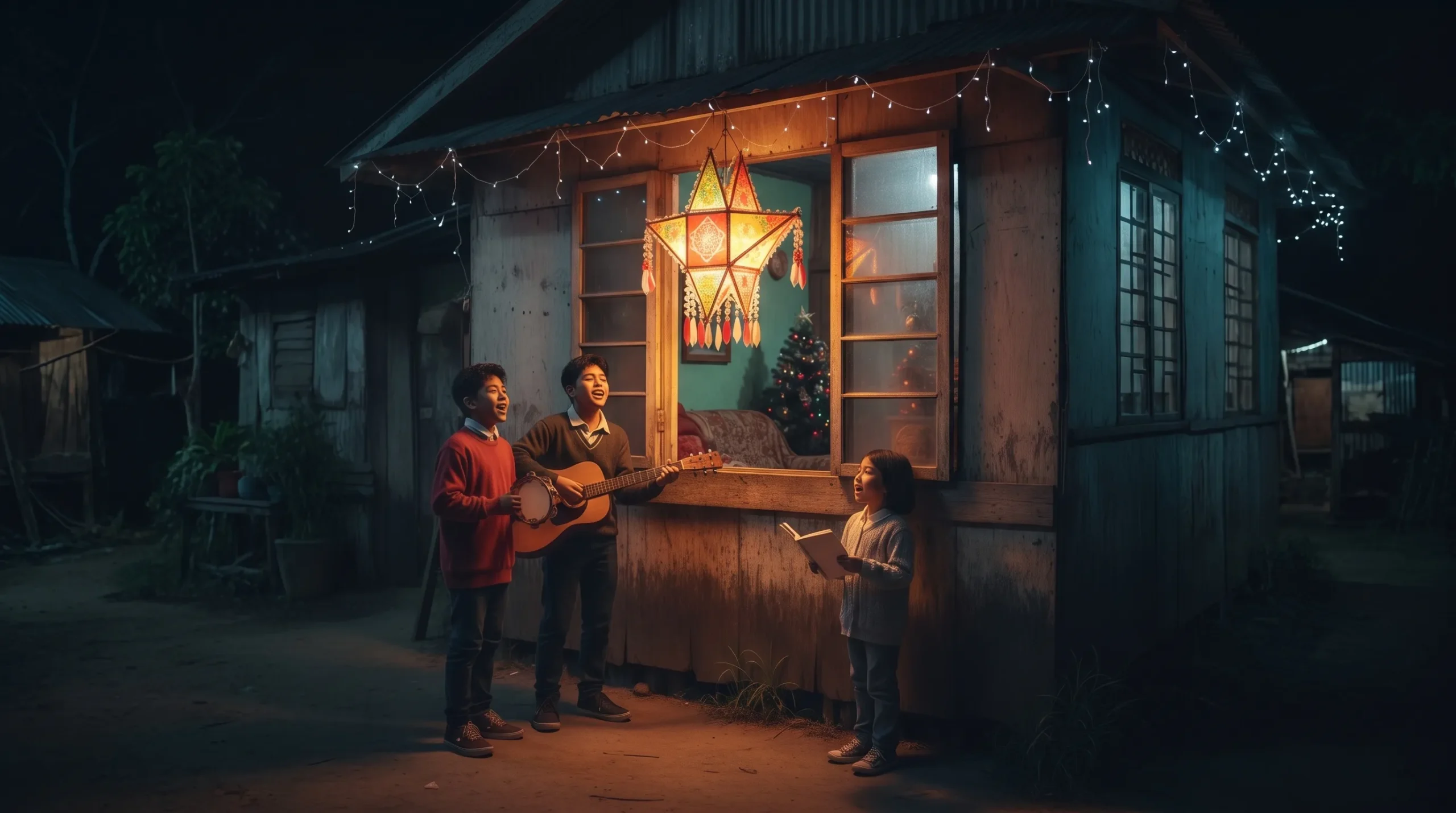
There’s also this tradition of children going house to house and singing Christmas carols while using makeshift instruments out of cans, bottle caps, and sticks. Although not as prevalent nowadays, it’s still a tradition in some parts of the country, where homeowners are expected to give a little bit of money to the carolers – or to tell them “patawad” (translated to “please forgive us”) if they don’t have the money to spare.
Parol
Another truly unique part of Filipino Christmas is the ubiquitous Parol. From the Spanish word Farol, meaning “lantern”, the Parol is probably the most recognizable Christmas ornament for Filipinos.
It’s shaped traditionally like a five-pointed star, although it comes in various shapes and sizes. The Parol is also made from a variety of materials, from “crepe” paper, cellophane, and plastic, to even glass, metal, or capiz shells.
Professionally-made parols can fetch up to thousands of pesos, especially those coming from the “Christmas Capital of the Philippines” – San Fernando, Pampanga. The city has an enduring tradition of the Parol, and is celebrated annually in the Giant Lantern Festival (or Ligligan Parul in Kapampangan).
In the Giant Lantern Festival, parol makers compete to showcase their talent and represent their barangay. These giant lanterns that participants create reach up to 20 feet in size, and contain as much as 10,000 light bulbs. It’s a truly breathtaking sight, and is a must visit festival during the Christmas season.
Monito Monita
The Filipino version of Secret Santa or the Kris Kringle, Monito Monita is something that is practiced primarily among officemates or classmates, but can also be done by friend groups and family members. It is derived from the Spanish words “hermanito” (little brother) and “hermanita” (little sister), and it has its own rules that make it unique.
The mechanics vary depending on the group, but the general idea is to draw a name in secret to determine your Monito/Monita. This is the person you will give a gift to, depending on the frequency that the group agrees upon (usually, it’s done weekly). There is also an agreed-upon amount that the gift will cost.
What makes this exciting is that the group picks a theme for the week – like something soft, something naughty, something edible, or something embarrassing to carry in public. The fun comes in trying to find a gift for your monito/monita that fits the theme.
Noche Buena
And finally, the culmination of all the Filipino Christmas Traditions is the Noche Buena. Literally the “good night” in Spanish, Noche Buena typically refers to the feast that the family prepares on Christmas Eve. For most families, Noche Buena is not complete without the traditional dishes like Lechon, Christmas Ham, Fruit/Buko Salad, Bibingka, Puto Bumbong, and Tsokolate. However, it’s really up to the family and what they want to share on Christmas Eve – it could be sushi or a fancy charcuterie board, if the family wants.
There are no hard and fast rules, but traditionally, the Noche Buena is eaten at midnight. Gifts are also opened at midnight as well – Filipinos don’t wait until Christmas morning to open their gifts.
But what makes the Noche Buena truly Filipino is that it’s a celebration centered primarily around the family. For some, the Noche Buena is just the immediate family, enjoying a quiet midnight meal after Simbang Gabi, admiring the big Parol that Tatay made with his bare hands. For others, it could be a huge affair, with the entire extended family exchanging the final Monito Monita for the season, while the kids are singing Christmas Carols with the hope of getting that extra aguinaldo from ninong or ninang.
It’s also not uncommon to invite friends and colleagues over, especially if you find out that they are spending Christmas alone or away from their own families. It’s is perhaps the ultimate expression of Filipino hospitality – it’s like saying, come over, let’s have Noche Buena, because we are family even if we’re not related by blood.
The Noche Buena is the culmination of the Filipino Christmas, and for some, is perhaps the most important Filipino Christmas Tradition. Every family has their own way of celebrating it. What’s consistent for every Filipino is that this good night is celebrated with the people they truly love and cherish.