Series: Game of Titos and Titas - Part 4
Key Takeaways
- Syatong is played with two sticks and a shallow ditch — and it produced more bruised hands than any other game we played
- Three phases, and you must survive all of them before a single point is counted
- Two scoring systems were in use — shrink the ruler, or apply a multiplier — and which one applied had to be agreed before play
- The short stick — the one that gets struck — is the whole game
- The losing team must run the field shouting “syatong” in a single breath, restarting wherever it gives out
Every summer, back when video games and computers were still a rarity, you would see children and teenagers walking around with bruised and swollen hands.
They had not been fighting. There had been no accident.
They had been playing syatong.
The most intense game in the neighbourhood
Syatong is mechanically simple and emotionally enormous.
Nobody wants to lose at syatong, because losing is public and the punishment is a spectacle. So players commit entirely. A bruised hand was an acceptable price for the day’s bragging rights, and you displayed it afterwards like a receipt.
It goes by other names — syato and shatong through much of Luzon, with small variations in the scoring. We called it syatong.
What you need
- One long stick, roughly 2 to 2.5 feet — the bat
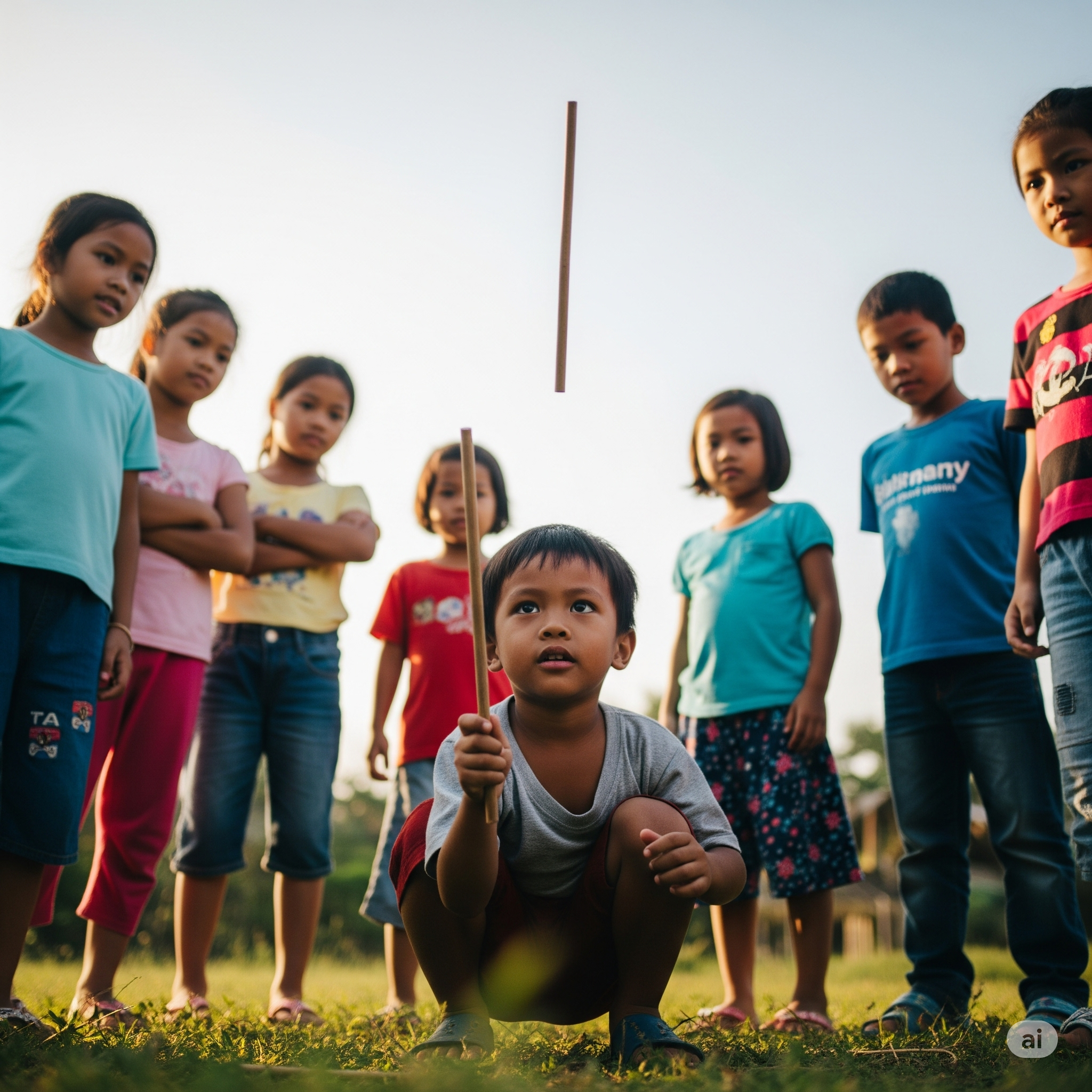
- One short stick, 4 to 6 inches — the one that gets hit
- A shallow ditch scraped into the ground
- Open ground, and plenty of it
- Two players, or two teams
The short stick
The short stick is the whole game.
The long stick is a bat, a lever and a measuring rod, and it does its work close to the body. The short stick is the projectile — launched, chased, caught, struck in mid-air, and driven as far down the field as a boy’s arms can send it. Everything that matters happens to it.
It has no ceremonious name in our telling. It was cut from a flat piece of wood or bamboo, four to six inches of it, and when it split you cut another. That was part of the appeal: the entire apparatus of the game could be replaced in five minutes with a bolo and a length of scrap.
How to play syatong
Syatong needs two players or two teams: the hitter and the fielders. Dig a small shallow ditch in the ground to seat the short stick, agree the target score before anyone swings, and you are ready.
The game runs in three phases, and this is the part that makes it hard — the hitter has to survive all three before a single point is counted.
Phase one — the flip. The short stick lies across the hole. The hitter flicks it into the air with the bat.
Caught by a fielder, and he is out. If they miss it, the hitter lays the bat across the hole and a fielder throws the short stick back from where it landed, trying to strike the bat. A hit puts him out. A miss sends him through to phase two.
Phase two — the strike. The hitter holds both sticks, tosses the short one up, and strikes it mid-air. Caught, and he is out.
Otherwise the fielders throw the short stick back toward the hole, and the hitter tries to meet it on the fly — like a batter facing a pitch. Connect, and that distance is measured too, added to whatever he earns in the phase that follows.
Phase three — the tap and whack. The short stick is wedged into the hole at a slant, one end proud of the ground. The hitter taps that exposed tip to pop it into the air, then whacks it as hard as he can.
Three attempts to make contact. Miss all three and he is out.
Then the measuring. Only a hitter who survives all three phases scores anything. The distance from the hole to where the stick came to rest is measured, and games run to an agreed total — often 100 or 500.
That structure is why syatong was so intense. You could clear the flip, survive the throw-back, connect on the strike, and still walk away with nothing by missing three taps at the very end.
How scoring works
The base unit is simple: lay the bat end over end from the hole to the short stick. One bat-length, one point.
The interesting question is how a harder hit gets rewarded, and there are two answers. Both were in use, and which one you played by had to be settled before anyone swung.
Shrink the ruler. Hit the short stick twice before driving it, and you measure the distance with the short stick instead of the bat. Nothing else changes — but the measuring unit is now a quarter the size, so the same throw yields four or five times the count.
Or multiply. Keep measuring in bat-lengths and apply a multiplier for the difficulty attempted: double the points for a double tap, triple for a triple.
They arrive at the same place by different roads. The first is quietly elegant — there is no bonus table anywhere, no rule that says “this is worth more.” The reward for skill is built directly into the geometry, and the harder your hit, the smaller the thing you measure it with. The second is plainer arithmetic and easier to keep track of in an argument.
I don’t think any of us noticed how neat the first one was at the time. We just knew the double hit was worth going for.
And this, more than the sticks or the ditch, is what syatong actually was: an argument you had to finish before you could play. How far apart, how many points to win, and which way the scoring runs. You settled it, and then you were bound by it.
Levels of difficulty
If you were playing the multiplier scoring, this is the ladder. What you did to the short stick in phase three decided what your distance was worth:
| Level | The move | Points |
|---|---|---|
| Single hit | Tap once, then whack | ×1 |
| Double tap | Tap, juggle it once mid-air, then whack | ×2 |
| Triple tap | Tap, juggle it twice mid-air, then whack | ×3 |
The punishment
Here is why nobody wanted to lose.
At the end of the game, the winning team takes turns hitting the short stick from the ditch, as far down the field as they can send it.
Then the losing team has to run that distance while shouting “syatong” — in one single unbroken breath.
And there is no mercy in the accounting. Take a breath, or let the shout die, and you stop where you stand. You start again from that exact spot. Nobody carries you forward for having tried.
You cannot do it. That is the entire point. Everyone knows you cannot do it, and everyone gets to watch you fail, wheezing, well short of the mark, while the winners fall over laughing.
In Tagalog-speaking places the penalty has a name — buhay, or gantihan. I cannot recall what we called it, if we called it anything at all. It was simply what happened when you lost.
Which is also what defuses it. Syatong gets heated, because children are ruthlessly competitive and this game hands them a scoreboard. But you cannot hold a grudge against someone who has just watched you run out of air in an open field. Everybody goes home laughing.
Frequently asked questions
What sticks do you need for syatong? Two. A long one of roughly 2 to 2.5 feet, which acts as the bat and doubles as a measuring rod, and a short one of 4 to 6 inches, which is the piece that gets launched and struck. Both are usually cut from scrap wood or bamboo.
Is syatong the same as syato? Yes. Syatong is the Bisaya form; syato and shatong are used in Luzon. The scoring varies slightly by region.
What is buhay in syatong? Buhay, also called gantihan, is the Tagalog name for the losing team’s penalty. The winners hit the short stick as far down the field as they can, and the losers must run that distance shouting “syatong” in one unbroken breath, restarting from wherever the shout gives out. I don’t know of a Bisaya equivalent.
How do you win at syatong? By reaching the agreed point total first, often 100 or 500. A hitter scores only if he survives all three phases, after which the distance from the hole to the short stick is measured and counted.
How is scoring counted in syatong? The base unit is a bat-length from the hole — one length, one point. Harder hits are rewarded one of two ways, agreed before play: either you measure a double hit with the short stick instead of the bat, so the smaller unit yields a far higher count, or you keep measuring in bat-lengths and apply a multiplier for the difficulty attempted.
What are the three phases of syatong? The flip, where the short stick is flicked out of the hole with the bat. The strike, where the hitter tosses it up and hits it mid-air, then tries to connect with the fielders’ throw-back. And the tap and whack, where the stick is wedged in the hole at a slant and popped up to be struck. Being caught at any phase puts the hitter out.
Is syatong dangerous? It involves launching a hard stick at speed across open ground, so it needs care: use a clear field, keep everyone well behind the launcher, and don’t play it in a street. The swollen hands were real.
For the bona fide titos and titas out there — did you play syatong in your youth? Was it called something else where you grew up, with different scoring? Tell me in the comments.
Game of Titos and Titas — the full series
- Lastiko: The Filipino Rubber Band Games We Played as Kids
- Birus: The Filipino Hide-and-Seek Played by Moonlight
- Holen: How to Play the Filipino Marble Game
- Syatong: How to Play the Filipino Stick Game (you are here)
- Jackstone: The Game of Skill and Flair