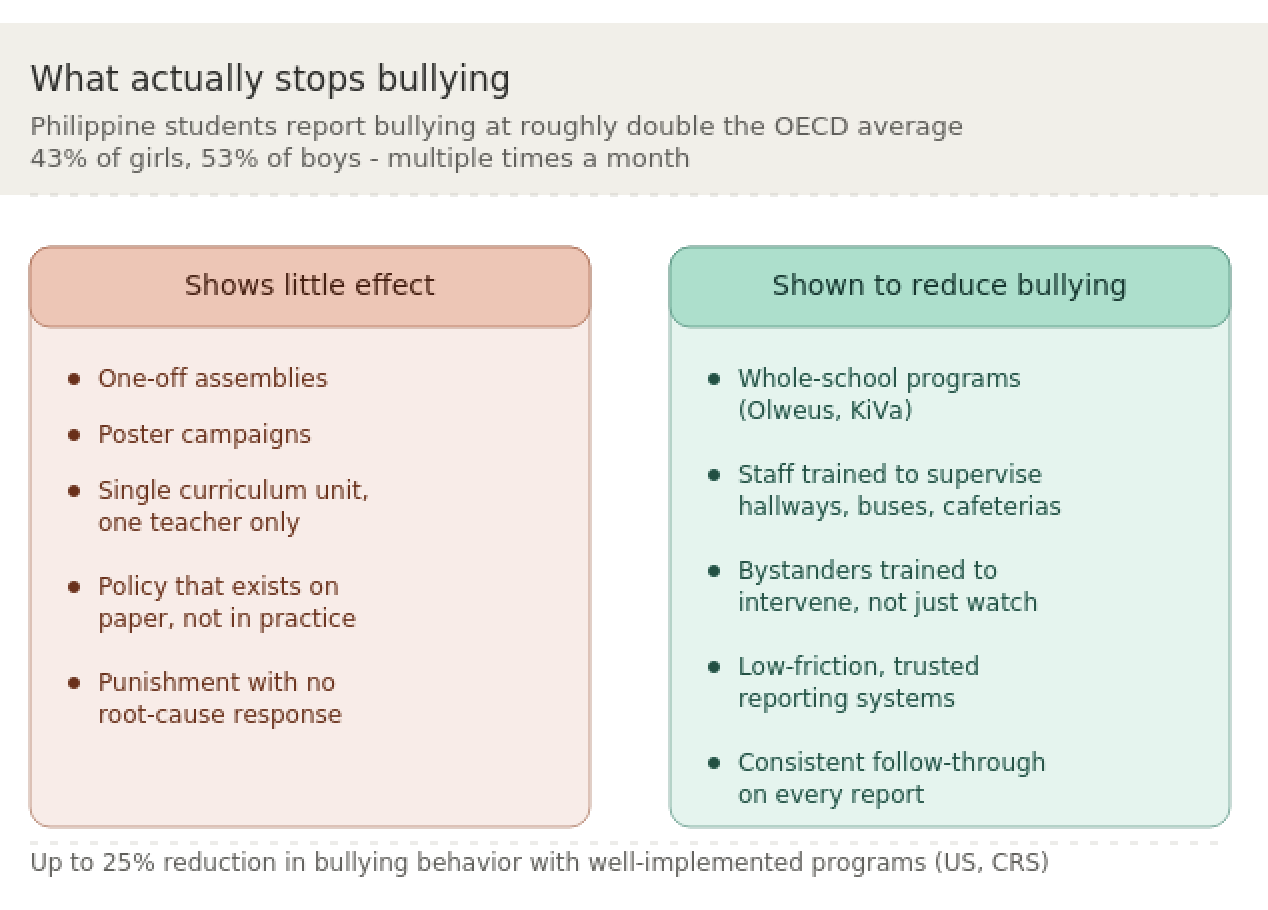
In 2022, the OECD’s PISA survey asked 15-year-olds how often they get bullied. The global average came back at roughly one in five experiencing it multiple times a month. In the Philippines, that number was 43 percent of girls and 53 percent of boys — more than double the international rate. Researchers studying the data concluded the Philippines had effectively become the “bullying capital of the world.”
That statistic sat in policy briefs and committee hearings for a couple of years. Then, on June 22, 2026, it stopped being an abstraction. Two students at San Jose National High School in Tacloban City opened fire on their classmates and told police they had been bullied. Four students died. Nine were wounded. The motive police cited was a “grudge” tied to bullying.
That tragedy deserves its own reckoning with gun access and juvenile justice law — we’ve covered that separately. But it also surfaces a narrower question schools and lawmakers can act on starting tomorrow: what actually works to stop bullying before it escalates? Not slogans. Not hallway posters. What does the evidence say?
There’s a real answer, and most schools aren’t doing it.
The Posters Were Never Going to Work
Ask a school administrator about their bullying policy, and you’ll likely hear about an assembly, a handbook clause, maybe a poster campaign during Anti-Bullying Awareness Week. These efforts aren’t malicious — but decades of research point to something uncomfortable: standalone awareness campaigns, delivered as one-off events with no structural follow-through, tend to produce little measurable change in actual bullying behavior.
What works looks different, and more demanding. The most rigorous evidence comes from meta-analyses by criminologists David Farrington and Maria Ttofi, who systematically reviewed dozens of anti-bullying program evaluations across countries. Their consistent finding: whole-school programs — training every adult, changing supervision practices, involving parents — reduce both bullying and victimization. Piecemeal efforts, like a single curriculum unit taught by one teacher, mostly don’t.
The Congressional Research Service has put a number on the upper end of that effect in the United States: well-implemented programs can reduce bullying behavior by up to 25 percent — the difference between bullying as background noise and bullying as a rare, addressed event.
What “Whole-School” Actually Means
The two programs with the deepest evidence base — Norway’s Olweus program and Finland’s KiVa — share a structure that explains why scattered efforts fail where comprehensive ones succeed.
Both operate on multiple levels at once: staff trained to supervise the spaces where bullying actually happens (hallways, buses, cafeterias), students taught what to do when they witness bullying rather than just what to do if it happens to them, and clear intervention protocols for both the bullied student and the one doing the bullying — since punishment alone, without addressing what’s driving the behavior, tends not to stick.
KiVa is built around a finding that reframed the field: bystanders matter enormously. Bullying rarely happens between just two people — it happens in front of an audience, and what that audience does shapes whether it continues. Programs that train bystanders show stronger, more durable reductions than programs that don’t.
The throughline: bullying prevention isn’t a unit you teach once. It’s an operating condition you maintain — not a single well-meant campaign.
What the Philippines Already Has on the Books
Here’s what makes the Philippine context frustrating: the legal framework for this comprehensive approach already exists. It’s just been unevenly enforced.
Republic Act No. 10627, the Anti-Bullying Act of 2013, requires every elementary and secondary school — public and private — to adopt a written anti-bullying policy, post it visibly, and report bullying incidents up through the schools division superintendent to DepEd’s central office every year. On paper, it mandates exactly the sustained, whole-institution commitment the research says works.
The gap has been implementation. A 2024 study by EDCOM 2 and De La Salle University found that students who witness or experience bullying often become mistrustful of the system meant to protect them — a strong signal the reporting mechanisms RA 10627 requires weren’t functioning as intended.
To its credit, DepEd has been responding. In August 2025, Education Secretary Sonny Angara signed a revised Implementing Rules and Regulations for RA 10627 — a genuine overhaul. The new rules expand the definition of bullying to capture “precursor behaviors” and social exclusion that doesn’t leave a visible mark. They introduce a tiered system for handling cases by severity, and create a new role — a Learner Formation Officer — tasked with being the first responder when a complaint comes in, so reports don’t disappear into an overworked principal’s inbox.
This is structurally close to what the research says should work. The revised IRR was signed roughly ten months before the Tacloban shooting. Whether it reaches classrooms in Tacloban — and the thousands of other schools across the archipelago — before the next crisis is the real test.
Five Things a School Can Actually Do This Term
For administrators and teachers who don’t control national policy but do control their own building, the research points to a short list of concrete, achievable changes:
- Make reporting genuinely low-friction. If a student has to find a specific staff member, fill out a form, and wait days for a response, most won’t bother. Anonymous, multi-channel reporting with a fast acknowledgment sees meaningfully higher use. A system that students don’t trust isn’t working, regardless of what’s written in the policy.
- Train every adult in the building, not just guidance counselors. Bullying happens in hallways, on buses, and online — not in the counselor’s office. Schools that train all staff to recognize warning signs outperform those that concentrate expertise in one role.
- Address bystanders directly. Most students who witness bullying never report or intervene, often because they don’t know how. Brief, repeated training on safe ways to interrupt or report has a measurable effect — more than messaging aimed only at the two students directly involved.
- Follow through, every time. A reported incident with no visible response teaches the whole school that reporting doesn’t matter. This doesn’t require harsh punishment — it requires consistency. A modest, predictable response beats an inconsistent severe one.
- Loop in parents as partners. RA 10627 already requires schools to give parents a copy of the anti-bullying policy. Schools that go further — training parents to recognize signs at home, where kids often disclose more than at school — see better outcomes than those treating parent involvement as a checkbox.
None of this requires new legislation. It requires treating bullying prevention as infrastructure, not a unit in the health curriculum.
The Stakes Are Higher Than a Single Statistic
It would be a mistake to read the Tacloban shooting as proof that bullying prevention doesn’t work. The opposite is closer to true: it’s a stark illustration of what happens when a well-documented risk factor goes unaddressed at scale, in a system where nearly half of students report experiencing exactly this kind of harm regularly.
The evidence base isn’t new or thin. Olweus has been refined since the 1980s; KiVa has been tested in randomized trials across countries; the Philippines’ own legal framework, updated as recently as last year, reflects real understanding of what works. What’s missing isn’t knowledge — it’s the sustained follow-through to turn a law into a lived experience inside a specific classroom, on a specific Monday morning.
That’s a fixable gap. It just requires treating it as the infrastructure project it is, rather than a slogan repeated once a year.
If your school or district is reassessing its bullying prevention approach, we’d welcome the conversation — share this with a colleague who’s working on the same problem, and subscribe for our continued coverage of school safety policy.
Email: nicgabjr@gmail.com X: @nicgabunada.com