Tacloban Wasn’t Supposed to Happen Here — That’s Exactly Why It Did
On a Monday morning that started like any other, students at San Jose National High School in Tacloban City were settling into class around 9:20 a.m. Two minutes later, police were already responding to gunfire. By the time it was over, three students were dead and 20 others wounded — a wounded count that has been revised upward more than once as treatment continued. Two of their classmates — 14 and 15 years old — were in police custody, charged with carrying out the attack themselves.
This wasn’t a foreign news story playing out somewhere distant and unfamiliar. It happened at a public school with more than 1,500 students, in a city of roughly 250,000 people that has already survived more than its share of tragedy — Tacloban was the epicenter of Typhoon Haiyan’s devastation back in 2013. And now it’s the site of something the Philippines has almost never seen: a targeted school shooting carried out by children, against children.
That combination — how rare this is, and how young everyone involved is — is exactly why it deserves more than a news cycle. It deserves a real conversation about what failed, and what it would take to make sure it doesn’t happen again.
What We Actually Know
Let’s start with the facts, because in the hours after a tragedy like this, rumor moves faster than verification.
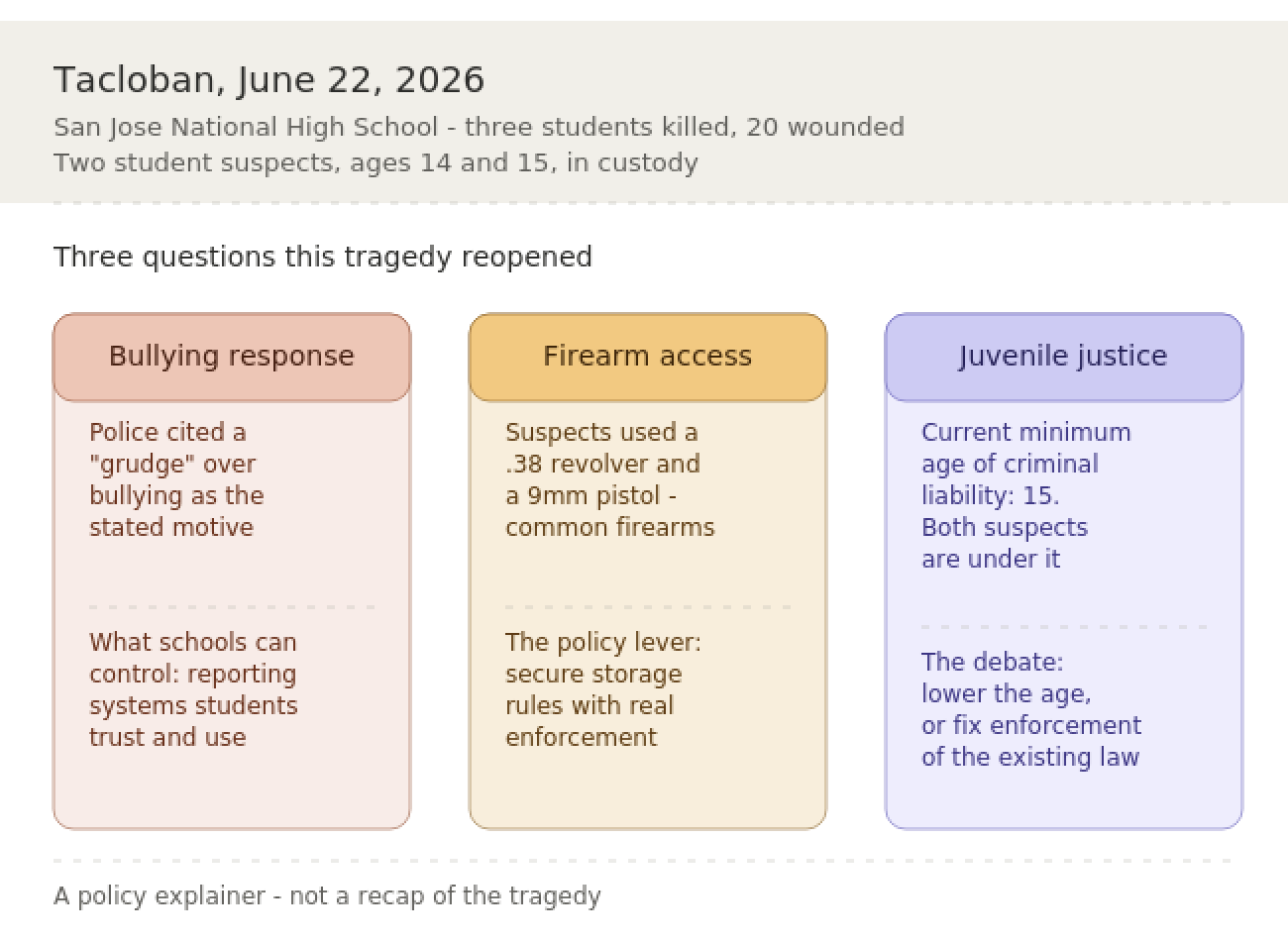
According to the Tacloban City Police Office, the shooting took place inside a classroom while classes were already underway. Teachers and students reacted to the sound of gunfire by either fleeing or hiding; video that circulated afterward showed students taking cover as shots continued. Two students were declared dead at the scene from gunshot wounds, and a third died while being rushed to the hospital. The number of wounded has been revised upward several times since the attack, most recently reported at 20. Police confirmed the suspects used a .38 caliber revolver and a 9mm Glock pistol.
Police Lieutenant Evalyn Diaz, the TCPO’s public information officer, said the case is now being handled in coordination with the city’s social welfare department, in line with the Philippines’ Juvenile Justice and Welfare Act — the law governing how the country treats minors accused of crimes. Regional police chief Brig. Gen. Jason Capoy told reporters the two suspects were close friends and, in initial questioning, said they had been bullied at school.
The response since then has moved quickly on the institutional side. The Department of Education labeled it a “high-alert situation” and pledged psychosocial support for affected students and staff. Classes were suspended not just at San Jose National High School but at two nearby schools as well. President Ferdinand Marcos Jr. ordered a full investigation and called for tighter school security nationwide. The Department of Justice has coordinated with regional prosecutors to determine how the case will proceed.
That’s the official record. Everything else — the deeper “why” — is where this story gets harder, and more important.
The Bullying Question Nobody Wants to Sit With
Police have publicly described the motive as a “grudge” tied to bullying, and the suspects themselves reportedly said they’d been bullied at school. If that holds up, it places this tragedy inside a pattern researchers have documented for decades: a meaningful share of school shooters, especially younger ones, describe themselves as targets of ridicule, exclusion, or harassment before they become perpetrators of violence.
That doesn’t make the violence understandable, let alone justified. Three students are dead, and as many as 20 others are recovering from wounds they didn’t choose. Nothing that happened to the suspects beforehand changes that math. But it does point to something schools and policymakers can actually act on, instead of just mourn.
Bullying isn’t a personality quirk kids grow out of — it’s a stressor with measurable psychological consequences, and schools that treat it as background noise are accepting real risk. The fix isn’t complicated to describe, even if it’s hard to execute: real reporting systems students trust enough to use, counselors who are actually accessible (not theoretical), and follow-through when a complaint is made — not a file that disappears into a drawer. Parent-facing programs that teach families to recognize warning signs matter too, since kids in crisis often say more at home, in fragments, than they ever say at school.
The lesson from Tacloban isn’t “bullying causes shootings,” full stop. It’s that unaddressed bullying is a known risk factor, and risk factors are exactly the kind of thing a system is supposed to catch before they compound into catastrophe.
How Did Two Teenagers End Up With a Revolver and a Glock?
Here’s the part that should unsettle legislators most: none of this required black-market weapons or elaborate planning. A .38 revolver and a 9mm semi-automatic pistol are common firearms in the Philippines, where gun ownership is widespread and, according to the Philippine National Police, gun violence cases number in the thousands every year.
The uncomfortable truth is that two firearms reaching two 14- and 15-year-olds isn’t a sign of a sophisticated plot — it’s a sign of an ordinary gap. Somewhere between purchase, storage, and a teenager’s bedroom, accountability broke down. That’s not a uniquely Philippine problem; it’s the same gap that shows up in school shootings worldwide, where the weapon almost never belongs to the shooter. It belongs to a parent, a relative, an employer, someone who assumed a locked drawer or an unspoken rule was enough.
If there’s one policy lever that’s both achievable and proven elsewhere, it’s this: secure storage requirements with real enforcement, paired with accountability for adults whose weapons end up in the hands of minors. That’s not a sweeping rewrite of gun culture. It’s a much narrower, much more defensible ask — and it’s the kind of thing legislators can move on without re-litigating gun ownership itself.
The Juvenile Justice Debate Just Got Louder
The other fight this tragedy has reignited is over the Juvenile Justice and Welfare Act itself — specifically, the minimum age at which a child can be held criminally liable, currently set at 15.
This debate predates Tacloban. Senator Robin Padilla has been pushing Senate Bill No. 372, which would strip criminal-liability exemptions from minors aged 10 to 17 who are charged with heinous crimes like murder, rape, or kidnapping with homicide. His argument is blunt: some children, he says, are capable of planning and committing horrific crimes, and the current law leaves victims’ families without recourse. PNP Chief Gen. Nicolas Torre III has voiced support in principle, though he’s cautioned that any change needs to be grounded in real data on whether today’s minors process consequences differently than minors did when the law was written.
The opposition is just as forceful. Senator Francis Pangilinan argues the real failure isn’t the age threshold — it’s weak enforcement of the law that already exists. Criminologist Raymund Narag has gone further, arguing that lowering the age would not deter youth crime, since young children entangled in the justice system won’t grasp the gravity of punitive consequences and will only be led further astray. Advocacy groups like the Child Rights Network and lawmakers including Leila de Lima have framed the proposal even more starkly: as punishing trauma rather than addressing it, and abandoning the rehabilitation-first philosophy the law was built on in 2006.
Tacloban will almost certainly intensify this fight on both sides. One 14-year-old and one 15-year-old are now at its center — both under the current age of criminal liability, both facing a system designed around the idea that children that age can still be redirected rather than discarded. Whatever you believe about where that line should sit, the suspects here aren’t a hypothetical anymore. They’re the test case.
What This Should Actually Change
Strip away the politics, and three concrete, achievable shifts emerge from this tragedy:
Schools need bullying-response systems that work, not just exist. A policy on paper means nothing if students don’t trust it enough to use it.
Firearm storage needs enforceable accountability. Not a debate about ownership — a much narrower, much more winnable fight about who’s responsible when a gun reaches a child.
The juvenile justice debate deserves data, not just outrage. Whether the age threshold moves or stays, that decision should be driven by what actually reduces harm — not by the understandable, but reactive, instinct to respond to a tragedy with maximum punishment.
None of this brings back the three students who died on June 22. But it’s the only honest way to answer the question every parent in Tacloban — and every parent reading this story from anywhere else — is asking right now: could this happen at my child’s school too?
The answer, uncomfortably, is yes. The only real defense is making sure the gaps that let it happen here get closed before they widen somewhere else.
If this piece raised questions about school safety policy, bullying prevention, or juvenile justice reform in your own community, we’d love to hear from you. Share this with a friend, an educator or a legislator who should be part of this conversation — and watch out for our next piece, which digs deeper into what evidence-based bullying prevention actually looks like in practice.
Email: nicgabjr@gmail.com X: @nicgabunada.com