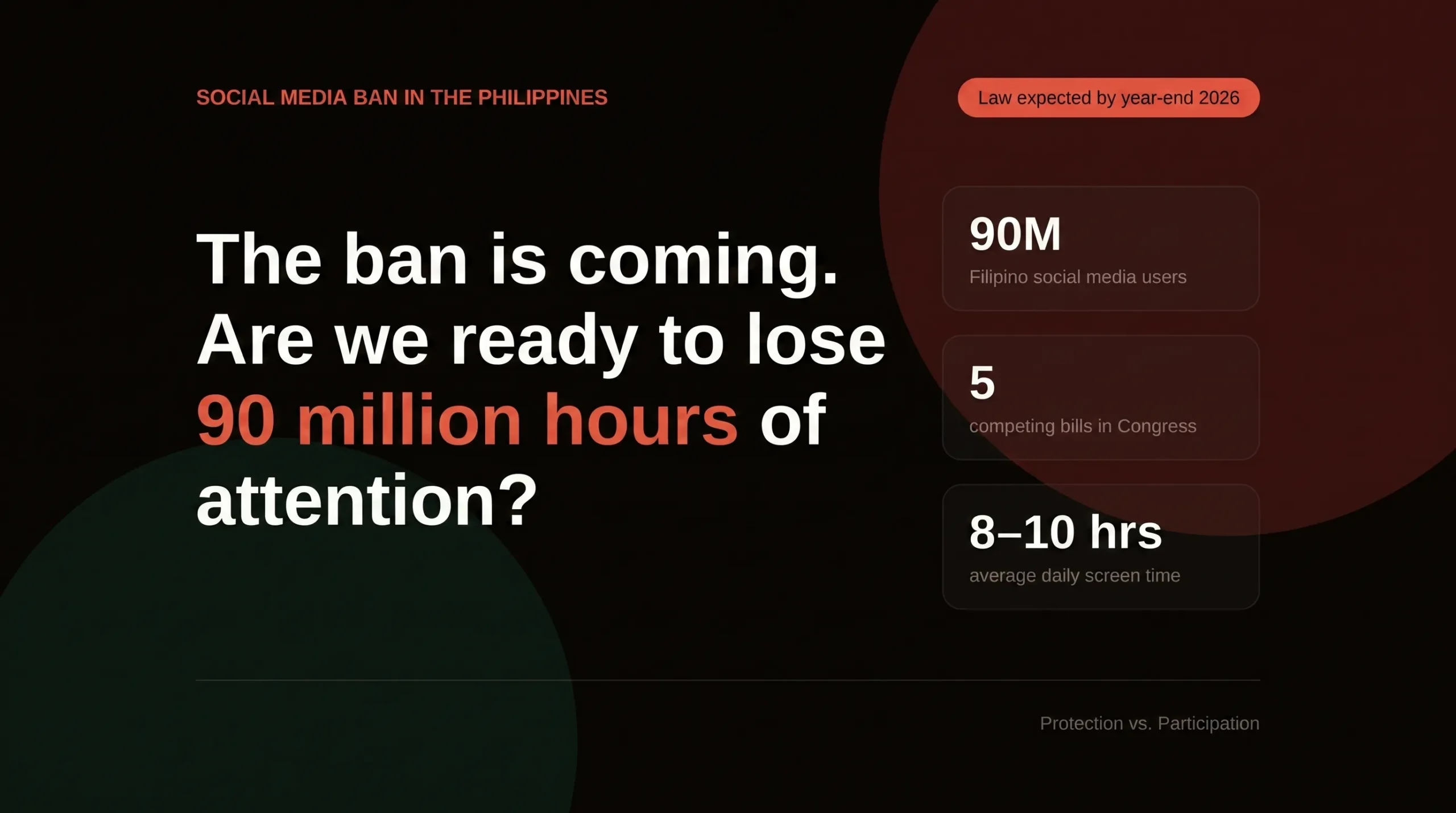
Here’s what should be keeping every marketer, PR lead, and digital strategist in this country up at night: the Philippines is not watching the UK’s under-16 social media ban from a safe distance. We are about to pass our own version of it. Digital Secretary Henry Aguda has said the government wants an online safety law enacted by the end of 2026, with a minimum age of 16 — even as industry players like TikTok lobby for a lower threshold.
The specifics matter, because this isn’t one bill, it’s five. The Senate Committee on Public Information and Mass Media has already held hearings on a stack of competing proposals: Erwin Tulfo’s SB 595, which would bar children 12 and under outright and require verified parental consent for 13- to 17-year-olds; Robin Padilla’s SB 601, which goes after addictive design features like autoplay and reward notifications rather than access itself; Camille Villar’s SB 185, which defines “addictive features” to include infinite scroll and endless-content feeds; and Win Gatchalian’s SB 2066, the Social Media Safety for Children Act, modeled explicitly on Australia’s Social Media Minimum Age Act, which would bar anyone under 16 from registering or holding an account at all, backed by mandatory platform-side age and identity verification, regular compliance audits, and account deactivation, with DICT, DSWD, DepEd, NTC, and NPC jointly writing the implementing rules within 90 days of passage. The House has its own counterpart in Bro. Eddie Villanueva’s HB 8262, the Social Media Protection for Minors Act, which would bar anyone 16 and under, puts the compliance burden on the platforms, and backs it with administrative fines running from roughly one million to twenty million pesos per violation. This is not a hypothetical for a future white paper. It is a live policy fight with a year-end deadline, and almost no one in our industry is treating it that way.
I want to make the case that should be obvious to everyone in this room but somehow isn’t: a blanket ban built on the UK and Australian model is the wrong instrument for the Philippine market, and the reason isn’t sentimental, it’s structural. Social media here isn’t a leisure category sitting beside “real life” — it is the infrastructure real life runs on. Treating it as a vice to be age-gated, the way we treat alcohol or gambling, misreads what the platform actually is here. And if we get the policy response wrong, the cost won’t just land on teenagers. It will land on every brand, campaign, and institution that has built its reach on this exact infrastructure.
Why the UK Comparison Doesn’t Travel
The instinct to point at London and say “see, even the UK is doing it” collapses two very different digital ecosystems into one policy. The UK ban targets named platforms — Snapchat, TikTok, YouTube, Instagram, Facebook, X — while explicitly carving out messaging apps like WhatsApp. It follows Australia’s Social Media Minimum Age Act, and UK officials have been candid that enforcement will fall on the platforms, not the children, and that some teens will find workarounds regardless.
That model assumes something the Philippines doesn’t have: a digital ecosystem where social media is one lane among many. In the UK, a 14-year-old locked out of Instagram still has email, a phone number, a household broadband connection, and offline institutions that don’t route through a feed. Lock a Filipino 14-year-old out of Facebook and Messenger, and you may have just cut their only line to their class section, their school’s enrollment announcements, and possibly a parent working overseas — not a marginal difference, but the whole ballgame.
The Numbers the Bill’s Authors Are Not Sitting With
If you work in this industry, you already know the Philippines isn’t a normal social media market — it’s the extreme case. Filipinos spend roughly four to five hours a day on social platforms, among the highest in the world, holding the global top spot from 2018 to 2023 before slipping slightly behind Kenya. Facebook alone reaches close to 95 percent of Filipino internet users monthly, with the average user active across eight or more platforms.
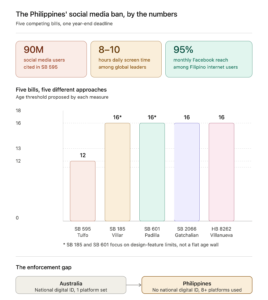
Senator Erwin Tulfo’s own bill cites internal estimates of 90 million social media users nationally, with daily screen time running eight to ten hours — a number he uses to argue for restriction. I’d argue it should give policymakers the opposite signal: a behavior this deeply embedded does not get switched off by statute. It gets rerouted, hidden, or pushed underground.
Senate hearings in February already surfaced the core objection from people who actually have to implement this stuff: UP president Angelo Jimenez warned that a blanket rule ignores that a 12-year-old and a 16-year-old are not the same developmental category, and that broad restriction risks cutting off “legitimate use of digital platforms for education, civic participation, and creative enterprise.” Meta, Google, and TikTok’s own representatives, along with the DOJ and the Cybercrime Investigation and Coordination Center, came out in favor of an age-appropriate framework over an outright ban. When the platforms and the cybercrime regulator are aligned against the bill’s harshest version, that’s not industry self-interest talking — that’s a signal the enforcement math doesn’t work.
What Tacloban Should Actually Teach Us
I’m writing this days after three students were killed and twenty more injured in a school shooting in Tacloban City, allegedly carried out by two minors, aged 14 and 15. It is one of the most painful things this country has had to process in years, and it has understandably reignited the entire conversation about minors and online platforms — investigators have linked one of the suspects to Gorebox, a violent shooting game, and this follows a pattern police have been tracking since at least last year, with at least five rescue operations involving twelve minors allegedly groomed toward violence through gaming platforms like Roblox, two of which had already ended in deaths before Tacloban.
I want to be careful here, because this is exactly the moment where policy gets made badly. The instinct after Tacloban — and I understand it, I feel it too — is to point at the game and say that’s the cause, ban it, and move on. The Cybercrime Investigation and Coordinating Center has already moved to temporarily block Gorebox. But the people who’ve actually studied this pattern keep arriving at a more uncomfortable, less satisfying answer: it isn’t really about the game. The PNP Anti-Cybercrime Group’s own briefings to the Senate describe a consistent mechanism across these cases — strangers using a platform’s chat or social features to build trust with a minor, then moving the conversation off that platform entirely, usually to Facebook Messenger, Discord, or Telegram, where the actual radicalization and planning happens. One international analysis of a similar case abroad put it plainly: the relevant digital element isn’t the violent content of the game, it’s the attacker’s behavior inside the group chat and the platform’s ability to connect them to a stranger in the first place.
That distinction is everything for this debate. If the mechanism is “violent content in a game,” the policy response is a content ban — block Gorebox, rate-gate the next one, declare victory. If the mechanism is “unsupervised chat features that let an adult build a private relationship with a child across platforms,” banning a single named app does almost nothing, because the grooming simply starts on whichever platform is left standing.
This doesn’t make the underlying danger any less real: grooming and online radicalization of minors is a genuine, documented, ongoing crisis here, and it deserves a serious regulatory response. But “serious” and “broad” aren’t the same thing. None of SB 595, SB 601, SB 185, SB 2066, or HB 8262 meaningfully addresses cross-platform grooming through private messaging, because that isn’t a social-media-access problem — it’s a content-moderation and chat-safety problem that cuts across gaming platforms, messaging apps, and social media alike. A 16-year-old barred from Facebook under any of these bills is still reachable on Discord, Roblox, or whatever comes next. The danger doesn’t live in the age gate. It lives in the unsupervised, cross-platform private channel — and that’s a much harder, less politically satisfying thing to legislate than a minimum age.
What a Ban Actually Breaks
The original sin in most ban proposals is treating social media as a single, fungible “screen time” category — interchangeable with gaming or video, something you can simply ration. In the Philippine context, that framing breaks down because social platforms have absorbed functions that have nowhere else to go:
They are the school’s communication backbone. Section announcements, assignment reminders, club coordination — these increasingly live in Facebook groups and Messenger chats, not school portals, because the portals don’t exist or don’t work reliably enough to depend on.
They are economic infrastructure for households, not just kids. Facebook’s embedded marketplace makes it one of the country’s primary channels for small commerce. A 15-year-old helping run a family livelihood page during a ban isn’t a hypothetical edge case in this market — it’s a Tuesday.
They are the dominant news source for the population they’re trying to protect. Something like six in ten Filipinos already use social platforms as a primary news source. Cut a 15-year-old off from that without building a replacement civic-information channel, and you haven’t protected them from misinformation — you’ve just removed the version of the feed where they might occasionally see a correction or a fact-check.
A ban modeled on a UK or Australian template treats all three of these as collateral damage in service of the safety goal. That’s a defensible trade if you’re the UK. It’s a much harder trade here, because the “harm” side of the ledger (anxiety, addictive design, exposure to harmful content) is real and worth taking seriously, but the “infrastructure” side of the ledger is larger and more load-bearing than it is in almost any comparable market.
The Enforcement Problem Nobody Wants to Say Out Loud
Every version of this bill — Tulfo’s SB 595, Padilla’s SB 601, Villar’s SB 185, Villanueva’s HB 8262 — converges on the same mechanism: mandatory age verification, ID checks or facial recognition, platform-side account audits, and administrative fines reaching into the tens of millions of pesos for non-compliance. On paper, that’s a credible enforcement architecture. In practice, it asks a state with inconsistent broadband regulation, patchy digital ID infrastructure, and no track record of platform-level enforcement at this scale to do something even the UK — with its national ID conversations, its Online Safety Act precedent, and far higher per-capita regulatory capacity — is still working out how to do cleanly.
And the workaround toolkit is not exotic. VPNs, borrowed accounts, age-misrepresentation at signup — these are the default behavior of an entire generation that has been creating accounts on platforms with a notional minimum age of 13 since long before any of these bills existed. The UK government’s own officials have conceded publicly that some teens will find their way around the ban. If that’s the expected outcome in a market with stronger enforcement capacity than ours, the realistic outcome here is not “fewer Filipino teens on social media.” It’s “the same number of Filipino teens on social media, now with less platform accountability, because they’ve migrated to whatever app didn’t bother with verification.”
That’s the version of this policy that should worry anyone running a brand safety, youth-audience, or platform strategy: a ban doesn’t remove the audience, it removes your visibility into where the audience went.
Reframing the Choice
The original framing of this debate — ban the tool versus empower the user — treats those as a binary with a clean either/or answer. I don’t think that’s the right framing anymore, and for an audience that thinks in terms of systems and incentives rather than slogans, I think it’s worth saying plainly: the binary is the problem.
A ban is a single, blunt lever pulled once, then left to enforcement agencies to implement against a moving target. Digital literacy, by contrast, isn’t a lever — it’s an operating layer built into schools, platforms, and households simultaneously, scaling with the user rather than against them. The two aren’t competing options; they solve different problems. Age-appropriate design constraints — limits on infinite scroll, autoplay, algorithmic reward loops, the features Padilla’s and Villar’s bills already target — are a platform-accountability problem. Media literacy is an education-system problem. Parental visibility tools are a household problem. Bundling all three into a single age-gate and calling it “protection” is policy theater that produces a press release, not a behavior change.
What the Senate hearings already point toward is closer to Australia’s actual implementation detail than the popular shorthand for it: design-feature restrictions on the platforms themselves, paired with a literacy mandate and narrower, age-banded access rather than a flat under-16 wall. The DICT-led interagency model written into several of these bills — NPC, NTC, DepEd, DSWD, DOJ all coordinating rule-making — is a more honest acknowledgment that this isn’t one problem with one fix. The political optics of a “ban” are simpler to sell than a multi-agency, multi-year capacity-building program. But optics aren’t outcomes.
What This Means If You Work in This Industry
For marketers and digital strategists, the planning question isn’t “will there be a law” — there will almost certainly be one before the year is out — it’s “which version, and what does it do to the audience you can legally and ethically reach.” A flat 16+ wall reshapes youth-targeted campaigns overnight and pushes that audience toward less moderated, less measurable platforms, which is a worse outcome for brand safety, not a better one. A design-constraint-plus-literacy model reshapes how you reach that audience — fewer engagement-bait mechanics, more friction in the feed — without erasing the audience from the addressable map entirely.
For political communicators and PR professionals, the stakes are sharper still. Six in ten Filipinos already get their news primarily from these platforms. Any policy that fragments where the under-16 population gets information doesn’t just affect kids — it fragments the information environment those kids’ households, schools, and communities operate in. A ban that pushes the conversation to less visible, less accountable corners of the internet is not a win for anyone trying to communicate clearly with the public, including the government writing the ban.
The UK can afford to treat this as a safety policy with social media as a discrete, separable category of risk. We can’t, because here, the category doesn’t separate cleanly from school, commerce, and civic life. That’s not an argument for doing nothing. It’s an argument for building a policy that matches the actual shape of the problem — which, in this country, looks a lot less like Australia and a lot more like infrastructure regulation than vice regulation.
The bills are already in committee. The deadline is this year. The window to get the distinction right is closing fast.
Email: nicgabjr@gmail.com X: @nicgabunada.com