Every fair contest rests on one simple rule: you don’t move the goalposts once the game has started.
In the impeachment trial of Vice President Sara Duterte, the goalposts moved on September 23. A week later, on September 30, the Supreme Court had the chance to say whether that was allowed, and it chose not to answer.
From 16 to 14: What Actually Changed
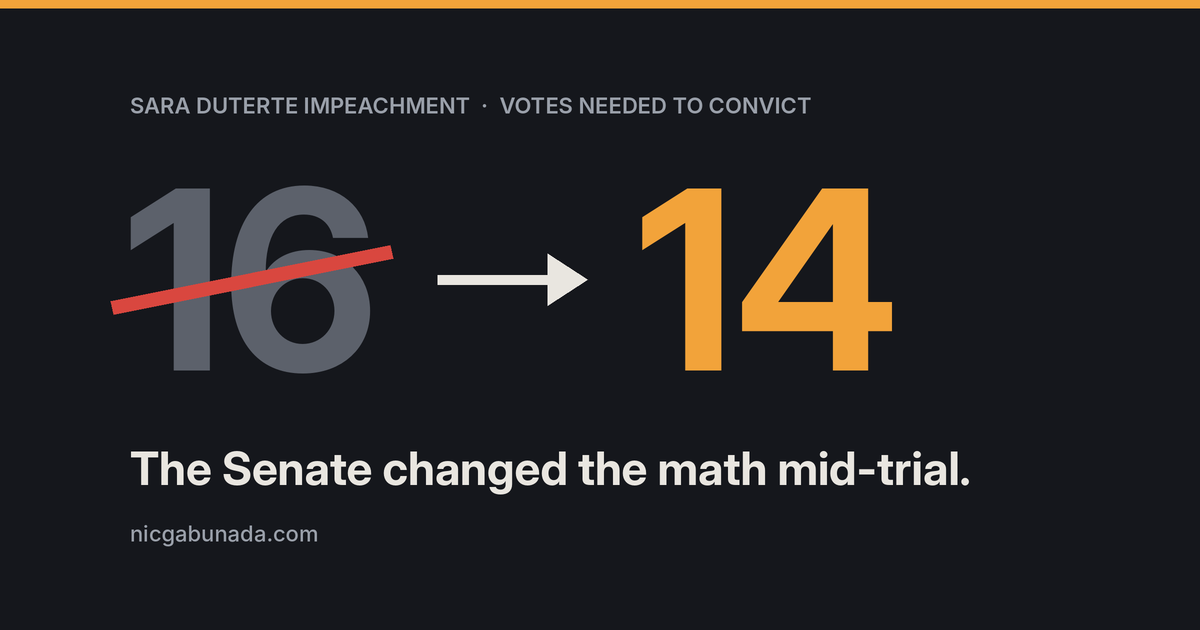
When the trial opened in July, the math was settled. On July 6, Presiding Officer Chiz Escudero ruled that conviction required 16 votes, two-thirds of the full 24-member Senate.
On September 23, Day 29 of the trial, the senator-judges overturned that ruling in a 13-1 vote, with six not participating. They redefined “all the Members of the Senate” to mean only senators who are “legally and factually capable” of participating when the vote is taken. Senators who are detained, suspended, in hiding, medically incapacitated, or beyond the Senate’s coercive processes no longer count.
Under the new definition, the impeachment court now counts 20 senator-judges instead of 24, so the prosecution needs 14 votes instead of 16.
Two votes may sound like a small difference, but in an impeachment trial it can decide the outcome.
Look at the text itself. Article XI, Section 3(6) of the 1987 Constitution says no person shall be convicted “without the concurrence of two-thirds of all the Members of the Senate.” The framers could have written “members present” or “members voting.” They wrote all. The Senate has now read into that word a qualification that isn’t there, and it did so mid-trial, after both sides had built their cases on the original number.
What the Supreme Court Did, and Didn’t, Do
The Supreme Court en banc dismissed three petitions, filed separately by former Executive Secretary Victor Rodriguez, Berteni Cataluña Causing, and Atty. Ernesto Francisco Jr. The grounds were procedural: lack of standing and prematurity.
The Court did not rule on the merits. It did not say the Senate’s interpretation is correct, and it said nothing about how the two-thirds requirement should be computed.
That distinction matters, because the Senate side is already treating the dismissal as a vindication. The impeachment court’s spokesperson called its proceedings “constitutionally bulletproof.” But a ruling on standing is not a ruling on the Constitution. The Court left the question open; it did not settle it.
The “prematurity” ground is the most troubling part. In effect, the Court is saying it will wait until there is a verdict. But by the time a conviction is handed down under the new math, the injury is complete: a nationally elected official has been removed and the political consequences have already played out. Judicial review exists precisely to stop the machinery before it produces an unconstitutional result, not to sort out the damage afterward.
The New Reality for the Defense
With Padre Faura declining to step in, the defense panel, led by Lead Counsel Atty. Sheila Sison with Atty. Michael Poa as spokesperson, has to fight on a field that has been tilted against it. Sison has already put on record that the Vice President is now participating in the trial “with caution.” That manifestation is the start of a larger strategy, and the defense will need three tracks running at once:
- Contest the legitimacy of the vote, every day. Every vote taken under the 14-vote threshold should be met with a standing objection on the record. The legal objection also has to become a sustained public argument, because the court of public opinion is where senators feel the pressure. As I wrote when she declared her presidential run in February, every impeachment vote against a declared frontrunner is now political capital spent, and senators know it.
- Win on the evidence. With the procedural shortcut closed, the trial comes down to proof. The defense must aggressively challenge the admissibility of the prosecution’s financial records and expose the gaps in witness testimony on the alleged misuse of OVP and DepEd confidential funds.
- Build the record for the return to the Supreme Court. If a conviction comes only because of the revised math, the “prematurity” objection disappears and the injury becomes concrete. Every procedural flaw documented now is groundwork for bringing this exact threshold question back to the Court after a verdict.
A Precedent That Outlives This Trial
This goes beyond the political survival of one Vice President.
Under the new rule, the number of votes needed to remove an official is no longer fixed by the Constitution. It now depends on circumstances that can change from week to week: who is detained, who is suspended, who is too ill to attend. Several of those circumstances can be influenced by political actors. Whoever shapes the denominator shapes the verdict.
And the forces pushing this impeachment are not even a single bloc. Even the two lefts filed separate complaints, each with its own agenda.
Every impeachable officer now faces that same moving bar: a future President, a Chief Justice, a member of a Constitutional Commission, an Ombudsman. Today the rule is being applied to Sara Duterte. Tomorrow it can be used against anyone who has fallen out of favor with whoever controls the Senate.
When the rules of accountability become negotiable, accountability itself becomes a political weapon.
What We Can Do
This is no longer only about defending one office. It is about whether constitutional rules still mean what they say.
- Explain it, online and offline. Expect efforts to normalize the lower threshold as a technicality. Share the facts: the bar dropped from 16 to 14, mid-trial, and the Supreme Court has not ruled that this is constitutional.
- Hold your senators to account. All 24 senators are elected nationally, so every one of them answers to you. Check how each senator-judge voted on September 23. Message their offices and tell them the public is watching. A vote to convict under a threshold the Constitution never set is a vote against the Constitution.
- Stay informed and stay engaged. Don’t let legal jargon blur the issue. Follow the trial, join community forums, and keep the conversation focused on due process.
The Supreme Court has stepped aside for now, but the final judgment on this trial belongs to the Filipino people. Stand firm, stay loud, and demand a fair trial for Vice President Sara Duterte.
What’s your take on the mid-game rule change? How should the defense fight back on the Senate floor? Share your thoughts in the comments, and pass this post on to someone who needs to see the numbers.