
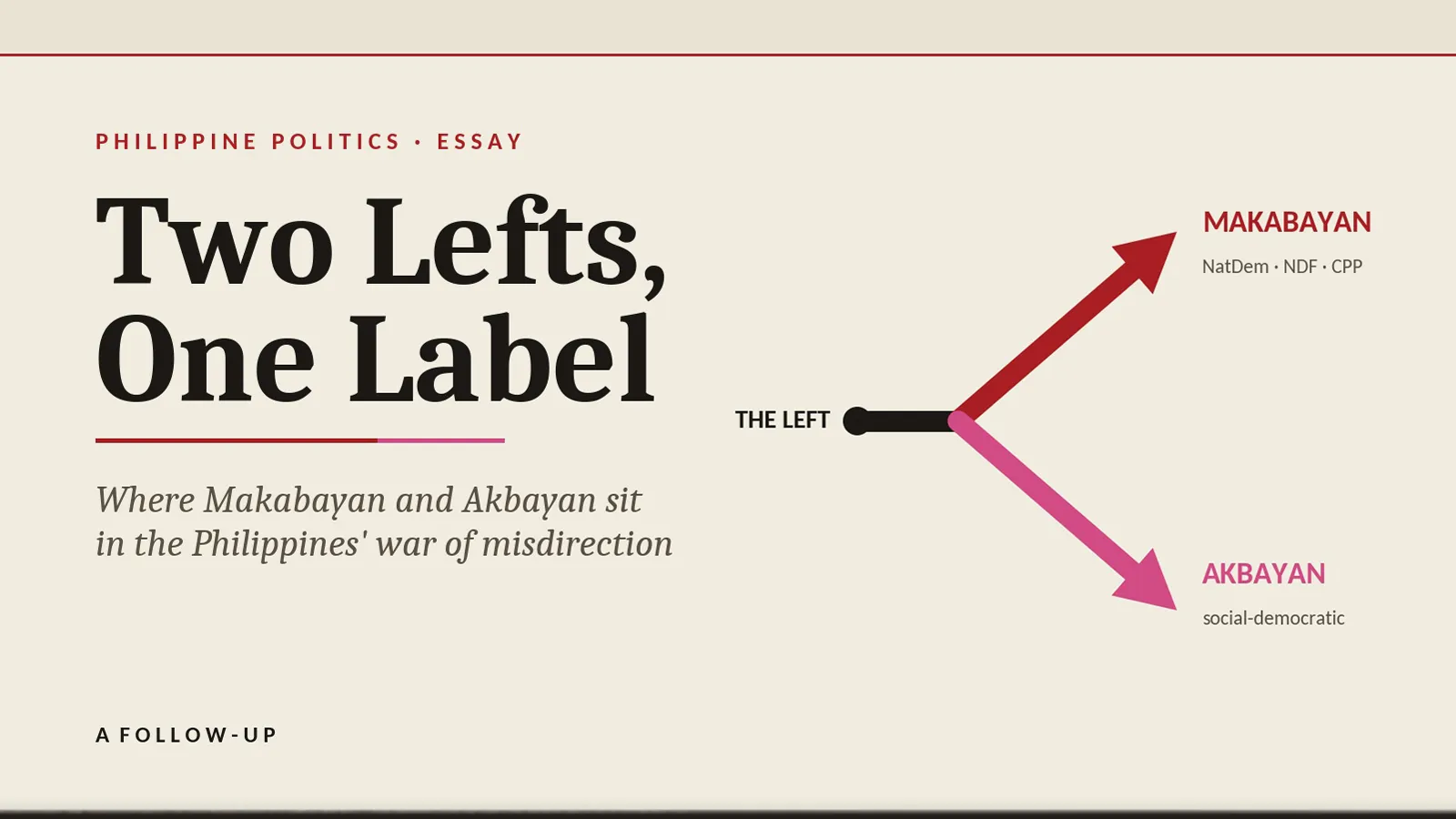
Where the Makabayan bloc and the Akbayan bloc sit in the Philippines’ war of misdirection
A follow-up to “Strategic Misdirection in Political Messaging”
The first piece argued that a great deal of Philippine political messaging works not by lying outright but by pointing the audience at the wrong object — collapsing distinctions the speaker would rather you not see. Nowhere is that mechanism cleaner than in how the country talks about “the left.” The word does an enormous amount of quiet work. It flattens two rival traditions, born of a bitter split, into a single red silhouette. And that flattening is not an accident of shorthand; it is a political asset that different players spend and defend.
So it is worth doing the un-collapsing. Where, precisely, do the Makabayan bloc — the national-democratic constellation of the Makabayan coalition, the National Democratic Front, and the Communist Party of the Philippines — and the Akbayan bloc actually stand in the dynamics of 2026? They are not the same animal wearing different collars. They are two animals, and much of the messaging around them depends on you not noticing.
The schism the label hides
The Philippine progressive left is not one bloc but two traditions descended from the same 1968 origin and severed by the 1992 “reaffirm–reject” rupture inside the Communist Party. The national-democratic (NatDem) tradition “reaffirmed” the party’s Maoist line of protracted people’s war: a two-stage revolution, anti-imperialist and anti-feudal, with the countryside as the strategic terrain. The “rejectionist” and independent currents that broke away — social democrats, popular democrats, unaffiliated Marxists — eventually flowed into legal, parliamentary, reformist vehicles. Akbayan, founded in 1998, is the most durable of them.
This is why “the left” is a misdirection-prone category. The two camps do not merely differ on tactics; they have spent thirty years in mutual suspicion, occasionally open hostility. NatDem partisans have long branded Akbayan as “yellow,” collaborationist, a junior partner of elite liberals — a charge that gained bite when Akbayan sat inside the Aquino III governing coalition. Akbayan-side figures, in turn, have called the NatDem movement dogmatic and authoritarian, tethered to an armed line that gets its own cadres killed. To treat them as one thing is to erase the most consequential fault line on the Philippine left. Yet that erasure is exactly what the state’s security messaging, and much lazy commentary, performs daily.
The Makabayan bloc: contraction under fire
The national-democratic complex has a layered architecture that is central to understanding both its resilience and its vulnerability. At the underground core sit the CPP and its armed wing, the New People’s Army — one of the world’s longest-running insurgencies. Above them is the National Democratic Front (NDFP), the united front and the government’s counterpart in the on-again peace negotiations, long associated with the late Jose Maria Sison (who died in exile in 2022) and now with figures like Luis Jalandoni and Julieta de Lima. And above ground, fully legal, are the Makabayan party-lists — Bayan Muna, Gabriela, ACT Teachers, Kabataan — and the sectoral mass movements around BAYAN.
The state’s security establishment treats these as tiers of a single movement: legal fronts of an illegal party. The groups themselves reject that they are fronts or that they take orders from anyone underground, and both Philippine fact-checkers and the Supreme Court have pushed against the guilt-by-association logic of “red-tagging,” with the Court recognizing that the practice can threaten a person’s constitutional rights. What is genuinely not in dispute is narrower and more interesting: they share an ideological tradition — national democracy — and a broadly common program. That shared program is real; the alleged shared command structure is precisely the contested claim on which red-tagging rises or falls. The ambiguity between the two is not a bug in NatDem strategy. The united-front doctrine has always relied on a firewall between legal and underground work — a firewall that shields activists in principle and exposes them in practice, because opponents can always gesture at the wall and insist there is a door.
By 2026, the RED bloc is contracting on every front at once. Electorally, 2025 was its worst showing in a quarter-century: the coalition went into the election with a full Senate slate and came out with none, and its party-list representation fell to a handful of seats, with Bayan Muna — once a dominant vote-getter — dropping toward 76th place and the edge of delisting, and Anakpawis already delisted. ACT Teachers and Kabataan held single seats; Gabriela survived only through a supplemental seat allocation. Militarily, the government now claims a shrinking number of NPA fighters and active fronts and has begun declaring whole regions “insurgency-free.” And the peace track that briefly flickered — the 2023 Oslo joint statement to resume talks — has been effectively frozen from the government side: by mid-2026 the defense and national-security leadership were publicly refusing any return to national-level negotiations, dismissing the movement as spent, and pivoting to “localized” surrender-and-reintegration programs run through the anti-communist task force.
That combination is the vise. The bloc still commands something real — disciplined sectoral organizing, ideological coherence, and a Senate protest vote of several million that its own leaders read as a floor of sympathy rather than a ceiling. But it is being pushed off the parliamentary board it spent two decades legitimizing itself on, precisely as the armed leverage behind it erodes. Its messaging problem is acute: it must simultaneously defend the legitimacy of legal dissent (against red-tagging) and decline to disown a broader movement whose armed component is its opponents’ favorite exhibit. Every time it does the second, it hands ammunition to those attacking the first.
The Akbayan bloc: the breakthrough and its temptations
If 2025 buried one left, it crowned the other. Akbayan topped the party-list race outright with roughly 2.8 million votes and three seats — an extraordinary reversal for a party that had barely clung to a single seat in 2022. Its lead nominee, human-rights lawyer Chel Diokno, anchors what the party has branded a “reform bloc,” and the constellation around it is the point: senator Risa Hontiveros (an Akbayan founder) in the upper chamber, Leila de Lima entering the House through the Mamamayang Liberal list, Kaka Bag-ao back in Congress, and the wider orbit of Leni Robredo, Kiko Pangilinan, and Bam Aquino. This is, recognizably, the liberal-progressive coalition of the 2022 Robredo campaign — the “pink” movement — consolidated into a parliamentary spine.
Akbayan’s self-location is social-democratic and constitutionalist: reform through elections and institutions, a rights-based idiom, an explicit refusal of the armed line. That refusal is not incidental to its brand; it is constitutive of it. Akbayan defines itself against two things at once — the dynasties, and the revolutionary left — and that double demarcation is what lets it occupy the “clean progressive” lane that neither the trapos nor the NatDem left can claim.
But the position carries its own misdirection risks, and an honest follow-up should name them rather than flatter the winner. First, the “clean” brand requires perpetual boundary-work against the RED bloc; the easiest way to look like the acceptable left is to let the other left absorb the “communist” charge, which shades uncomfortably close to benefiting from the very counter-insurgency framing that hollows out a rival. NatDem critics make exactly this accusation, and it is not baseless. Second, an institutionalist opposition embedded in a broad anti-Duterte, anti-dynasty coalition can find its messaging captured by, or mistaken for, the agenda of elite factions it does not control — a real hazard when the body doing the impeaching is a House dominated by the president’s allies. Respectability is a resource, but it is also a leash.
Same field, different games
The two blocs now operate on the same terrain — the Marcos–Duterte war — but they are playing different games on it, and the difference is legible in a single revealing tableau. In February 2026, as the second impeachment of Vice President Sara Duterte took shape, the two lefts filed separate impeachment complaints: one from the Makabayan bloc, and one from a group led by Tindig Pilipinas, Akbayan, and Mamamayang Liberal. Same target, parallel tracks, no merger. That is the whole relationship in miniature.
The framings diverge accordingly. Makabayan casts itself as the “genuine opposition” (oposisyon ng bayan) — rejecting Marcos and Duterte alike as feuding fractions of the same ruling class, warning against being absorbed into either camp, and reading the elite war as a systemic symptom rather than a contest with a good side. The Akbayan-liberal constellation runs a more institutional accountability line: prosecute the drug-war killings through the ICC, defend the West Philippine Sea, hold Marcos to account on the flood-control corruption scandals, and treat Sara Duterte’s impeachment as a rule-of-law imperative. The first framing risks looking aloof from the fight most voters can actually see; the second risks looking like a de facto passenger in a Marcos-controlled vehicle. Each is a bet about where the misdirection lies — whether the danger is choosing a dynasty, or refusing to.
The throughline: what the collapse conceals
Tie it back to the original thesis. There are at least three layers of strategic misdirection stacked on top of these two blocs, and they interact.
The state’s layer is the double game: red-tagging that deliberately blurs legal dissent into armed insurgency, run in tandem with a peace process that dangles national negotiation while the security apparatus executes localized decapitation and declares victory region by region. Negotiation is the message; dismantlement is the operation.
The NatDem layer is the united-front ambiguity itself — a structural blur between above-ground and underground that functions as both shield and target, and that the movement manages through disciplined messaging it cannot fully resolve without abandoning either its legality or its revolutionary claim.
The broad-left layer is the boundary-work of respectability — Akbayan’s continual, necessary insistence that it is not that left, a distinction that is true and principled and also quietly convenient, because the collapse of “the left” into one red mass costs the two blocs very differently.
And underneath all three sits the simplest misdirection of all, the one the label itself performs on the ordinary reader: that there is a single “left” to be for or against. There is not. There are two, they do not like each other, one is being pushed off the electoral board while the other has just seized the best position on it, and the security state’s core messaging trick is to make sure you never learn to tell them apart. The un-collapsing is the analysis. Everything downstream — the 2028 lineups, the fate of the impeachment, the future of the peace track — will be fought partly over whether the public can hold the distinction the messaging is built to erase.
____________________________________________________________________________________________________________
Read the piece: The Enemy of My Enemy Is a Strategy, Not a Truce in case you’d like a strategist’s read on from either chair, or drop me a line at nicgabjr@gmail.com.