

Series: Inside the Campaign
Third of 10 Parts
Key Takeaways
- In a crowded race, your most powerful move is positioning your competitors — not just yourself
- We anchored our frame in real voter emotions: fear, frustration, and exhaustion with the status quo
- The question wasn’t “Who is Duterte?” — it was “What kind of future do you want?”
- Every competitor’s position was grounded in publicly known facts, not manufactured attacks
- The lesson: find the emotional terrain voters already stand on, then give it language
When I joined the Duterte campaign in early 2015, our candidate was — by any objective measure — a long shot. He was a regional mayor from Davao with low awareness levels in Luzon and the Visayas, no national political machinery, and a personality that the Manila media establishment didn’t quite know what to do with.
In Bisaya, we had a saying for our situation: daug lang mi kung perdi-gana — we win even when we lose. It was gallows humor. But it also meant we had nothing to lose, which is perhaps the most liberating position a campaign team can be in.
We had to be smart. And the first place we chose to be smart was in how we framed the competitive field.
Understand the environment before you position anyone
Before we placed Duterte anywhere on the spectrum, we spent time understanding what was actually bothering Filipinos in 2014 and 2015. The big three questions people asked about their lives weren’t abstract policy questions — they were deeply personal:
- Nakakain ka na ba? — Are you eating enough?
- Nakapag-aral ka na ba? — Have you been able to study?
- May trabaho ka ba? — Do you have work?
Despite years of GDP growth, economic progress had not meaningfully trickled down. And beyond economic anxiety, there was fear. Criminality and drugs were not abstract statistics — they were parents worrying every time a child came home late. They were commuters sleeping on flooded roads after three hours of trying to get home. They were people who felt that the government saw their suffering but had chosen to look the other way.
This was the environment. Not a policy debate. An emotional reality.
Then we framed the field
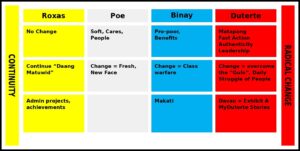
With that emotional reality as our anchor, we positioned the candidates not on ideology but on the question that mattered most: Would you want more of the same?
- Mar Roxas represented continuity — and in an environment where people were exhausted by the current administration’s shortcomings, continuity was not a selling point.
- Grace Poe represented a softer version of the same governance philosophy — Daang Matuwid na may Puso — but without the experience to make good on its promises.
- Jejomar Binay represented change, but tainted change — a candidate whose record was shadowed by widely publicized corruption allegations.
And then there was Duterte. Change — real change. Tunay na pagbabago. Experienced, decisive, and unbothered by the sensitivities that had paralyzed previous administrations.
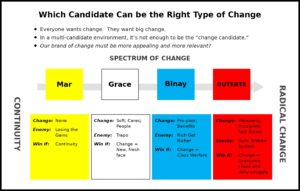
The frame was simple: If you want continuity, support Mar. If you want similar governance under an inexperienced leader, choose Grace. If you want change but under a corrupt one, choose Binay. But if you want real change — choose Duterte.
Why this framing worked
Positioning is most powerful when it is both true and felt. Every claim we made about our competitors was grounded in public record. We didn’t manufacture their weaknesses — we named them clearly and let voters draw their own conclusions.
More importantly, the frame met voters where their emotions already were. We didn’t create the frustration with the status quo. We simply gave it a direction and a choice.
The best positioning doesn’t change minds. It confirms what people already feel but haven’t been given language for.
What this means for you
Before you position your candidate or brand, understand the emotional terrain your audience is already standing on. Find that language. Own it before anyone else does. And make sure every decision, from your messaging hierarchy to your creative executions, flows from that single, clear frame.
In a crowded field, clarity is your scarcest and most valuable resource.
FAQ
Q: Doesn’t positioning your competitors risk giving them free attention?
A: Only if you name them as your primary subject. We positioned them structurally — within a frame that always redirected the audience back to the core question: what kind of change do you want? The competitors appeared as context, not as subjects.
Q: Is this approach ethical?
A: Every claim we made was factually grounded. Naming a candidate’s known weakness — corruption allegations, inexperience, policy continuity — is not an attack. It is accurate political communication. The test is whether you’re inventing weaknesses or surfacing real ones.
Q: Can this framing strategy work for brands, not just politicians?
A: Absolutely. Any time a brand operates in a crowded category, the ability to frame the competitive field — defining what each competitor represents before they define themselves — is a decisive strategic advantage. The emotional anchor changes; the logic is identical.
Previously: Post 02 — Authenticity as the most powerful campaign strategy → Next: Post 04 — Exploiting regional identity: the Bisaya na pud movement →