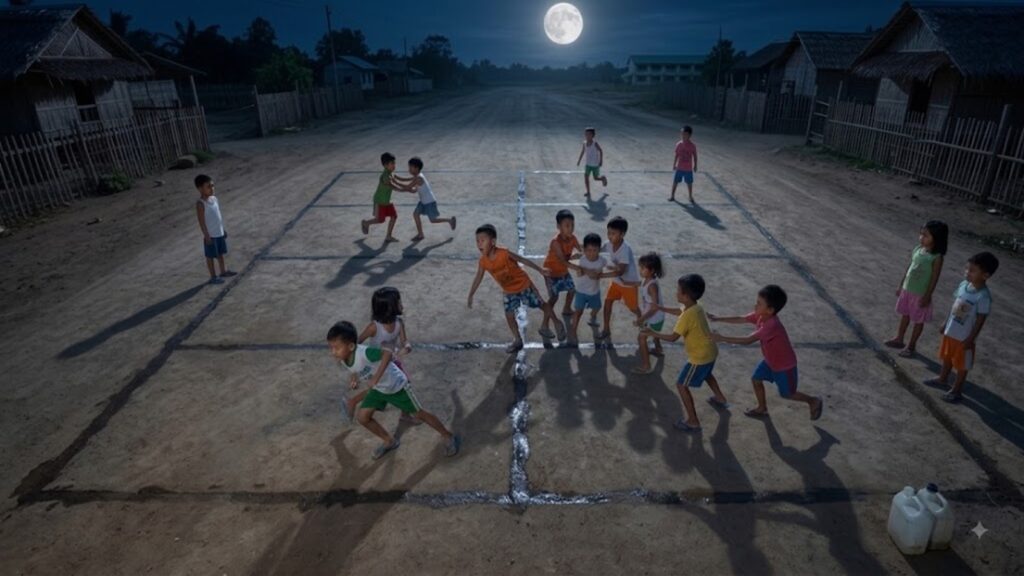

Series: Game of Titos and Titas - Part 5
Key Takeaways
- Jackstone is played with ten six-pointed metal stones and one small bouncing ball
- Ten numbered rounds — picking up one stone, then two, then three, and upward — are only the qualifier
- The real game is the exhibition round, where the leader sets a trick move and everyone else must copy it exactly
- Into the Cave, or kweba, is the hardest of the ones we played: you arch one hand on the floor and sweep the stones underneath it
- Nine named exhibitions are set down here — three from my own memory, six reported by players elsewhere
- You don’t win by being flawless. You win by imagining something nobody else can do.
All Around the World. Double Knock. Into the Cave.
Those are exhibition names — the flourishes that actually decided who won at jackstone, one of the most-played children’s games of yesteryear.
What jackstone is
Jackstone is played with ten small metal stones and one bouncy ball. The stones are six-pointed and look, more than anything, like little stars.
It was mostly a girls’ game. Boys played it too, especially on rainy afternoons when the yard was a lake and running about outside was out of the question.
The core move never changes: scatter the stones, bounce the ball once, sweep up stones with the same hand, and catch the ball before it lands again. Everything else in the game is elaboration on that single motion.
What you need
- One set of ten jackstones
- One small rubber ball
- A hard, flat floor — tile or wood, never a rug
- Two to ten players
More players means a longer game. Ten players means an entire afternoon.
You could buy a jackstone set anywhere once — toyshops, sari-sari stores, and vendors camped outside the school gate at dismissal. The good sets were metal or heavy plastic. The cheap ones bent if you stepped on them, and somebody always stepped on them. Nobody minded much.
How to play jackstone
1. Scatter. Toss the ten stones onto the floor so they spread out. Too tight and you can’t isolate one; too wide and you can’t reach the far ones. The scatter is itself a skill.
2. Round one — ones. Bounce the ball, pick up one stone, catch the ball after a single bounce. Set that stone aside. Repeat until all ten are collected.
3. Round two — twos. The same, but sweeping two stones per bounce.
4. Keep climbing. Threes, then fours, and upward to ten. The stones become harder to group as the number rises, and by the high rounds you are arranging the scatter in your head before you even throw.
5. Miss and you get called a pig. Drop a stone, fail to catch the ball, or let the ball bounce twice, and the turn passes. You resume from the round you failed on next time around.
You also get called baboy — a pig — by everyone watching. This happened whether you fumbled a simple round of twos or collapsed on an exhibition, and it was delivered with real relish. There was no ceremony to winning at jackstone. The ceremony was all in the failing.
6. Clear all ten rounds and you reach the exhibition.
The exhibitions we played
This is the real game.
The first player to finish the numbered rounds becomes the leader. The leader sets an exhibition. Everyone else has to reproduce it exactly.
These are the three I remember by name:
- Double Knock — tap the stone twice on the floor before picking it up, still catching the ball on a single bounce
- All Around the World — circle the stone around the bouncing ball before collecting it
- Into the Cave — sweep the stones under an arch made by your other hand
Fail to copy the leader’s exhibition and you’re eliminated. The game ends when the leader finally runs out of ideas.
Which is why the best jackstone players were not necessarily the fastest or the steadiest. They were the most inventive. Technical skill only got you to the exhibition round — it didn’t win it.
You didn’t win by being flawless. You won by imagining something nobody else could do.
I’ve thought about that a fair bit since. A game where the qualifying rounds test execution and the final round tests imagination is a better-designed competition than most things I have encountered in professional life.
Into the Cave
Of all the exhibitions, this is the one worth describing properly — partly because it’s the hardest, and partly because I have never seen it written down anywhere.
Some players called it kweba.
Instead of sweeping the stones off open floor, you have to get them into a cave. And you build the cave out of your own hand.
Making the cave. Before you throw, lay your non-dominant hand flat on the floor. Tent the knuckles upward so the hand arches, keeping your fingertips and the heel of your palm on the ground. The gap underneath is the cave, and the mouth of it faces the stones.
Playing the round.
- Scatter the stones loosely in front of the entrance, then bounce the ball
- Sweep the required number of stones — ones first, then twos, and upward — right inside the cave
- Catch the ball on a single bounce, with the arched hand held perfectly still
- On the next throw, reach back into the cave, pull those same stones out, and catch the ball again
Fouls. Three ways to lose it, and everyone loses it at least once:
- Collapsing the cave — flattening the arch or lifting your fingers while sweeping
- Stuck at the entrance — a stone left sitting on the threshold instead of fully inside doesn’t count
- The second bounce — the arch slows you down, and the ball does not wait
And the cruel version. Kweba-labas — in and out. Sweep the stone into the cave, pull it back out, and catch the ball, all on a single throw and a single bounce.
I remember it being close to impossible. Which of course is why the good players set it.
Exhibitions from elsewhere
Those three are what I can vouch for. But jackstone was played in every province, and the exhibition round is by definition the part that varied most — the whole point was that the leader made something up.
The ones below I never played. I only heard about them much later in life, long after I had put the stones away, and I set them down here as reported rather than remembered. If you played any of them, or knew one by another name, the comments are the place to say so.
Hakot — the gather. Toss the ball, sweep all ten scattered stones into one tight cluster, and catch on the bounce. From then on you work the standard progression out of that pile without nudging the neighbouring stones.
Lukso — the leap. Instead of sweeping stones along the floor, you pinch them clean off it. The hand comes down like a bird. Drag a stone, or shift another while lifting, and your turn is over.
Pikit — eyes closed. Memorise where the stones lie, shut your eyes, and clear the round blind. A gentler version has you close your eyes only while the ball is in the air, opening them to catch.
Binaliktad — upside down. Catch the bouncing ball on the back of your hand instead of the palm.
Halik-Manok — the chicken kiss. Pick up a stone and touch it to your lips, or peck at it, before securing the ball.
Kandado — the lock. Once a stone is picked up it must be locked between two fingers — between the ring finger and the little finger, say — and held there while you go on collecting the rest.
Two more names have reached me without descriptions: Over the Wall and Through the Bridge. If either is familiar to you, I would like to know what they were.
Frequently asked questions
How many stones are used in jackstone? Ten, plus one small rubber ball.
What is the exhibition round in jackstone? The final round, reached by clearing all ten numbered rounds. The first player to get there sets a trick move, and every other player must copy it exactly or be eliminated.
What is Into the Cave in jackstone? An advanced exhibition, also called kweba. You arch your non-dominant hand on the floor to form a cave, sweep the stones inside it, and catch the ball on a single bounce — then retrieve them on the next throw. Flattening the arch, or leaving a stone at the entrance, is a foul.
What does baboy mean in jackstone? Baboy means pig. It’s what the other players called you when you fumbled a round or failed an exhibition — the standard, cheerfully merciless penalty for a miss.
Is jackstone the same as jacks? It belongs to the same family. The Filipino version standardises on ten stones and adds the exhibition round, which is where the game’s real character lives.
How do you win at jackstone? By surviving the exhibition round. The game ends when the leader runs out of new exhibitions to set — so the most inventive player, not merely the most skilful, tends to win.
For the bona fide titos and titas out there — did you play jackstone in your youth, and what did you call your exhibitions? I’ve set down the three I remember and six more I’ve been told about, but I’m certain that isn’t all of them. If you knew one by another name, or knew one I’ve missed, tell me in the comments and I’ll add it. I’d like to get these written down before they go.
Game of Titos and Titas — the full series
- Lastiko: The Filipino Rubber Band Games We Played as Kids
- Birus: The Filipino Hide-and-Seek Played by Moonlight
- Holen: How to Play the Filipino Marble Game
- Syatong: How to Play the Filipino Stick Game
- Jackstone: The Game of Skill and Flair (you are here) — final part