
Part one of seven. In June and July 2021, veteran Mindanao journalist Edwin Espejo published a seven-part series on Facebook examining how the political opposition attempted to reduce the 2016 Duterte campaign — and the people behind it — to a story about “trolls.” The series is republished here in full, with Espejo’s text unchanged apart from minor copyediting. The introductory notes preceding each installment are mine and should not be read as part of Espejo’s original work.
Readers should know that I am a subject of the series as well as its publisher. Espejo wrote it independently and without my involvement; I have republished it without altering his argument, including where he is generous about my role.
A note on scope. Espejo wrote this series in 2021. Its subject is the mechanics of the 2016 campaign and the narrative that was built around the people who ran it. It does not address events after that date, including the proceedings now before the International Criminal Court, and should not be read as commentary on them.
Introduction by Nic Gabunada
Looking back at the noise and the narratives of the past few years, I am resharing this seven-part series by veteran journalist Edwin Espejo.
Edwin wrote it in the middle of 2021, when the opposition was once again working to decapitate those of us behind President Duterte’s campaign — the word was to call us trolls, and by calling us trolls, to avoid ever having to explain the movement that put him in Malacañang.
That same disconnect is still playing out in our politics. The vocabulary changes a little each cycle. The reflex does not. Here is the first part, as originally published on Facebook.
— Nic Gabunada
Decapitating the ‘Trolls’ of Duterte
First of a series
By Edwin Espejo | June 28, 2021
A known communication specialist during the 2016 presidential campaign identified with the then Davao City Mayor Rodrigo Duterte campaign camp was recently in the headlines after he reportedly bagged a contract with the Department of Finance to help in developing the agency’s “brand and communications strategies.”
Nicanor Gabunada, a resident of a sleepy town of Padada in Davao del Sur, is a retired top marketing man of ABS-CBN who surfaced and appeared in online and television interviews several weeks after Mayor Rodrigo Duterte was proclaimed winner of the 2016 presidential elections.
Gabunada was a former student activist but graduated magna cum laude in management engineering at the Ateneo de Davao University.
Low-key and unassuming, Gabunada was not engaged in public relations prior to his involvement in the 2016 presidential elections.
In fact, no one in the communications group of Duterte was engaged in the profession that is public relations.
Rappler’s core of editors, including Maria Ressa, was a contemporary of Gabunada at ABS-CBN, albeit in different departments. He in the marketing arm and Ressa as head of its news and public affairs department.
Gabunada retired from ABS-CBN in 2005 while Maria Ressa and her associates went on to establish Rappler, an online news outlet now more known as Rappler, in January 2012*.
He went into freelance consulting practice and joined Omnicom Media Group, a media ad placement agency, but resigned in 2015 to join Duterte’s team.
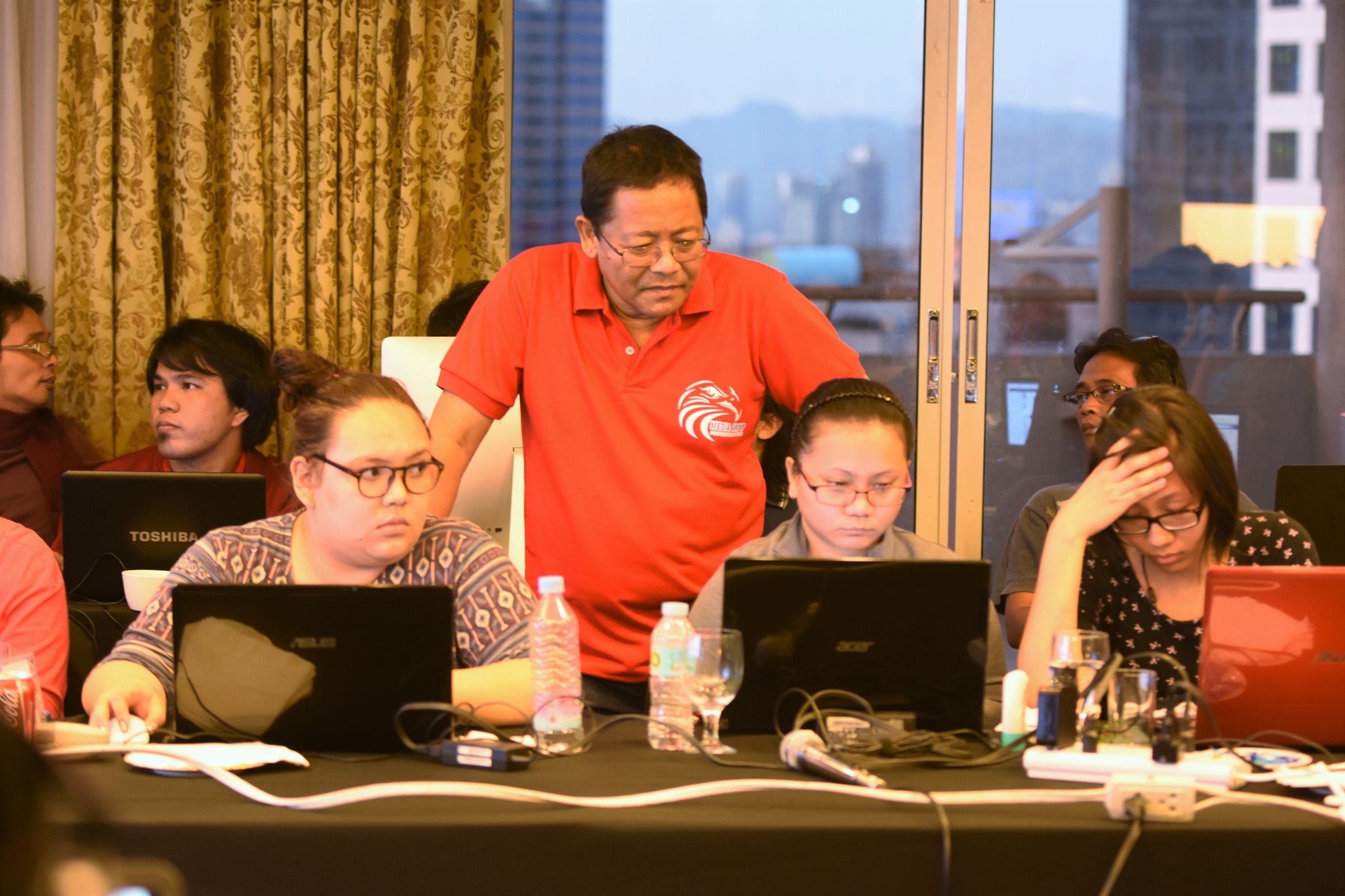
Unlike the high-profile communication and PR teams of the 2016 major presidential candidates, Duterte’s media group was composed of media volunteers and journalists from Davao City and nearby provinces. Its video production teams were a ragtag band of amateur events videographers and photographers with no previous media production outputs of national import.
(To be continued)
About Edwin Espejo
Edwin Espejo is a journalist based in General Santos City. He has written for Asian Correspondent and MindaNews and shoots for Agence France-Presse. He chaired the General Santos City chapter of the National Union of Journalists of the Philippines through years in which Mindanao was the most dangerous place in the country to be a reporter, and was among those publicly demanding arrests after the murder of journalist Christopher Guarin in 2012. That same year, then-congressman Manny Pacquiao sued him for ₱75 million over his reporting in Asian Correspondent; a companion suit filed by a Pacquiao associate was dismissed by prosecutors for lack of convincing proof.
Espejo served as a commissioner of the National Commission of Senior Citizens from January 2021 to April 2026, and held that post when he wrote this series.
Notes:
Decapitating the ‘trolls’ of Duterte — Edwin Espejo’s seven-part series
Part 1 — Decapitating the ‘trolls’ of Duterte: A 7-Part Retrospective (you are here)
Part 2 — The Anatomy of a Disconnect: Why the ‘Troll’ Narrative Failed to Explain 2016
Part 3 — The Unseen Momentum: Rewriting the Rules of Engagement
Part 4 — A Target Board Over My Back
Part 5 — The Story That Comes Back Every Election Season
Part 6 — The Ad Men Can Only Be as Good as the Product
Part 7 — Beyond the ‘Troll’ Label: A Reality Check for the Opposition
*This post was published on March 19, 2024. My introduction has been revised. The original text has been lightly copyedited for typographical errors, and one factual correction has been made: Rappler was launched in January 2012, not 2008 as originally stated. No argument, characterization or judgment in Edwin Espejo’s original has been altered.