
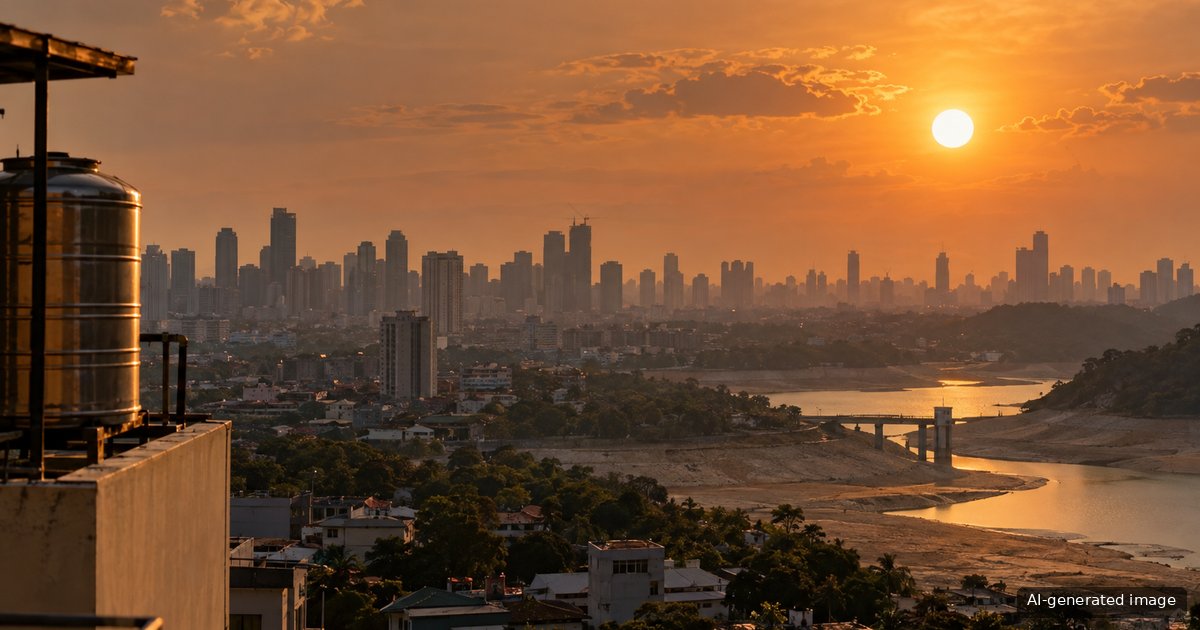
We’ve been hearing about El Niño for as long as most of us can remember. It usually means hotter days, less rain and reminders to save water. Then the rains return, the dams refill and life goes on.
This time feels different. The media now call it a Super El Niño, and the forecasts behind that name are hard to ignore. So the question at the back of my mind is simple: how scared should we actually be? And what can ordinary Filipinos do about it?
What PAGASA Says About the Super El Niño
PAGASA says a strong El Niño is already present in the Pacific. It expects the event to intensify into a “very strong” state between October and December 2026 and to persist until the first half of 2027. PAGASA Administrator Nathaniel Servando has said the peak will fall within October to December, although impacts will vary by area.
International forecasters agree. In its September forecast, Columbia University’s International Research Institute for Climate and Society (IRI) reported a Niño 3.4 reading of about +3.0°C. All 22 models it tracks point to a very strong El Niño in the coming months.
The US National Oceanic and Atmospheric Administration (NOAA) goes even further. It sees a 75 percent chance that this will be the strongest El Niño since 1950.
“Super El Niño” is the popular label. PAGASA’s technical term is “Very Strong El Niño.” Either way, the numbers are unusual.
I’ve Lived Through This Before
I remember a long drought less in numbers than in meals.
In 1972, a long drought hit the Philippines and the harvests failed. Back home in Padada, corn was our everyday staple. Suddenly, it became hard to find.
So we turned to government rice, what most people today would know as NFA rice. We lined up at accredited stores to buy the few kilos each family was allowed. Even that wasn’t always enough. On some days, we lived on lugaw, stretching what little rice we had to feed more mouths.
The drought also reached our classrooms. Quite a number of my high school classmates could not enroll the following school year because their families’ crops had failed.
Things improved a bit when the first rains came in the first quarter of 1973. By then, however, the farms of our town and the neighboring places had changed.
That is the part of a drought that statistics rarely capture. It shows up at the dinner table and in the empty seats of a classroom, long before it appears in a government report.
The Philippines Has Faced This Before
The country has been through other severe droughts since. Some of the worst came in 1982–83, 1986–87 and 1997–98.
The 1997–98 episode is a sobering reminder. According to IRI, about 70 percent of the country suffered severe drought. Angat Reservoir averaged only 32 percent of normal levels during critical months, and Metro Manila had to ration water. Irrigation was cut off to 27,000 hectares, and agricultural and fisheries productivity fell 6.6 percent.
We don’t have to look that far back, though. Just this year, before the Super El Niño had fully taken hold, Luzon’s dams ran dangerously low.
By July, Angat, San Roque and Pantabangan had all fallen below their minimum operating levels. Angat supplies about 90 percent of Metro Manila’s water. It sank far below its 180-meter minimum operating level and deep past the 160-meter critical mark.
In late July, Angat hit an all-time low of 150.55 meters. That broke the previous record of 157.57 meters set during the 2010 El Niño.
As a result, water allocations for Metro Manila were reduced and irrigation to farms in Bulacan and Pampanga was halted. Some 27,000 hectares of rice fields lost their water, almost the same area cut off in 1997–98. History has a way of repeating its numbers.
Later rains brought Angat back up from its record low. Still, if our dams could fall that far before this El Niño even peaked, the dry months ahead deserve our full attention.
When Will the Super El Niño Hit Hardest?
Here is the catch. Out in the Pacific, the Super El Niño should peak before the end of 2026. On the ground, however, its effects are expected to be worst in the first quarter of 2027, during the dry season.
That is when our water, food and power supplies will be tested most. In other words, we still have a few months to prepare, but not many.
Is the Government Doing Enough?
The government says it is moving. According to Malacañang, the Department of Agriculture is assessing irrigation systems, promoting drought-resistant crops and adjusting planting schedules. The National Irrigation Administration has a mitigation plan for farmers. The Department of Energy is preparing for possible power disruptions, and health authorities are stepping up measures against heat-related illness.
The government has also adopted a National Action Plan for El Niño that puts food and water first, with local governments on the frontline.
On paper, that sounds reassuring. But I have been around government long enough to know that a plan announced at a Palace briefing is not the same as water reaching a farmer’s field in February. A few questions deserve to be asked.
First, is there enough money? The DA is seeking an additional ₱10 billion for El Niño mitigation, on top of ₱6.2 billion already released for fuel and fertilizer assistance. That is roughly ₱16 billion to cushion farmers and fisherfolk against what could be one of the strongest El Niño events on record. There is also a broader national disaster fund, but it has to cover every calamity, not just this one.
Now compare that with what we lost to flood control. Finance Secretary Ralph Recto estimated that ₱42.3 billion to ₱118.5 billion was lost to “ghost” flood control projects from 2023 to 2025. Senator Panfilo Lacson, who led the Senate probe, put the amount diverted to ghost projects since 2016 at about ₱180 billion.
Even the lowest estimate is more than two and a half times the DA’s entire El Niño request. The highest is more than ten times.
The irony is hard to miss. Much of that money was tagged as climate adaptation spending, meant to make us more resilient to extreme weather.
Imagine what it could have bought for a drought: repaired irrigation canals, small water impounding projects, solar-powered pumps, desilted reservoirs and replanted watersheds. Instead, too many communities got projects that existed only on paper.
Second, is there enough time? Desilting canals, building water impounding structures and tapping groundwater all take months. The dry season is only a few months away.
Meanwhile, honest spending has slowed too. Infrastructure spending fell 40.8 percent in the first half of 2026 as tighter safeguards imposed after the scandal delayed payments. The budget department itself warns that a severe El Niño could disrupt the infrastructure program in early 2027. In short, the scandal didn’t just steal money; it also slowed down the work that was never stolen.
Third, will the help reach the people who need it? After the flood control scandal, it is fair to ask how fuel subsidies, seeds, pumps and irrigation funds will be tracked. The public should be able to see who gets what, where and when.
None of this means the government’s preparations are pointless. It means they deserve scrutiny. The 2023–24 El Niño cost agriculture ₱57.78 billion, the largest losses in recent history. We cannot afford another round where money meant to protect our farmers and our water ends up protecting someone’s pockets.
How to Prepare for the Super El Niño
Government will carry much of the load. However, much of the Super El Niño’s impact will be felt at home, at work and in the barangay. That is where small habits, started now, can make a real difference.
Save water. Fix leaking faucets and toilets now. To find hidden leaks, turn off all taps and check whether your water meter still moves. Reuse rice-rinse water for plants and laundry water for flushing. Use a timba instead of a hose. Store a reserve in clean, covered containers, since open drums breed dengue mosquitoes. Finally, follow your water utility’s advisories, and boil drinking water if you’re unsure of its quality.
Beat the heat. Check PAGASA’s heat index forecasts and avoid the hottest hours of the day. Drink water regularly, and pay special attention to children, seniors and outdoor workers. Learn the warning signs. Dizziness, nausea and heavy sweating can mean heat exhaustion. Confusion or hot, dry skin can mean heat stroke, which needs immediate medical help. Never leave children or pets in a parked car.
Ease the load on the grid. Set the aircon to a moderate temperature and pair it with a fan. Clean the filters and unplug idle appliances. Keep power banks and rechargeable lights ready for brownouts. If anyone at home depends on refrigerated medicine or medical equipment, plan ahead.
Protect the budget, but don’t hoard. Expect some food prices to rise. Plan meals, buy local and in-season produce, and reduce waste. Remember that panic-buying only creates the shortages people fear.
Prevent fires. Dry weather makes grass and garbage fires more likely. Avoid open burning, which is already prohibited by law.
Look out for each other. Employers can provide water and shaded rest areas for outdoor staff. Schools can limit outdoor activities on high heat-index days. Barangays can identify seniors living alone and households without water storage. This is bayanihan at its most practical.
Support farmers and fisherfolk. For them, the stakes are higher. Farmers should stay in touch with their municipal agriculturist and insure crops and livestock with the Philippine Crop Insurance Corporation (PCIC) before losses happen. It also helps to ask about shorter-maturing or drought-tolerant varieties. Fish farmers should follow BFAR advisories, since warmer water can cause fish kills.
Check your sources. Rely on PAGASA, your LGU and your utilities, not viral posts. Misinformation spreads almost as fast as the drought itself.
Don’t Panic. Prepare.
The biggest difference between 1972 and today isn’t the temperature of the Pacific. It’s how much warning we have.
After the 1986–87 drought, the Philippines built a drought monitoring and early-warning system and set up agencies to manage climate risk. Today, PAGASA issues regular El Niño advisories, months ahead.
Still, this Super El Niño won’t be painless. Some communities will face water shortages. Some farmers will lose crops. Many families will struggle with dangerous heat.
But an El Niño is not, by itself, a disaster. What turns a climate event into a disaster is the failure to prepare for it.
So how scared should we be? Concerned, certainly. Complacent, certainly not. Panicked, no.
We know we can survive another El Niño. I did, on lugaw and NFA rice. The more important question is whether we have learned enough to make this one less painful. That depends as much on our homes and barangays as on government offices, and on whether public money finally goes where it is supposed to.