
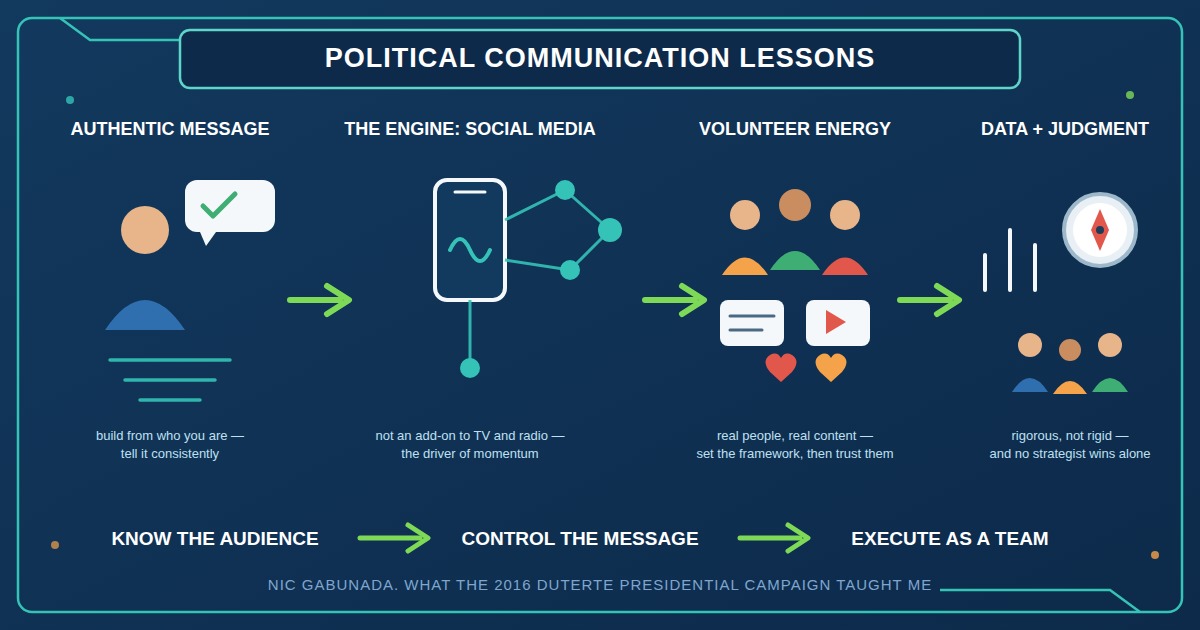
Key Takeaways:
- This post is about strategy, not politics — what the 2016 campaign taught me about communication at scale
- Authenticity at scale is possible, but it requires the discipline not to smooth out your candidate or brand
- Social media wasn’t an add-on, it was the engine — you can’t manufacture organic movement, only create conditions for it
- The volunteers were the campaign’s greatest assets; my job was to set the framework and get out of the way
- Data matters, but so does judgment — the best strategists are rigorous without being rigid.
In 2016, I was a member of the Communications Group of Rodrigo Duterte’s presidential campaign, in charge of social media and the execution of the campaign’s TV and radio advertising. What happened over those months was, by any political communication measure, historic.
Let me be clear about something upfront: this post isn’t about politics. It’s about strategy. It’s about what I observed, what worked, and what I learned — lessons that apply whether you’re running a national campaign, launching a product, or building a movement around a cause.
With that said, here’s what the 2016 campaign taught me about political communication.
Authenticity at scale requires discipline
Duterte was a candidate who did not fit the traditional mold. The campaign understood that trying to smooth him out, dress him up, or package him like a conventional politician would have been a mistake. The message strategy had to be built around who he actually was — not who handlers might have wished he were.
The lesson for every brand and campaign: don’t fight your authentic truth. Build from it.
Audiences can smell inauthenticity from a mile away. So your job is to find the most compelling, honest version of the story — and tell it consistently.
Social media was the engine, not an add-on
At the time, many traditional political operatives still treated social media as supplementary. Something you did in addition to TV and radio buys. Not something that drove momentum.
We treated it differently.
Social media was where the conversation was happening. It was where supporters organized, where the message was amplified, and where the campaign had a genuine, organic community. Our job was to support that ecosystem — with content, with coordination, with clear strategic direction — not to control it.
That’s a crucial distinction. You can’t manufacture an organic movement. You can only create the conditions for it.
The volunteer energy was the greatest asset
Some of the most effective content from 2016 didn’t come from professionals. It came from volunteers — ordinary people who believed in the cause and expressed it in ways their own communities found authentic. Memes, videos, posts that traveled because they felt real. Because they were real.
My role — and this is consistent with how I’ve always worked — was to set the strategic framework and then get out of the way. Let the people closest to the audience do what they do best. Empower them, equip them, trust them.
Data matters — but so does judgment
We used data throughout the campaign. Audience research, sentiment tracking, reach and engagement metrics, and other scientific data gathering and analysis tools available and affordable.
But data can only tell you so much. There were moments when we had to make calls on incomplete information — on instinct sharpened by experience, on a read of the room no survey could capture.
The best strategists I know, whether in political communication, brand marketing, or PR, can hold both. Rigorous, but not rigid.
The team is everything
After the campaign, one of my volunteers created a meme describing my management style. It listed things like: coaches, not commands; says “we,” not “I”; gives credit, doesn’t take it.
I’m proud of that description.
The 2016 campaign reinforced something I’ve believed my whole career: no strategist wins alone. You win with the people around you. You win by building a team that trusts each other, pulls in the same direction, and believes victory is possible.
The takeaway
Political communication is, at its core, just communication — with higher stakes and a harder deadline. The fundamentals don’t change. Know your audience. Control your message. Use your channels wisely. Build a team that can execute under pressure.
The lessons from 2016 are as useful in a brand war as they are in an election.