Series: Inside the Campaign
First of 10 Parts
Key Takeaways:
- Social media in 2016 was no longer a youth or elite medium — it reached every corner of the Philippines
- With 42 million active social media users and free Facebook from telcos, the platform was effectively free for millions
- We spent a fraction of what our competitors did on traditional media — and won
- Social media scales both authentic messages and disinformation equally — discipline is non-negotiable
- For strategists: stop treating social as supplementary. In many campaigns, it IS the campaign.
For years, the conventional wisdom in Philippine politics was simple: if you want to win, you dominate television. TV was king. Radio was queen. Everything else was a footnote.
The 2016 presidential elections changed all of that — and I say this not as an observer, but as someone who was inside the room when the shift happened.
I was part of the Communications Group of then-candidate Rodrigo Roa Duterte. My mandate covered TV and radio strategy, but increasingly, the most important battlefield we found ourselves on was social media. And what I witnessed there permanently changed how I think about media, message, and movement.
Social media is no longer a niche medium
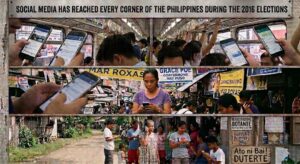
Let me put to rest a stubborn myth: that social media is only for the young, the educated, and the urban affluent. That may have been true in 2010. It is no longer true during the 2016 campaign. The 2016 campaign proved, conclusively, that social media has gone not just hanggang sa laylayan — down to the margins — but hanggang sa kaloob-looban — deep into the country’s most remote communities.
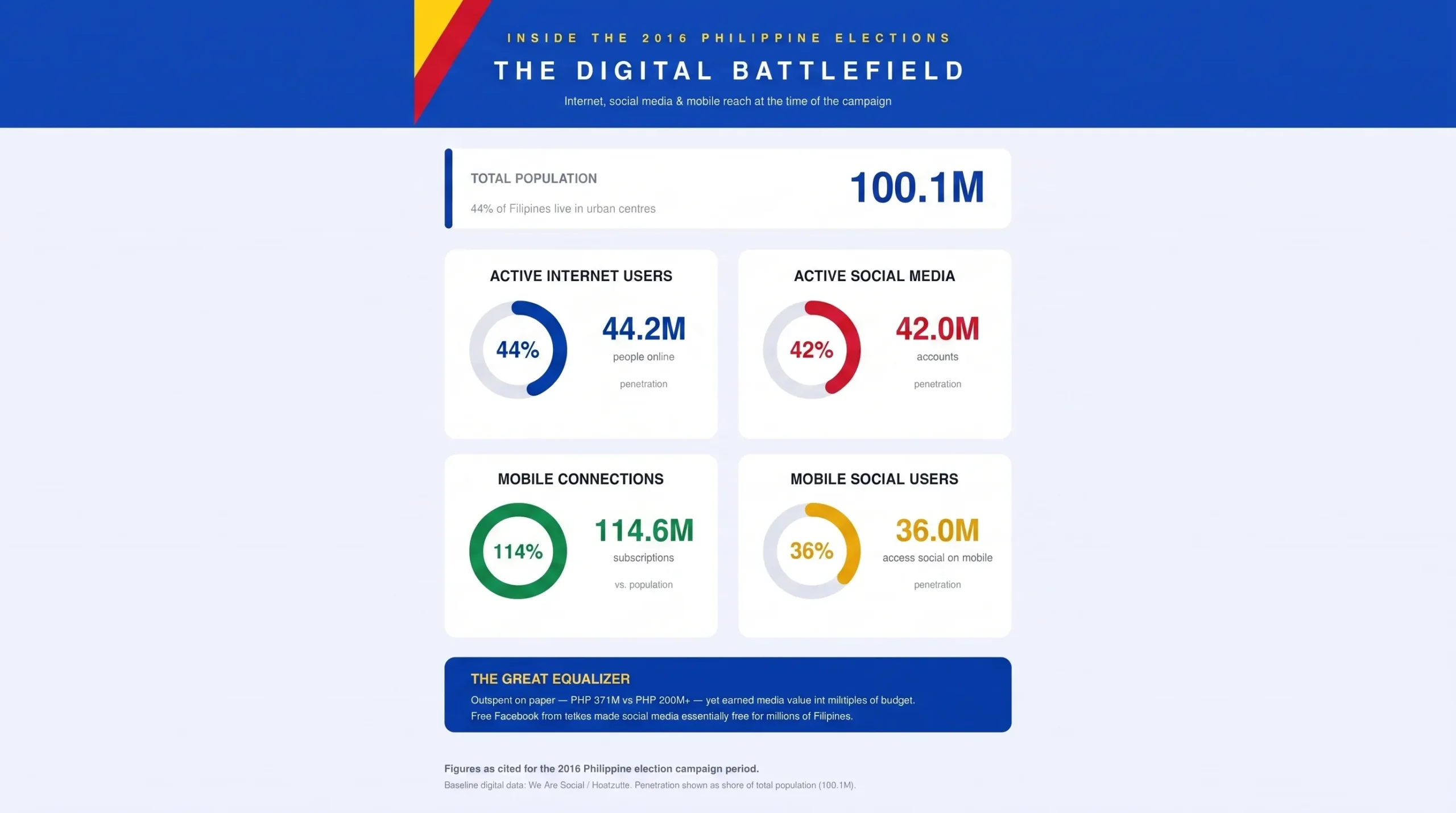
With 44.2 million active internet users, 42 million active social media users, and 36 million active mobile social users at the time of the campaign, the numbers alone told us we were standing in front of a medium unlike anything Philippine politics had used before. Add to that the free Facebook deals being offered by the country’s telcos, and suddenly social media wasn’t just accessible — it was essentially free for millions of Filipinos.
It became the great equalizer
Traditional media — TV, radio, print — requires money. Lots of it. The candidate who spends more generally gets more airtime, more coverage, more reach. In the 2016 race, the leading spender on advocacy ads reportedly spent over ₱500 million. Our official spend was ₱371 million — but in reality, we got media values that were multiples of that figure: not only because of relationships I’d cultivated with network friends over the years, but also because of the added value we earned from social media exposure and engagement.
By traditional logic, we were outspent.
But social media doesn’t work by traditional logic. A post shared by a passionate supporter in Cagayan de Oro reaches as far as a TV ad. A meme crafted by a volunteer in Davao travels to OFWs in the Middle East. A testimonial written by an ordinary citizen in Cebu lands in the feed of a first-time voter in Metro Manila. The medium scales without a media buy.
Outspent on paper — but our media value was multiples of our budget. That is the arithmetic of social media done right.
But — and this is important — it also scales the mischief
I won’t pretend the digital space was clean. There was, alongside all of that organic energy, a fair amount of digital kalokohan — pseudo-bloggers, manufactured publications, coordinated noise. This is par for the course in any online environment. It made things complicated. It also made things exciting. We had to be sharp, fast, and disciplined in our messaging precisely because the information environment was so chaotic.
What this means for you
If you’re a marketer, a PR professional, or a digital strategist still treating social media as a supplementary channel — a boost to your real campaign — I want to challenge that thinking. Social media is no longer the amplifier. In many cases, it is the campaign. The question is not whether your audience is there. They are. The question is whether you understand them well enough to move them.
The 2016 elections were proof. And I was there to see it.
Next in the series: Post 02 — Authenticity as the most powerful campaign strategy →
Share this post if you know a strategist still building campaigns around TV-first thinking. The shift has already happened.
Email: nicgabjr@gmail.com X: @nicgabunada.com