
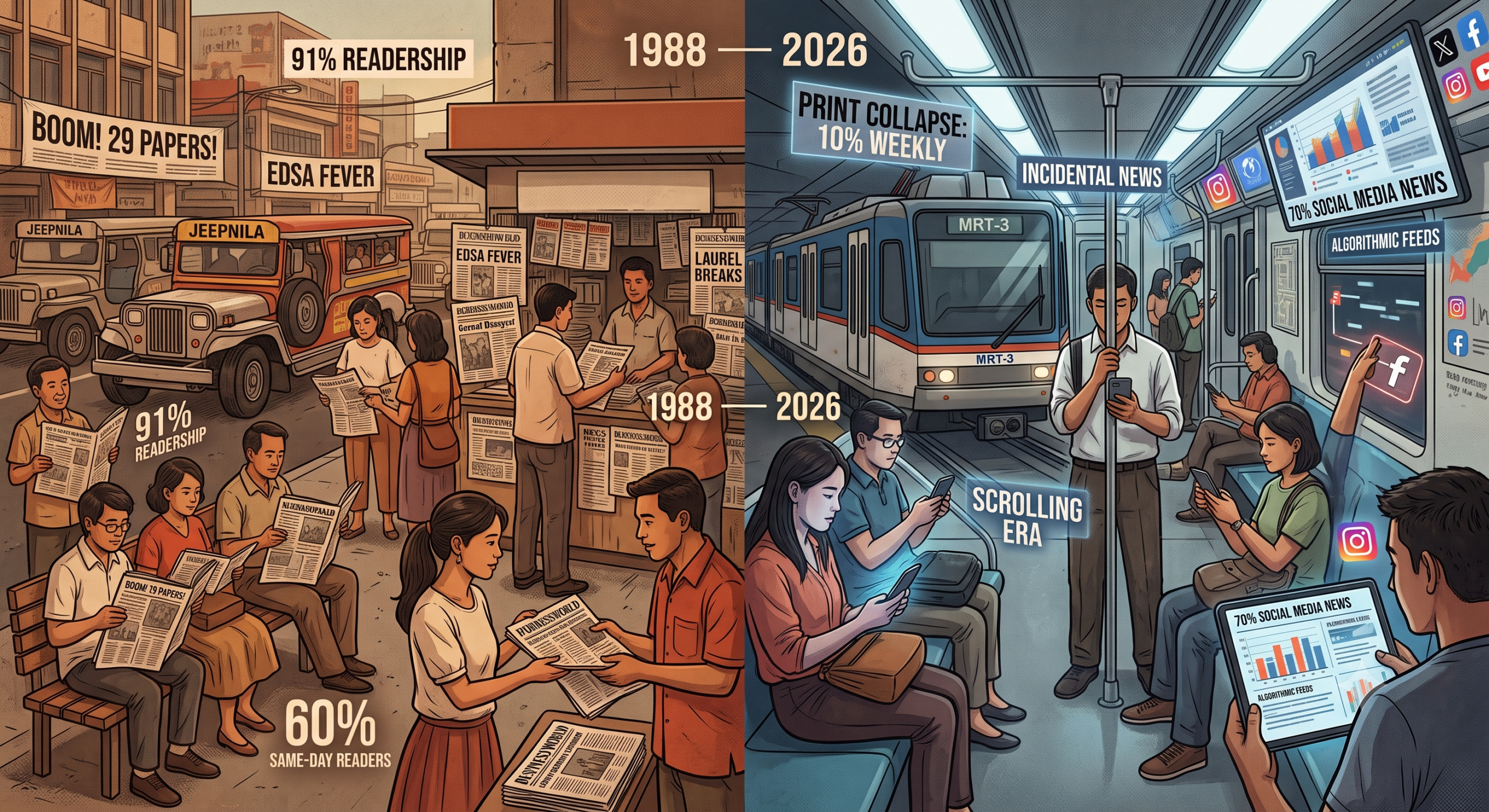
One of the most significant changes I’ve witnessed is the effect of declining newspaper readership over the decades.
Looking back at the column I wrote for BusinessWorld in 1988, titled “Declining newspaper readership in Metro Manila,” I am struck by how equivocal I was at the time about a trend that, in hindsight, was the first tremor of a seismic shift in media consumption. I didn’t sound an alarm back then—I explicitly asked whether the decline meant the market was shrinking, and answered myself: “Not necessarily.”

At the time, my analysis was grounded in fresh data from our Pulse Research Group’s Media Profile study. We were tracking an extraordinary post-EDSA Revolution press boom. In 1985, our tables listed just 13 mainstream newspapers. By 1988, that number had risen to 29 separate titles—the biggest number yet. The public, starved for uncensored news for 16 years, had an insatiable appetite.
Yet my research at the time revealed a curious paradox: despite a record supply of newspapers, Metro Manila readership had suddenly dropped from 96% in 1987 to 91% in 1988, after rising steadily since 1986. The trend looked sharper still in another figure I tracked: the share of Metro Manila respondents who said they hadn’t read a newspaper at all roughly doubled in a single year, from 4% in 1987 to 9% in 1988. Same-day readership—people who’d read a paper in the past 24 hours—slipped from 69% to 60%.
I attributed most of this to a duller news cycle rather than a structural shift. 1988 simply had fewer cliffhangers than the snap elections of 1986 and the dramatic events of 1987; I went so far as to describe the news of the year as “zzzzzzz… boring.” I also pointed to the rising pull of tabloid-style prime-time television and radio news, which I called the biggest challenge newspapers would have to contend with. And I noted that about 19% of readers didn’t buy papers at all but only borrowed them from neighbors—though even then, I doubted that a drop in borrowing habits would meaningfully affect circulation.
MarkDynamics Revealed by Online Research
Decades later, I decided to do some online research to see how that “Not necessarily” actually played out. It turns out the market was, in fact, shrinking—just not yet, and not for the reasons I considered most likely at the time. The dip I shrugged off in 1988 as a quiet news year was the opening note of print’s long-term decline, and television’s “biggest challenge” has since become its own.
My recent digital deep-dive revealed a radically altered landscape, drawing on institutional tracking:
Massive Consolidation: The hyper-saturated market of 29 competing papers I wrote about has shrunk drastically. According to a study published by the Philippine Institute for Development Studies (PIDS), high production costs and migrating ad revenues have caused a massive contraction. In Metro Manila, the number of newspaper establishments plunged from 76 down to just 32, leaving a highly concentrated market where the top four players control a staggering 83% of the total industry revenue.
The Collapse of Print, the Erosion of Broadcast: In 1988, a dip to 91% readership and a doubling of non-readers seemed, to me, like a blip explained by a slow news year. The Reuters Institute Digital News Report 2026 shows just how far that “blip” eventually went. Between 2020 and 2026 alone, weekly newspaper readership in the Philippines fell from 22% to just 10%. Television, the medium I identified as print’s biggest challenge, is now losing its own audience: weekly TV news use dropped from 66% to 42% over the same six years, radio fell from 25% to 14%, and even use of news organizations’ own websites and apps slid from 60% to 42%. General interest in news is declining too, with active “news avoidance” rising to 51%.
A Stable, Not Surging, Social Media: Here is the genuine surprise in the data. Filipino use of social media for news barely moved over that same six-year span, inching from 68% to 70%. At first glance, this looks like a simple substitution story: people abandoning newspapers, TV, and radio in favor of Facebook and TikTok. But University of the Philippines data scientist Dr. Alicor Panao, writing for the Inquirer, points out that the numbers don’t actually support that story. Traditional media collectively lost tens of percentage points over six years; social media gained only two. If audiences were simply switching platforms, social media’s growth should have absorbed at least some of what television, radio, and print lost. It didn’t.
Panao’s conclusion is more unsettling than a platform migration: many Filipinos are not switching where they get news—they are simply consuming less news, period. And there’s no clear successor waiting in the wings. Podcasts and AI chatbots, the newest entrants, each reach only about 9% of Filipinos—nowhere near enough to absorb what television and news websites have lost.
My Conclusion: The “Incidental” News Era
When I wrote that BusinessWorld piece in 1988, I believed the media landscape was a battlefield where print, radio, and television fought for the conscious, deliberate attention of the citizen.
Today, my research points to a more complicated phenomenon than a simple changing of the guard. Globally, the Reuters Institute finds that social media and video networks have, on average across 48 markets, overtaken standalone news websites and apps as the leading gateway to news (54% versus 51%)—and in the Philippines specifically, that gap is far wider: 70% for social media against just 42% for news websites and 42% for TV.
But the more striking local finding isn’t that Filipinos shifted to a new channel. It’s that they didn’t shift so much as simply drift away from news altogether, with social media’s flat trajectory standing in for genuine engagement only because everything else fell faster. News is no longer a deliberate daily purchase or a scheduled evening broadcast; for a great many Filipinos, it has become something encountered passively, occasionally, while scrolling for something else entirely—and for a growing share, barely encountered at all. Coupled with an all-time low in general media trust, which dropped sharply to just 28% in the Philippines (down 10 points, the steepest decline of any country tracked this year), the landscape has evolved into something more decentralized and disengaged than I could have imagined when I penned that column in 1988.
How has your own relationship with the news changed over the years? Do you still pick up a physical paper, or are you strictly scrolling? Let me know your thoughts in the comments below or send me a message in the addresses below.
Email: nicgabjr@gmail.com X: @nicgabunada.com