
Key Takeaways:
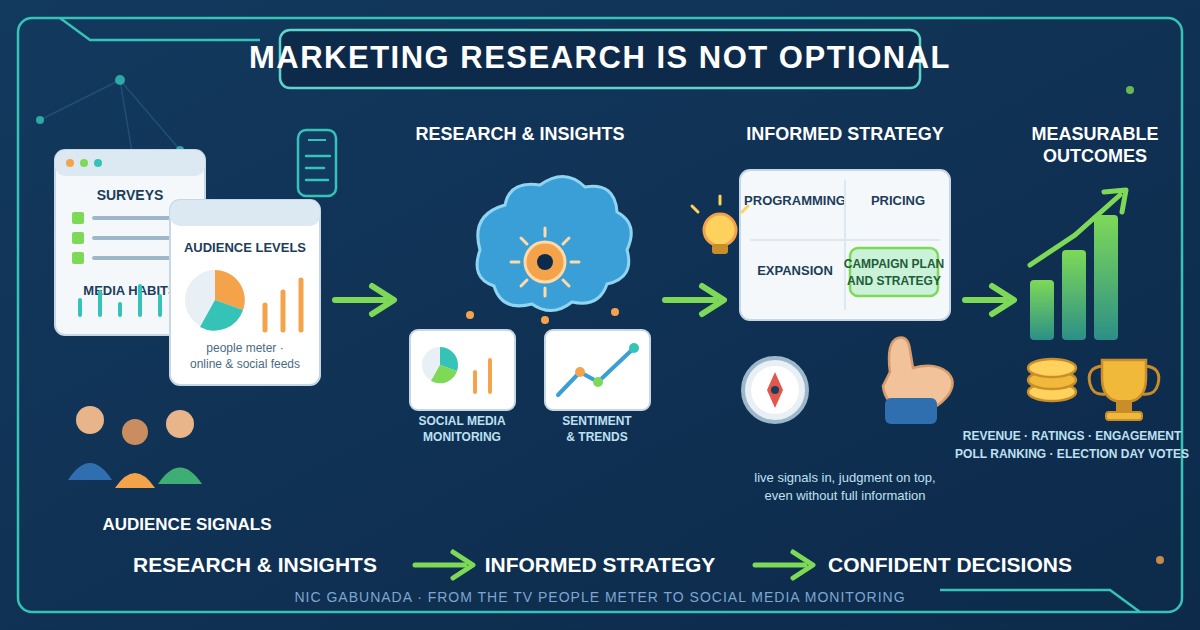
- You cannot craft an effective message if you don’t know who you’re talking to — yet gut feel decisions remain rampant
- Helping set up the Philippines’ first TV people meter changed how the industry planned and bought media
- At ABS-CBN, research informed programming, expansion, and the groundworks for Studio 23, Sky Cable, Star Cinema and more
- Research done well is not a support function — it’s a strategic weapon
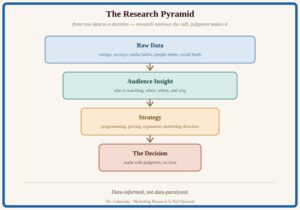
- But the best practitioners are data-informed, not data paralyzed: research reduces uncertainty, it doesn’t replace judgment
I’m going to say something that might sound obvious. But I’ve seen enough campaigns crash and burn to know it’s not practiced nearly enough: you cannot craft an effective message if you don’t know who you’re talking to.
That is what marketing research is for.
It sounds simple. Yet I’ve watched brands, media outfits, and even political campaigns make massive decisions on gut feel alone. The number of times is staggering. And expensive.
A research career that started by accident
My career in research wasn’t planned. It was, to use a word I often come back to, serendipitous.
I finished my graduate studies in Industrial Economics at CRC. Then, as part of my scholarship commitment, I worked there as an economist for three years. Only after that did I join Pulse Research Group under Rosario Chew, the acknowledged doyen of market research in the Philippines.
There, I was appointed General Manager of Media Pulse — the arm that studied the media habits of consumers. This was a revelation for me.
We provided audience research and measurement to advertisers, ad agencies, TV and radio networks, and print publications. So I got an inside track on how the industry made decisions: what information they were hungry for, where the gaps were, and how the right data could shift a campaign’s entire direction.
The TV people meter: the end of guesswork
One project from that period still makes me proud. I helped set up the TV people meter in the Philippines.
For the first time, the industry had a scientific way to measure TV viewership. No more guessing. No more relying on recall surveys alone. Real-time, people-based measurement.
It changed the game for media planning and ad buying.
Marketing research as a strategic weapon at ABS-CBN
When I moved to ABS-CBN as Head of Research and Business Analysis, I had an even bigger canvas.
Our research went far beyond ratings. It informed programming decisions, signal distribution, network expansion, and marketing direction. In fact, my unit’s studies became inputs for some of the network’s biggest moves — including the launch of Studio 23, Sky Cable, Star Cinema, Star Records, and The Filipino Channel.
Here’s my point: marketing research, done well, is not a support function. It’s a strategic weapon.
The new toolkit: online research and social media monitoring
The principles of research haven’t changed since my Media Pulse days. The tools have — dramatically.
When social media arrived, the audience stopped waiting to be surveyed. People began telling us, in real time, what they think, feel, watch, and share.
By the 2016 elections, that shift was complete. In the campaign, we used audience research, sentiment tracking, reach and engagement metrics, and other scientific data gathering and analysis tools available and affordable. Social media wasn’t just a channel for the message. It was a research instrument in itself — a live, continuous read of public sentiment.
And that’s still how I work today. In advertising and reputation management, online research and social media monitoring have become the modern people meter: always on, always measuring. A brand that listens only through quarterly surveys is navigating with last quarter’s map.
The discipline is the same one I learned decades ago. Measure scientifically. Listen continuously. Let the data sharpen — not replace — your judgment.
The other half of the skill: deciding without full information
Now, here’s the part that might surprise you, coming from a research guy. You also have to be able to make decisions without the benefit of full information.
Research gives you the foundation. But the world moves fast. Campaigns have deadlines. Opportunities don’t wait for your next survey wave.
The best practitioners I’ve worked with can synthesize incomplete data, apply good judgment, and move. That’s the standard I hold myself to as well.
So think of research as reducing your uncertainty, not eliminating it. Use it to narrow the options and sharpen your instincts. Then commit.
The takeaway: data-informed, not data-paralyzed
The next time someone on your team says, “We’ll figure out the strategy once the research comes in” — push back. Research informs strategy. It doesn’t replace the thinking. And the thinking has to start now.
For marketers, PR professionals, and digital strategists, the winners are the ones who are data-informed but not data-paralyzed. Build that research muscle. Then learn when to trust your gut on top of it.
Email: nicgabjr@gmail.com X: @nicgabunada.com