
Key Takeaways:
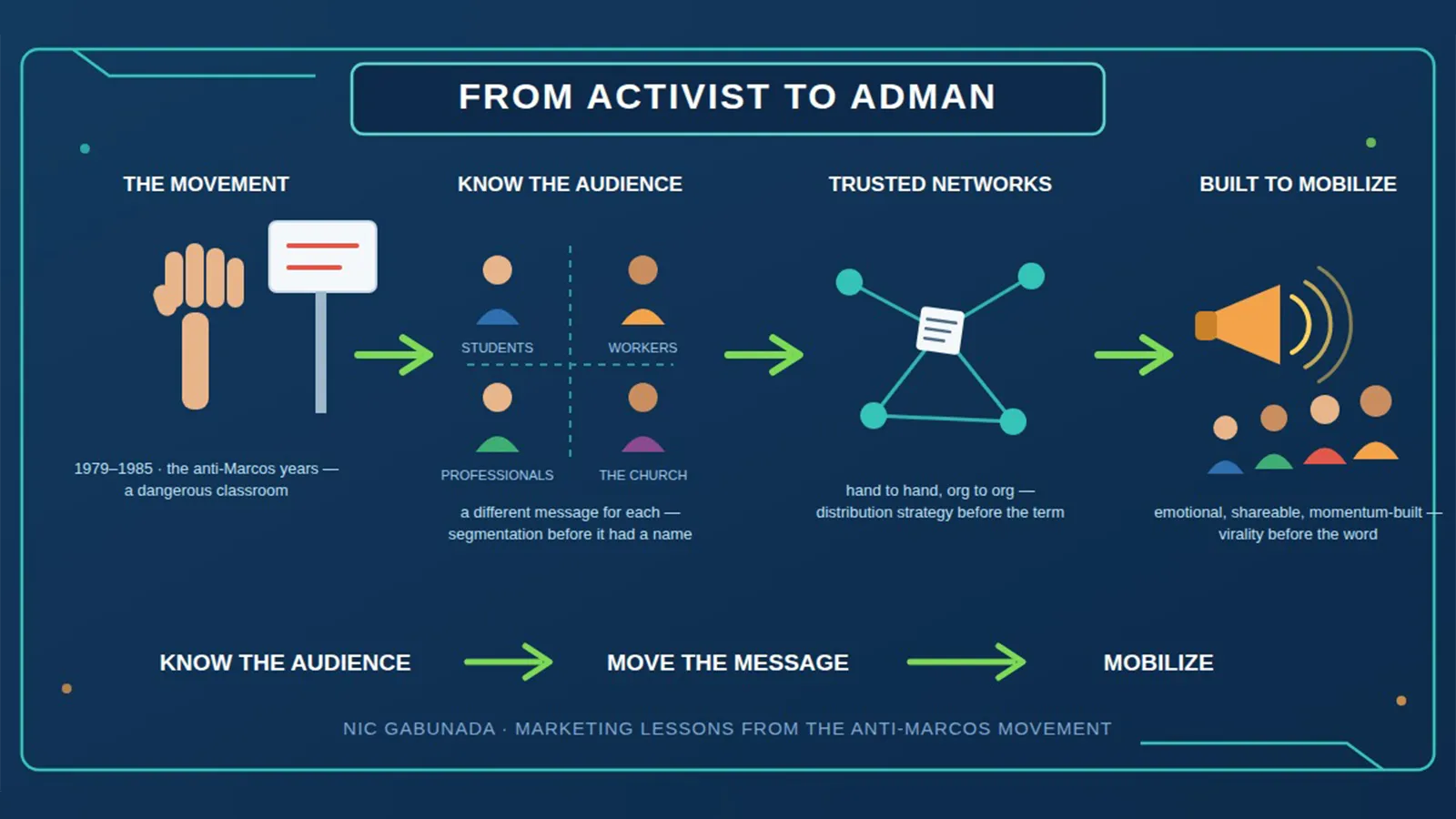
- Some of the most valuable marketing training happens outside marketing –mine happened in the anti Marcos movement
- Every flyer and every rally had to land: that was audience segmentation before anyone called it that
- Distribution mattered as much as content — trusted networks were our channels
- The goal was never just to inform but to mobilize; that’s virality by another name
- Look behind history’s movements and you’ll find someone who understood audience, message and reach
People are sometimes surprised when I tell them where I got my most valuable marketing lessons. It wasn’t a classroom. It wasn’t a boardroom. It was the Anti-Marcos movement — in the streets, in secret meetings, in the business of moving people when the stakes were life and death.
Manila, 1984: an unusual marketing classroom
Let me take you back to 1984. I was 25 years old. By day, I worked as an economist and research tutor at the Center for Research and Communication (CRC), one of the most respected institutions in the country. But I was also deep in the Anti-Marcos movement, something I had been part of since my college days in Davao.
Those were heavy years. The Aquino assassination had just happened. The economy was in freefall. The country was at a boiling point.
And right in the middle of it all, I was learning the fundamentals of communication strategy, audience mobilization, and message amplification — almost without realizing it.
Here are the three marketing lessons the underground struggle taught me that no seminar ever could.
Lesson 1: Know your audience before you try to move them
In the movement, we couldn’t afford to waste a single flyer, conversation, or rally. Every message had to land.
So we studied who we were talking to — students, workers, professionals, the Church — and tailored the approach for each. You speak differently to a student in Diliman than to a worker in Tondo.
Today, we call that audience segmentation. Back then, nobody gave it a name. We simply couldn’t win without it.
Lesson 2: Distribution matters as much as content
A brilliant message that nobody hears is useless.
So we had to figure out how to get our materials out: through networks, through trusted middlemen, through organizations that already had access to the people we needed to reach.
Sound familiar? It’s exactly what digital strategists now call a distribution strategy. The channels have changed. The principle has not.
Lesson 3: Amplification turns messages into movements
Our goal was never just to inform. It was to mobilize — to get people to act.
That meant crafting messages that were emotionally resonant, easy to share, and built for momentum. The modern equivalent is virality. The mechanics are different, but the principle is exactly the same.
Why these marketing lessons still matter
When I eventually moved into formal marketing and media work — first at CRC, then at Pulse Research Group, then at ABS-CBN — I realized I already had a head start.
The discipline of working under pressure, with limited resources, toward a specific goal, for a specific audience? That’s the muscle every marketer needs.
I also noticed something about myself during those years: I preferred to stay in the background. I was more comfortable as the strategist than as the face of the campaign. That preference followed me through my entire career. And I think it made me better at my job.
The takeaway
The best marketing training isn’t always labeled “marketing.”
Look at the movements, causes, and campaigns that changed history. Behind every one of them was someone who understood the audience, controlled the message, and knew how to make it travel.
I was lucky to learn that lesson young — even if my classroom was more dangerous than most.
Email: nicgabjr@gmail.com X: @nicgabunada.com